horror

Review: The Mourning House

Ronald Malfi, The Mourning House (Delirium Books)

Dr. Sam Hatch is a soul adrift. Since losing his wife and child a year before, mourning_househe’s tried to outrace his pain, literally, with a series of taped-together cars and sometimes his thumb. Now a transient, he squats for a night in a “vacant shell of a house” in Maryland.

Here is where the past catches up with Hatch.

Ronald Malfi’s The Mourning House (published Dec. 18 by Delirium Books as an e-book and limited edition hardcover) is a short tale of grief, obsession and the fragility of physical and mental structure. It is also a haunted house story, if there is such a thing (I’ll explain in a moment).

Malfi, whose previous novels include the IPPY-award winners Floating Staircase and Shamrock Alley, adds to this great literary tradition, and The Mourning House is a thoroughly enjoyable tale that is more of a character study than a plot-driven thriller. It hooked me with the opening chapter and kept me burning through the pages to the end.

It also got me thinking about the lure of the haunted house. Why is it such an enduring trope? There are the familiar literary explanations: the house as manifestation of the self (“The Fall of the House of Usher”); the lingering energy (aka back story) of past inhabitants (The House of the Seven Gables); the narrative tale that leaves you wondering whether the characters are occupying the house or the other way around (The Shining).

But The Mourning House is part of a lesser-discussed subgenre: the malleable or ever-shifting house. This also happens to be my favorite kind of haunted house story.

I don’t subscribe to the supernatural. I’m not afraid of ghosts, and I’ve yet to fall victim to a family curse. But “The 5 1/2 Minute Hallway” in Mark Z. Danielewski’s House of Leaves is one of the most terrifying passages I’ve ever read. Here, new residents of an old house discover that the interior and exterior dimensions of a hallway are incongruent. There is a geometric dissonance that disturbs the occupants (and the reader).

Malfi taps into that feeling of dissonance. Hatch isn’t visited by apparitions in The Mourning House, and there’s nothing a poltergeist could do that would torment him as severely as his own memories. What is troubling is that items around the house have moved while he was out; his closet seems to be of variable dimensions; and a curious subfloor is revealed beneath his feet.

Each morning, Hatch awakes in, essentially, a new house, and that, my friends, is the crux of great horror fiction. It tickles that spot in our lizard brains that burns for shelter. It’s why the haunted house is a timeless premise—and why I argue that there is, ironically, no such thing.

At the core of every haunted house story is a protagonist troubled long before they ever set foot in the house. The house becomes a metaphor, a hallucination, a projection of mental disturbance. The nature of the haunting reflects the nature of one’s troubles. For Hatch, the ever-shifting house is symbolic of helplessness and fragility. He was a successful doctor with a happy marriage, but in an instant it was taken from him.

Our homes are extensions of ourselves. That’s why home invasions are more traumatic than street muggings. For Hatch, it’s only natural that his haunting plays on his vulnerability. At any moment, the place where he should feel safest could shift forever. And he is helpless to do anything about it.

Malfi handles this masterfully in The Mourning House. The beginning and ending are magnificent, as is the bulk of what comes between. For the most part, the novel is well-paced, the prose solid and the action compelling. Here and there, scenes feel rushed or we get an overload of description without the emotional interiority that anchors us to the story (see chapter two).

But there’s no sense nitpicking over these few moments. Malfi is an excellent storyteller and a demon of description. This is a great piece of writing, and I recommend it for any fan of quality horror fiction or anyone who may fit that description on your holiday shopping list.

For more information, visit the Delirium Books Web site.

Audio Interview

Sorry for the delay in writing, but we’ve been busy prepping for the holidays. From now until Dec. 24, we’ll be posting a daily review of a literature-themed Christmas gift. You can make it a last-minute gift for the literary subversive in your life, or just enjoy the reviews for review’s sake.

We begin with an audio interview with best-selling author Carrie Vaughn, whose new novel, Kitty Steals the Show, would make the perfect stocking stuffer for the lycanthrope lover on your list.

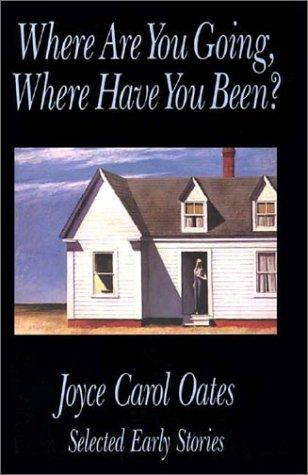
Unsettling Chapters: Where Are You Going, Where Have You Been?

As promised, we’ve come back to one of our favorite authors, Joyce Carol Oates–the queen of disquieting literature. For this Halloween installment of Unsettling Chapters, we’re discussing the Holy Grail of dark fiction, “Where Are You Going, Where Have You Been?

Nearly a half-century since its publishing in 1966, this remains the most disturbing story I’ve ever read. I was introduced to “Where Are You Going…” in college, where it was read aloud by our English teacher, and my former employer, Julie Papadimas.

What I remember most is gripping the side of my desk, trying to keep from screaming at Connie.

This is as visceral a reaction I’ve ever had to a work of fiction. I wasn’t just affected by this story. I was pissed. I felt sick. I wanted to dive into the pages and lock the front door.

Though a lot of readers, I’m sure, are familiar with the ending, I don’t want to spoil it for anyone who hasn’t read it. I will only say that halfway through the story, it dawned on me just how it had to end. You feel the bile rising in your throat, yet there’s no looking away. There’s no putting it down. There is only the suffocating gaze of Arnold Friend and his sociopathic schmooze.

This is not a trick-or-treat brand of spooky, but the essence of true fear. The rare story that forces the reader to accept their vulnerabilities and realize that we can’t always protect the ones we love. Can we even save ourselves?

“Where Are You Going, Where Have You Been?” unnerves me in a way similar to Flannery O’Connor. It’s fiction that replicates that moment on a roller coaster when the train is briefly suspended at the top, about to descend, but seemingly frozen in place. When you feel the bottom drop underneath, but you have yet to tumble after. The breathless space where time knots into an excruciating paralysis.

This is the way Oates entwines and consumes us. With the patient grace of a constrictor. And her grip has yet to slack.

I pray that it never does.

And finally, for a Halloween treat, you can read (or re-read) “Where Are You Going, Where Have You Been?” at the University of San Francisco’s Web site.

Enjoy, my Samhain sweets.

…And sadly, that brings us to the end of our 31 Days of Dread series. Tomorrow, like a post-rampage Hulk, we will return to our proper form as Ensuing Chapters, where we’ll produce a monthly column for Transgress Magazine and write semi-weekly blog posts.

Thanks for reading. If you have any suggestions for disturbing books or stories we may have missed, please send them along. We’re always looking for a new unsettling read… and we’ve got 11 months to kill until next October.

Unsettling Chapters: A Study in Emerald

Arthur Conan Doyle’s A Study in Scarlet, the first book in the Sherlock Holmes series, has to be one of the most adapted pieces of modern literature. Nearly every Holmes’ reboot begins with an updated take on this classic tale, which speaks to the brilliance of Doyle’s writing.

It’s a timeless tale of murder, deceit and the prototypical damaged investigators: the PTSD-stricken Watson and the mentally disquieted Holmes (pick your diagnoses: autism, OCD, bipolar, etc.).

For my money, the greatest adaptation of this story is “A Study in Emerald,” which appears in Shadows Over Baker Street, a mash-up of Sherlock Holmes and H.P. Lovecraft.

Penned by master storyteller Neil Gaiman, “A Study in Emerald” imagines the tale in a post-Lovecraftian landscape, 700 years following the epic struggle between humans and the Great Old Ones.

It shouldn’t come as a shock as to who won that inter-dimensional war, but the nature of the post-war dystopia might. As will the unexpected deviations from the original.

Is it truly unsettling? Not in the same way as most of the books we’ve previously discussed. But it is a bold venture by a gifted author, and the greatest mingling of two of my favorite mythos.

This story also appears in Gaiman’s Fragile Things, along with other favorites like “October in the Chair,” “Bitter Grounds” and “Strange Little Girls.”

For Halloween, Gaiman is offering a free audio book through All Hallows Read. It’s a program that promotes literacy by encouraging people to give someone a book for Halloween. Now through Oct. 31, in partnership with Audible.com, Gaiman is offering a free audio story of his, “Click-Clack the Rattle Bag.” Get yours at www.audible.com/ScareUs.

Unsettling Chapters: King Apocalypse

In “The Hollow Men,” T.S. Eliot famously wrote, “This is how the world ends/ Not with a bang but a whimper.”

It’s obvious that Eliot never read any Stephen King!

King has destroyed the world many times over, and by many different means (plague, cars, cell phones, even exploding meth labs), and each time it is most certainly with a bang. My personal favorites are The Stand and The Mist, but there’s something for everyone on his buffet of world-ending visions.

Any longtime reader of King’s knows that his strength is character development. His end-of-days narratives are so strong not because of the impending doom but for how his characters respond to it.

For example, The Stand is horrific when Captain Trips decimates the globe, but heroic when its survivors stand up to Randall Flagg. The Mist enthralls with the interpersonal conflicts that emerge within the grocery store. I’m not afraid of fog-shrouded aliens, but I’m terrified of religious extremism in closed quarters.

Another favorite trick of King’s is what I call the extrapolated horror. “Trucks,” the short story that inspired the film Maximum Overdrive, focuses first on the ordeal of the survivors holed up in the diner. In many ways, the story is quite silly (a semi-trailer apocalypse!), but where it haunts the reader is its ending: The moment when you realize that all the horror that has come before is merely the opening act for something far, far worse.

This is a small sampling of King’s apocalyptic works:

The Stand

The Mist

Under the Dome (sort of)

“Night Surf” (prelude to The Stand)

King has also penned his fair share of dystopian literature:

“The Long Walk”

“The Running Man”

“The Children of the Corn”

With more than 100 novels, stories and screenplays to his name, King’s bookshelf is long. Pull one or two down from the shelves this Halloween. Believe me, the end of days never sounded so good.

Unsettling Chapters: House of Leaves

We are all familiar with the parameters of dream logic—the mental space where things are out of place or time but follow an alternative, interior logic. You know, like you’re catering a dinner for all your ex-girlfriends in a gothic castle, and for some reason Dog the Bounty Hunter is pitching you a show about vigilante sea lions. You wake up and wonder: “Why did that make sense?”

It’s a fun diversion that is, unfortunately, difficult to replicate in waking consciousness. But you can come close by reading Mark Z. Danielewski’s House of Leaves, a 2000 horror novel that is more of an entity than a book.

Designed with multiple fonts and colors, footnotes within footnotes and text running backward, forward, upside down, even spiraling, the physical layout of the text manipulates the novel’s pacing and creates a somewhat interactive experience.

It’s probably as close as we’ve come to reading with 3-D glasses.

The narrative is equally layered and complex, and academics have taken multiple stabs at this book. I would guess it’s had the most scholarly treatments of any horror novel since Frankenstein. Therefore, I won’t even attempt to offer an academic account, as I don’t have anything particularly profound to say on that front (and would bore myself to tears in the process).

What I can speak to is the effect Danielewski creates by inviting the reader into a story that they can’t quite trust. We have multiple unreliable narrators; the ever-shifting dimensions of a house; drug-impaired testimony; unverifiable videotapes; and the ravings of a half-mad blind man. (He also borrows the Lovecraftian theme of geometry-induced madness, not to mention a mysterious tome.)

Can we trust what we see and read? Hell no. And that’s why House of Leaves is so unnerving.

I think of it as a literary haunted house. Every October, people line up outside strip malls, warehouses and amusement parks to navigate dark, disorienting hallways. They know they won’t be harmed, but will experience the thrill of uncertainty.

The same with House of Leaves. It elicits a visceral reaction in a way few other books can. We’re aware of what Danielewski is doing. When we need to rotate the book to read the text, we know it’s to recreate the impossible geometry of the staircase. When there is one word of text on a page, it’s to replicate the cavernous quality of the basement and to force us to read slower.

But we’re affected just the same, as when we’re knowingly manipulated inside a haunted house.

House of Leaves is not a quick read. It is an experience. If you started reading it today, I don’t know that you could finish it by Halloween. But I feel confident in saying that you’re not supposed to read it that quick. This is a book to be absorbed. It should age along with you.

Read correctly, you will internalize the disorientation. You will want to measure the length of every hallway in your house to find inconsistencies. To make sure, every day, that the dimensions of your world haven’t changed while you were sleeping.

Because in Danielewski’s world, they do change. Sometimes they’ll shift right under your feet, and they might even swallow you whole.

Unsettling Chapters: Bradbury

One of America’s most influential writers, Ray Bradbury thrilled readers for decades and produced some of the defining works of the 20th century. For me, he defines a particular time in America—one of wonder and worry: the promise of space travel and the portent of a bookless dystopia.

For more on Bradbury, below I’ve pasted the essay I wrote upon his death this past summer. “The Moonless Sleep” appeared in Transgress magazine, alongside a Bradbury tribute by the talented Stephanie Train.

But for all the great fiction he produced throughout his lifetime, I remain in awe of his 1955 debut, The October Country, a collection of short stories originally published by Arkham Press as Dark Carnival.

I don’t have much to say about this collection. The stories speak for themselves and make for a satisfying Halloween read:

The Moonless Sleep

Blaze on, ye dark carnivals, with the steam-wrought thunder of a midnight train! Gather ye lunatics, barkers and graveyard melancholics along the autumn midway! For Cooger and Dark’s Pandemonium Shadow Show has come for its maker. And sadly, under the Big Tent of terrestrial existence, the Time Carousel spins only one direction. There will be no unwinding of the years. No flip-page fountain of youth. No restoring the burnt ashes to books.

On Tuesday, June 5, Ray Bradbury—master of the grimly fantastic—died at the age of 91. He left behind hundreds of stories, novels, screenplays, teleplays and nonfiction works, spanning 1947’s Dark Carnival to last month’s essay, “Take Me Home,” in The New Yorker.

Bradbury enthralled a long-ago generation with the possibilities of space travel and the terror of a foreseen dystopia. The man’s got a Hollywood Star, an Emmy, a Pulitzer special citation and has had a moon crater and a freaking asteroid named in honor of his work.

So here’s to one of the true giants of American literature: A bittersweet slug of dandelion wine. Drink hearty, my friends.

#

Growing up a horror fan in the 1980s, I worshipped the holy trinity of Poe, Lovecraft and King. But there was always space on my bookshelf for Bradbury. It began during summer vacation—1984 or ’85—when HBO broadcast Something Wicked This Way Comes. I watched it every chance. I memorized every scene, every line. I still see the smoke of the train, feel the tickle of the tarantulas under the sheets and tighten with unease recalling Mr. Dark littering the library floor with the torn pages of Jason Robards’ life. I identified with young Will Holloway—the nervous, homebound boy who preferred travels of the imaginary and literary variety over the untamed severity of Jim Nightshade.

So began my infatuation with carnivals and the leitmotif of illusion, midway facades and the bittersweet escapism of the roadside attraction. It’s probably why I find carnivals appealing in art and depressing in real life, sort of like a dive bar during the day.

Something Wicked This Way Comes chilled me as a child, then moved me to tears as an adult when I recognized the undertone of melancholia in the narrative. I re-read it in my thirties and realized it was not so much the story of two boys, but rather the story of the father. The old man. Jason Robards in the safety of his library, puffing a pipe in a long-gone American pastoral.

Fahrenheit 451 rallied me as an angry young man, and still rumbles in my blood, much the way the dystopian works of Vonnegut continue to invade my thoughts nearly every day. We read “A Sound of Thunder” in elementary school, and I still feel the quiver in the back of my neck when we came to the end. And can anyone with an iPhone not consider “There Will Come Soft Rains” as prescient as it is brilliant?

Perhaps my favorite Bradbury work is The October Country, a stripped-down version of his story collection Dark Carnival. Even now, “The Crowd” is as haunting as ever, “Homecoming” is still creepy as hell, and I was so enamored that I once penned a prequel to “The Wind” as part of my creative writing thesis at Penn State.

Of all the dark treasures in The October Country, none affected me more than “The Scythe,” a treatise on the life cycle that feels appropriate in the wake of Bradbury’s passing. In the story, a Dust Bowl family breaks down on a dead-end street, starving and desperate. They discover a farmhouse whose owner has died, deeding the property—rich with wheat and livestock—to whomever discovers his corpse.

Of course, there is a tangled string attached.

The twist is not a huge surprise, but the story’s power comes from the author’s philosophizing on the nature of life and death. Trapped in a Twilight Zone dreamscape, protagonist Drew Erickson refuses his grim duty… and reaps an equally grim fate:

… and still they lived, caught halfway, not dead, not alive. Simply—waiting. And all over the world, thousands more just like them, victims of accidents, fires, disease, suicide, waited, slept just like Molly and her children slept. Not able to die, not able to live. (209)

#

Though best known for his fantastic vision and plotting, there is much to admire in Bradbury’s craft. The deceptive modesty of his prose, disguising his poetic bent. His command of flow and revelation. The comforting familiarity of the most unreal environs. How did he do it?

I’ve been asking that question for a few decades now, but still no luck. His book on craft, Zen and the Art of Writing, is one of the most inspiring writing primers ever penned. But like a great magician, Bradbury is just as mysterious whilst revealing his secrets.

I was fortunate to meet the author in June 1999. Bradbury spoke at the Chautauqua Auditorium in Boulder, Colo. He discussed his cinematic approach to writing. He said that people sometimes asked him how to adapt one of his stories into a film, a query at which he expressed disbelief. To paraphrase, he answered: Read it from one page to the next. “Page one, scene one.” Write as if you’re making a movie, he implored the aspiring authors in attendance.

Other tips centered on when to write that first novel (Don’t even bother until you’re thirty) and how (by threading together a series of short stories). Short fiction is rough waters for a young author—even someone of Bradbury’s talent. In the early days, he met with publishers who liked his writing, but ultimately turned him down: Call us when you’ve got a novel, they told him. Nobody wants to read short stories.

Undeterred, Bradbury got the last laugh. He repackaged and re-pitched those rejected story collections as the “novels” The Martian Chronicles and The Illustrated Man. They were published in 1950 and ’51 respectively.

He offered other anecdotes and advice, but honestly, I don’t recall much of it. I was too enthralled with his stories.

I was also shocked by his appearance. For years, he’d been using the same photo on his book jackets: a kindly, slim, frost-haired middle-ager. That was my image of him until he hobbled onto the stage, heavyset and a decade or so older than his picture. Throughout the talk, the altitude played hell with his breathing. His hair was shaggy and unkempt.

When the talk was finished, he was helped down a set of stairs to meet with fans. His legs were unsteady as he navigated the steps. An assistant held his left hand. In the right, he clutched a freshly cracked beer bottle. He held it steady and savored a long drink when he reached the small table where he would sign books. A pen in one hand. A beer in the other.

I thought: This is my kind of guy. This is my kind of writer.

I trembled as I approached the table.

#

Bradbury penned a new introduction to the 1996 edition of The October Country. It was fittingly titled, “May I Die Before My Voices.” It refers to the muses that compel him to write—the daily imaginings that inspire his stories. To some, those voices would be a burden, a form of madness. For Bradbury, it was his raison d’être.

He closes his introduction with the breathtaking lines: “If some morning in the future I wake and there is silence, I’ll know my life is over. With luck, on my last day, the voices will still be busy and I will still be happy,” (viii).

I can’t say if the voices were still speaking to him on June 5, but I feel comfortable saying that Bradbury’s voice is as resonant as ever. More than half a century after the release of Fahrenheit 451, dystopian literature still tops the best-seller and box-office charts. The universe is as mysterious as ever, and we have yet to walk on Mars or time-travel to hunt dinosaurs.

For these reasons, his timeless visions will continue to enthrall. I will certainly die before Bradbury’s voice gives out, and I’m happy to think that there will come future generations that will be equally comforted and inspired by his words. His prose that rockets off the page, that transports the reader in time, space, and can elicit moisture in the eye as effortlessly as a scream in the throat.

Bradbury’s gone, but his voice remains. To thrill us. To haunt us. To fill us with wonder. To remind us that we need not fear the voices in our own heads ever going silent. Because hopefully, surely, our voices will resonate beyond our meager, terrestrial lives.

Unsettling Chapters: Pseudopod

The apocryphal saying goes, “May you live in interesting times.” Indeed, the publishing world is in something of a fugue state these days (or should we say the past decade).

But rather than a curse, I consider it a good thing. I’ve found that I prefer reading magazines and newspaper articles on my Nook.

Programs and Web sites like Calibre, Byliner and Instapaper have made long-form journalism accessible to wider audiences, and audio books and podcasts have opened up new literary avenues for both writers and readers.

The latter, in particular, have made it possible to “read” while driving or drifting to sleep.

And when it comes to audio horror, Pseudopod stands head and tentacles above the rest.

Launched in 2006, Pseudopod recently broadcast its 300th episode… and the body count continues to rise. Featuring weekly short stories from contemporary horror authors, occasional flash pieces and periodic classics, the podcast has something for everyone.

There are brilliant tales of ultraviolent, existential horror (“Counting From Ten,” “The Duel”); grim philosophy (“Some Things Don’t Wash Off,” “What Dead People Are Supposed to Do”); dark fantasy (“Goon Job,” “Full Moon Over 1600”); adventure, both internal and external (“The Primakov,” “The Greatest Adventure of All”); and Lovecraftian weird (“Hometown Horrible,” “Jihad Over Innsmouth”).

Those are only 10 of the 300-plus stories Pseudopod has produced, and the chills keep coming. Former editors Mur Lafferty and Ben Phillips seem like old friends, and host (and an initial contributor) Alasdair Stuart is in the class of Rod Sterling and Jack Palance. I’m awed, weekly, by his haunting delivery and thoughtful post-story editorials. Even when the featured story is so-so, Stuart’s commentary alone is worth the listen.

The podcast is free, and may be downloaded through a program such as iTunes. You can also access the entire archive of stories at the Web site.

Despite being free, Pseudopod is a professional, paying market, and it runs on donations from listeners. My suggestion, especially if you’re new to the program, is to order the archive discs (which also make great gifts). Sure, I’ve got my favorite episodes on my computer, but by purchasing the discs, I have a permanent hard copy and have supported a great cause at the same time.

Other must-listen stories include “Raising Eddie,” “Bag Man” and “The Hand You’re Dealt.” But with a few hundred stories to choose from, this podcast has something for everyone’s Halloween hit list.

Unsettling Chapters: In the Black Mill

Sadly, there is a great divide in the literature world, one which I don’t really understand. Having completed an MFA program, I can speak to the snootiness of the literati establishment and its delineation between literary and genre fiction.

Personally, I believe it’s all simply fiction, and if there is any division, it’s between well-written fiction and not-so-well-written fiction.

But rather than rehash this tired debate, I’d like to talk about a writer who obliterates this divide, Pulitzer Prize-winning author Michael Chabon. He has explored genre and pulp fiction in his novels The Amazing Adventures of Kavalier and Clay, The Final Solution and The Yiddish Policemen’s Union and as editor of McSweeney’s Enchanted Chamber of Astonishing Stories.

Perhaps his most daring genre work is the short story “In the Black Mill,” an homage to Lovecraft that first appeared in Playboy and later in his collection Werewolves in Their Youth.

For my money, “In the Black Mill” is the greatest Lovecraft-inspired work ever written. However, in full disclosure: I grew up in a rusting steel town outside of Pittsburgh, which is the setting for “In the Black Mill.” Lovecraftian horror set in the Rust Belt of my youth? A forbidden ritual centered on an old steel mill?

Sign me up.

I don’t want to get into specifics, or give away too much, other than to say the pleasure of reading “In the Black Mill” comes from its balance of originality and familiarity. A lot of Lovecraft-inspired fiction comes across as overly referential or derivative. Chabon infuses the old legends with a post-industrial setting, a brilliant ending and a healthy dose of meta-fiction.

But for all the new wrinkles, Chabon links up with Lovecraft via three avenues: thematic connections, stylistic connections and familiar places and names.

First, the thematic connections:

There is a narrator called away from home, in this case an archeologist (Lovecraft was fond of having scholars or heirs travel to strange locales). Upon arrival, he encounters numerous grotesqueries among the local folk: physical deformities, impurity (particularly of food and drink) and increasingly odd and suspicious behavior. All classic Lovecraft devices, particularly his penchant for displacement.

Stylistic connections:

Here, Chabon deviates from his typical style and writes with Lovecraftian grandiosity. See un-Chabon-like phrases such as “…the immemorial accursedness of his drab Pennsylvania hometown” and “…the eldritch moment.” The narrator also pays close attention to setting and description, much like HPL. We come to know the topography of this Rust Belt village as well as we know Arkham, Dunwich and Innsmouth, “that ill-rumoured and evilly shadowed seaport of death and blasphemous abnormality.”

Likewise, Chabon draws a third connection to Lovecraft by utilizing similar places and names. There is the Miskahannock river and valley (what I imagine to be an amalgamation of Lovecraft’s Miskatonic river and valley and “hannock,” a variation of the Delaware Indian word for “stream,” which is a commonly used suffix in Western Pennsylvania, as in Neshannock Township). There are the Yuggogheny Hills (Yog-Sothoth meets the Allegheny) and then characters named Philippa Howard Murrough and August Van Zorn.

Perhaps the greatest commonality between this story and HPL is philosophical. Lovecraft exceled at presenting what appeared to be insurmountable terror, only to reveal at the end that the evil is even greater than at first imagined. It’s not the personal torment that is so horrifying, but scope. The implication that the nightmare has only just begun, and eventually, we will all suffer the narrator’s fate.

This is post-industrial Rust Belt horror at its finest.

Unsettling Chapters: The Church of Dead Girls

Frequent readers have probably noticed a pattern among the entries of Unsettling Chapters. That is, the overt theme of a story is more often a sleight of hand. Put another way: The thing is not really about the thing.

Lovecraft’s Old Ones are a manifestation of his insecurities. McEwan’s transgressions are a front for the anxiety of individuality in the face of rigid and arbitrary social mores. Murakami’s gore portrays mental disturbances rather than literal scenes.

And so it goes with Stephen Dobyns’ 1997 mystery, The Church of Dead Girls.

As with Birdman, Mo Hayder’s debut discussed on Oct. 5, the ghoul in this novel uses human corpses as an artistic medium. But while The Church of Dead Girls offers terror and thrills, it also has high-minded literary aspirations.

The thing is not really about the thing.

This is less a whodunit and more a sociological work. What are the fears and biases of small-town folk? What prejudices are lurking in the shadows? A rash of murders and missing teenagers brings them all to the surface. Things get ugly.

The Monsters Are Due on Maple Street” ugly.

Once threatened, the townsfolk begin pointing fingers in every possible direction. This compelling arc makes for a fascinating read. And gruesomely detailed horrors make this a must-read for Halloween.

Speaking of fingers, whatever happened to those missing left hands?

Read the book and you’ll understand.

Parts of this post are adapted from an earlier article of mine, “Thirteen horrifying reads for Halloween,” which appeared in the Boulder Camera in 2008.