Psychological

Review: Jawbone, Monica Ojeda

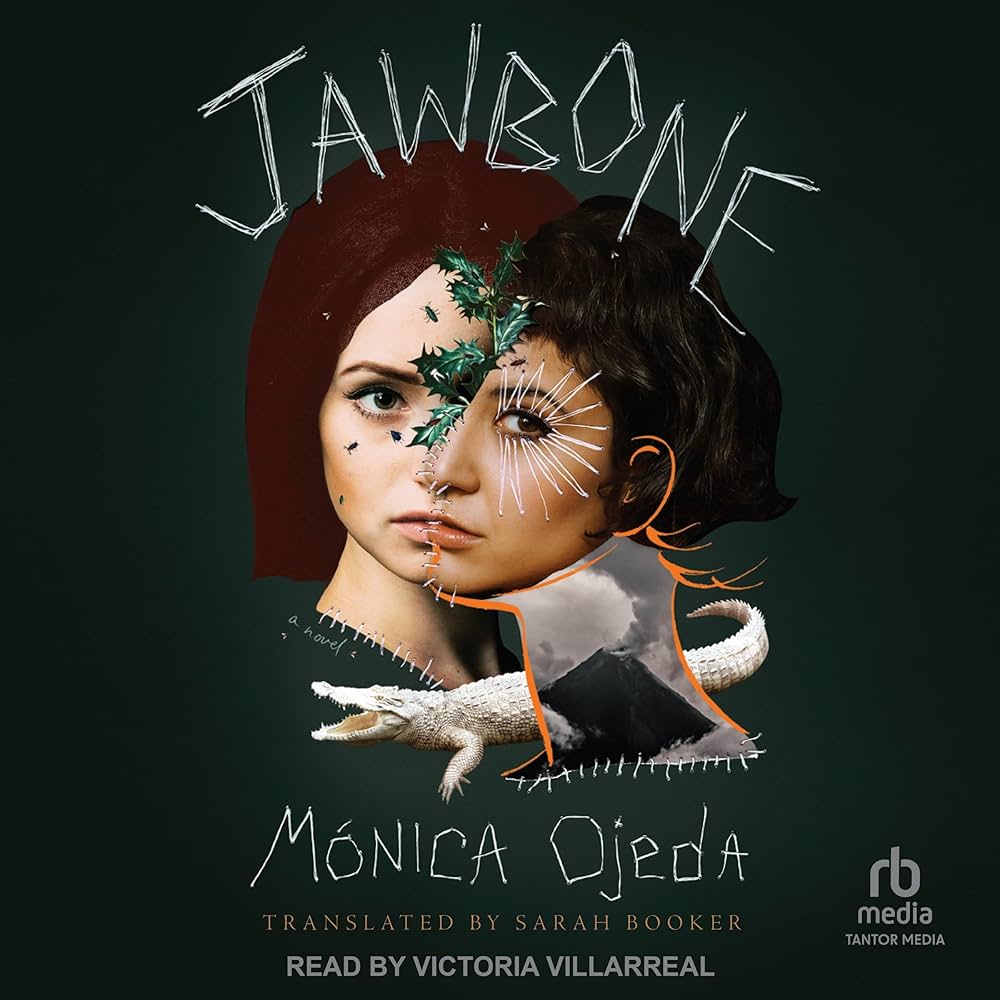
Books like Jawbone are why I love reading: Elaborate and evocative worlds that pull you into their dark waters and hold you under. Brash and flawed characters who reflect our own shortcomings and desires. Extraordinary circumstances that somehow feel familiar.

Monica Ojeda is the spellmaster who conjured up this horror gem that was a finalist for the National Book Award in 2022 (translated by Sarah Booker). Ojeda is a confident, fearless and challenging writer, and I’m here for it. She doesn’t take it easy on the reader. She dares you to stop turning the pages, knowing you won’t, much like her characters push each other into more dangerous and gross dares.

There are two primary story lines to follow: the friendship of Fernanda and Annelise — two imaginative teen girls who revel in horror stories, deadly stunts and a shared mythology they build around caimans, a drag-queen god and the menacing color white — and Clara, their austere literature teacher who is still recovering from her abusive upbringing and a home invasion perpetrated by two students at her previous school.

Clara recognizes in Fernanda and Annelise the same danger she noticed in the two girls who attacked her. She is determined not to let these new girls get the jump on her, so when Annelise, who senses Clara’s fear, warns her that Fernanda is planning something awful, Clara pre-emptively kidnaps Fernanda and keeps her tied up in her house.

In captivity, Fernanda considers her fascination with horror. With physical escape impossible, she turns to a philosophical one: “To be afraid was to sense the truth like an eyelash floating over an eye.”

The truth is that every character is a victim. Every character is a perpetrator. Much of what is alleged is unconfirmed. Is Annelise using Clara to inflict revenge on Fernanda? Is Fernanda the monster she’s accused of being? Is Clara an abductor or merely a survivor?

The narrative makes use of multiple voices and various media — including creepypastas, therapy sessions, the Cthulu mythos, personal essays and disjointed conversations — to construct a puzzle box of trauma, metamorphosis and torture. Ojeda’s pacing is expertly controlled through textual choices. A one-page Q&A chapter will be followed by a few pages of dense, unbroken block text that forces the reader to slow down and live with the discomfort Ojeda imposes.

The mostly female cast of the novel (which is set in an elite girl’s school in Ecuador) adds another layer of meaning. We view puberty through the lens of body horror. Female sexuality is both power and vulnerability. Sex is fear and desire all tangled up. The girls are repulsed and fascinated by their changing bodies.

Jawbone is a bleak and immersive read, provincial with its isolated world inhabited by exotic bugs, venomous snakes, hungry caiman, a drag-queen god and plenty of human monsters.

It is a grotesque study in desire and insecurity, adolescence and debasement, and the deeper you look, the darker it gets. As Annelise observes, “When the idea of good and evil disappears, all that’s left is nature and its violence.”

Review: The Sluts, Dennis Cooper

Dennis Cooper and I have been on a collision course my entire life. I’m embarrassed for having taken so long to discover him, but I am making up for lost time (I’ve read seven of his books this year and am currently on my eighth).

It started with The Sluts. After having this book recommended to me constantly on GoodReads and other book sites, not to mention popping up routinely on BookTube, I finally took the plunge. Not knowing anything about him, I feared that maybe he was less a novelist and more a shock merchant. I’ve been burned by extreme authors in the past.

I read it in a day, and it immediately rocketed into my top ten all-time favorite books. The prose is electric and the text moves at a reckless pace.

Published, and set, in 2004, The Sluts came out right before the social media boom. It’s an epistolary novel told through the tools of the old Internet: dedicated websites, bulletin boards, even faxes. I won’t pretend that I didn’t enjoy the nostalgia of it.

But though it is twenty years old, The Sluts is a novel for our current time. It is a metafiction filled with unreliable narrators and all the hallmarks of the post-truth world. It occurs in an insular and mistrusting web community and incorporates a healthy dose of fan fiction.

The star of the show is Brad, a sex worker of exceptional beauty and questionable age and mental health. He is the soiled dove who captures the imagination of dozens of connoisseurs on an escort review website. Some want to save him. Some want to abuse him. Everybody wants to hire him.

At a certain point, it becomes clear that whatever you want Brad to be, he is, so while Brad is the central character of the novel, in the end we know nothing about him. The only information we have about him is discussion board gossip posted pseudonymously.

Ultimately, this turns the focus of The Sluts back on the reader. What do we know of any character in any book other than what a faceless author has provided on the page? How do we distinguish between true fictions (primary storylines) and artful lies (metafictions), and why do we distinguish between them in a book that we already know isn’t real?

It’s fitting that Cooper essentially places the reader in front of the computer in this story. Every day, we’re fed information from a screen. It’s up to us to discern truth and fallacy. We interact with strangers, read their reviews of movies, appliances, restaurants… even (gasp) books.

In the end, though, it comes down to the user, alone behind their keyboard. We find whatever we seek online. It’s a digital Plato’s cave where not only are we seduced by a false reality, but we are tricked into believing that we have agency over that reality.

The reader chooses which Brad reviews to believe and which to discard, thereby projecting our own fantasies and anxieties onto this ethereal sex worker who is pure dream or pure nightmare.

Trust me, this is a deeply engaging novel that will shake you to your philosophical core.

Review: My Dark Vanessa

When you find yourself audibly yelling at the characters in a book like you’re watching a horror movie, you know you’re reading something special. My Dark Vanessa, the debut novel from Kate Elizabeth Russell, enrages, amuses, perplexes and ultimately batters the reader into despair.

In this challenging and transgressive masterpiece, Vanessa Wye narrates two timelines of her life: one beginning in 2000, when she goes away to boarding school at age 15 and becomes the target of her English teacher’s advances, and 2017, when said teacher, Jacob Strane, is being investigated for sexually assaulting a different student.

While it’s easy to get caught up in the twisting plot and unsettling behavior, what stands out to me is Russell’s handling of the two voices. It’s challenging enough to believably capture the voice of a teenage character, but to also balance that with a more mature voice that is consistent with that of the child is remarkable.

That Russell pulls it off in her debut novel is astounding.

Practically every page has a line that cut into me on some emotional level, whether it was an insight into the pressures young women face; pervasive pop culture that glamorizes statutory rape; the cruel and humiliating treatment dealt to victims of sexual violence; or a personal reckoning with my own youthful behavior.

The latter is why I feel the #MeToo movement has been such a wake-up call to many men. It brought home not only the frequency of sexual harassment and assault, but also introduced many of us to the broader scope of what it is.

It’s alarming to think of how common the behaviors at the lower end of the sexual violence spectrum were in the 1980s and ’90s — and how many of them, such as leering and catcalling, were expected of young boys as part of our development.

That underlines the importance of My Dark Vanessa. It’s tough to read for both the subject matter and for the way it forces the reader to truly consider how they would react in this situation. It also provides a long-overdue response to Lolita.

Of course, Nabokov’s controversial novel is unavoidable when discussing a book like this, and Russell takes it head on. She writes in the afterward: “I imagined the novel I wished I could have discovered alongside Lolita at fourteen, how it might have felt then to read a book that told her story rather than his.”

Like Russell, I have a complicated relationship with Lolita. It’s one of my favorite novels, but at the same time it is criminally misunderstood. The trope of a “Lolita” as a girl who is sexually aggressive toward older men is a sick distortion.

It speaks volumes about our culture that a novel about raping and kidnapping a twelve-year-old girl has been twisted into a cultural archetype to mean an insatiable teenager who seduces middle-aged men against their will.

That’s exactly why My Dark Vanessa is such an important book.

Even if, like me, you read transgressive fiction quite often, this book will haunt you — not for its salacious content, but for how insidious the sexual violence pervades every interaction in the book. Russell is not aggressive in her return serve of the male gaze. She simply holds a mirror up to it — and what she reflects back is something ugly, something that demands reckoning, that refuses to be ignored.

With Lolita, it is easy to distance oneself from the villain. In My Dark Vanessa, there is no such mercy. No doubt, this is one of the most disturbing and important books I’ve ever read.

Review: Tender is the Flesh

Tender is the Flesh

Agustina Bazterrica

I have recently developed a preference for Impossible Burgers, a plant-based meat alternative, over ground beef. Reading Agustina Bazterrica’s Tender is the Flesh did not cause me to second-guess this decision.

To be clear, the novel is not simply a polemic about factory farming or a futuristic retelling of Upton Sinclair’s The Jungle. It is a deeper critique of the entire global economy, our class structure and a food supply chain designed to minimize consumer guilt.

Tender is the Flesh takes place in a future where a virus has made animal meat lethal to humans. Animals have been eradicated, and for a while, the world went vegan out of necessity.

That didn’t last long. Craving a meat fix, consumers (I use that word intentionally) turned to the only viable meat option remaining: humans. Dubbed the “Transition,” the world’s meat counters were once again stocked with product — now referred to as “special meat.”

Marcos, our protagonist, manages a meat processing plant and is highly regarded in the field. His father had operated a renowned slaughterhouse prior to the virus, but was unable to cope with the Transition. He was “a person of integrity, that is why he went crazy.”

Marcos also struggles with the Transition, but reminds himself that he does it to pay for his father’s care in a nursing home. Marcos is also dealing with the death of his child and the resulting estrangement from his wife.

He copes by detachment:

“He wishes he could anesthetize himself and live without feeling anything. Act automatically, observe, breathe, and nothing more. See everything, understand, and not talk. But the memories are there, they remain with him.”

His attempt at dissociation fails when a supplier, hoping to make nice for a botched order, gifts him with an expensive delivery — a young female “head” who is certified First Generation Pure (FGP), the most prized and costliest grade of “special meat.”

Like all “head,” her vocal chords have been severed so that she can’t complain and when it’s time to slaughter, the butcher won’t be upset by her screaming. Marcos ties her up in the barn while he decides whether he should sell her for a tidy sum, breed her or use her for food. (In a clever bit of world-building, foodies have perfected the technique of butchering “head” piecemeal so that they always have fresh meat available.)

Tender is the Flesh is broken into two parts. The first covers a very compressed timeline where we get to know Marcos, learn of his family tragedies and bear witness to the new method of meat processing. This is gut-churning stuff, even for a hardened horror lover such as myself.

But as hardcore as this first part may be, it is the second half where the book goes to a dark place even I wasn’t expecting.

Throughout part one, Marcos tries to distance himself from the horrors of reality. He’s a vegetarian who is disgusted by the business of human meat processing. He is also troubled by the reliance on euphemisms that legitimize (and dehumanize) the whole business.

In the second half, detachment is no longer an option. The gift of the FGP forces him to reckon with reality. He names her Jasmine, even though that is a crime punishable by death. He cleans her up and moves her into the house.

Once forced to action, Marcos is both a passionate idealist and a ruthless businessman. He connives to protect Jasmine, visits an abandoned zoo and prepares for his father’s death.

This culminates in a gut punch of an ending that is a reminder that being human isn’t the compliment some people want it to be.

Tender is the Flesh is an incredible book that is beautiful, well-written and dark beyond dark. It has one of the bleakest endings of any book I’ve ever read. In other words — I loved it.

And yeah, it makes the Impossible Burgers taste even better.

Recommended Reads: Covid-19

“He knew what those jubilant crowds did not know but could have learned from books: that the plague bacillus never dies or disappears for good…”

That line, of course, is from Albert Camus’ 1947 masterpiece, The Plague, a book that has the distinction of being in my top 20 all-time reading list, yet is only my third favorite work by Camus.

Published three decades after the Spanish flu epidemic, and only a few years removed from World War II, Camus used the backdrop of the Bubonic plague to dramatize the philosophies of Existentialism and the Absurd.

This brilliant novel is back in demand and selling by the thousands. Of course, The Plague was a parable about fascism and a post-Nazi warning to future generations, which makes it doubly relevant as global instability has given rise to nationalist violence and challenges to western democracies.

Now that social distancing, if not full-on quarantine, is quotidian reality, many are returning to literature for entertainment, distraction or insights. Not to make light of the circumstances or the plight of those suffering, but since we’re isolating, we might as well make the most of it. Here are seven tales of plague, apocalypse and what happens when our delicate social networks collapse.

“Time Enough at Last,” Lynn A. Venable

Originally published in 1953, this brilliant story became an instant classic when it was adapted into the classic episode of The Twilight Zone. I remember first watching this episode as a kid, and for the first 28 minutes thinking it was a wonderful fantasy. The sole survivor of a nuclear bomb, who wants nothing more than to be left alone to his reading, finds his wish has come true!

With nobody around to bother him, and unrestricted access to the public library, he finally has the peace, solitude and, most of all, time to read all the books he’s ever wanted. To me, it was like heaven, until the final twist when our hapless hero breaks his glasses. It is still my favorite episode of the show.

I later read the source material in the collection, The Twilight Zone: The Original Stories, and the original story, though not as well-known, is as good as the adaptation. There are many other great stories in this anthology as well, including many by the great Richard Matheson.

But if you’re vibing on isolation right now, you can’t go wrong with Venable’s mid-century classic.

“Rain,” Joe Hill

I confess I’m biased, having lived in Boulder, Colorado, for the better part of 22 years, but I think this apocalyptic novella is one of Hill’s best efforts. And it’s not just because he describes a summer day in Boulder “as glorious as the first day in Eden” (though that is totally accurate).

But then, without warning, sharp needles begin raining from the sky, piercing an unexpecting populace. “A lot of healthy, vigorous children died in Boulder that day–parents all over town booted their kids outside to whoop it up on one of the last, most brilliant days of summer.”

And it only gets darker from there.

It’s a story befitting the title of its collection, Strange Weather, as this (un)natural disaster turns into a blood-soaked survival march down the Boulder-Denver turnpike.

The Troop, Nick Cutter

I finally got around to reading this highly recommended novel last year, and I was not disappointed. It was creepy, isolating and had a visceral effect on me. For starters, camping horror always gets my blood pumping. Throw in some bioengineering and evil science experiments, and you have my undivided attention.

I brought this with me on a flight to Norway, and I figured it would last me all the way to Lillehammer. I devoured it (no pun intended) before reaching my layover in Reykjavik.

I was also pleasantly surprised when I looked at the author’s photo. I wasn’t familiar with Nick Cutter, but I definitely recognized the author as Craig Davidson. In 2007, I reviewed his debut novel, The Fighter, for the Rocky Mountain News.

My review wasn’t glowing, admittedly, but the novel showed a lot of promise–and it’s stuck with me for more than a decade. He did a lot of things right in that book, but I felt it was a bit uneven overall. The Troop, however, was on point from start to finish, with consistent tone and pacing.

If you think social distancing is scary, try The Troop.

The Cabin at the End of the World, Paul Tremblay

A big part of the creep factor in Paul Tremblay’s home-invasion novel is that we never know if the alleged apocalypse is real. A group of deranged, but seemingly well-meaning (mostly) eschatologists show up at the cabin of a vacationing couple, Andrew and Eric, and their daughter Wen. The intruders have a message: In order to save the world from the end times, one of the trio has to die.

Is the apocalypse really happening? It’s hard to say. Every time they turn on the television, something bad is happening on cable news. But isn’t that true at any time? If you want to live in perpetual fear, just watch cable news.

This convinces the intruders that they are right, and further proves to Andrew that these people are crazy.

I think there are some powerful analogs to our current situation. It’s hard for most of us to gauge first-hand what’s going on, since all signifiers of normality are gone. Sure, there is the television, but that again leads to the ratings-driven cesspool of cable news.

Who can you trust? And which information do you take to heart?

And what are you willing to sacrifice?

“The Masque of the Red Death,” Edgar Allan Poe

Covid-19 has reminded all of us that nobody is invulnerable. Actors, athletes and world leaders have all contracted the disease. Young, old, rich, poor. Nobody is immune.

That is the message of Poe’s horrific tale of a plague that induces hematidrosis–a “profuse bleeding at the pores” from which the Red Death gets its name. Symptoms come on suddenly, the pain is intense and the only mercy is that the victim is dead within a half-hour.

Knowing that death could come so sudden makes this story first-rate psychological horror, but it also becomes class warfare when the elite Prince Prospero invites his rich friends to wait out the plague in the sanctuary of his castle, leaving the poor to die in the streets.

But nobody is safe from this brutal disease, and in the end “darkness and decay and the Red Death held illimitable dominion over all.”

The Stand, Stephen King

Of course my all-time favorite horror novel would be on this list. I tried to include lesser-known books to mix it up, but the classics are classics for a reason. No other apocalyptic vision has disturbed me more than King’s magnum opus. As a superflu decimates the world, the facade of civility slips and human nature bares its fangs.

Those in touch with the better angels of their nature congregate in Boulder, Colorado, arming themselves to make one final stand to save humanity from itself.

The Plague, Albert Camus

Finally, we’ll let big Al have the last word. As part of the French Resistance, living in Nazi-occupied Paris, Camus experienced an existential threat most of us will never know. His allegorical plague revealed the best and worst of humanity, and it served as a reminder for how to live, whether in good health or during a pandemic:

“We should go forward, groping our way through the darkness, stumbling perhaps at times, and try to do what good lay in our power.”

Stay healthy and well, my friends.
Review: Legion: Skin Deep

Brandon Sanderson

Legion: Skin Deep

Not long ago, I sang the praises of Sanderson’s novella Legion (https://ensuingchapters.com/2013/01/03/review-legion/), a mystery tale centered around the brilliant, unquiet mind of Stephen Leeds.Legion

Leeds is afflicted with a mental disturbance wherein he has imaginary friends with benefits (no, not that kind, pervo, though two of his manifestations are going through a difficult breakup in this installment). His mental manifestations, which he calls “aspects,” have names, back-stories and seemingly a life of their own, though they are bound by the limits of Leeds’ finite knowledge and experience.

Consider it a cross between schizophrenia, dissociative identity disorder and unconscious cognition.

Put simply, like all of us, Leeds can access a limited portion of the information he receives from external stimuli, but he’s also able to access the subconscious bits via imaginary personalities. The result is a skill set unmatched by any other detective in literature. (Leeds isn’t a detective per se, but like fellow troubled genius, Sherlock Holmes, often finds himself consulting on cases).

In Skin Deep, the second novella in the series, Leeds is coerced into locating the corpse of a tech worker who was in possession of dangerous information—while at the same time outwitting a devious businessman and avoiding the strike of a first-rate assassin.

As before, the plotting and character development is astounding. I listened to the audio version, and devoured it in two sittings (it would have only been one were it not for work). Once again, Oliver Wyman’s narration is poetry. He inhabits all of Leeds’ imaginary allies as well as his very real adversaries, shifting seamlessly and convincingly through various genders, races and personalities.

But this is more than a groovy mystery; Sanderson uses Leeds as a launch-pad for theological debate. I believe he handled the religious discussion better in the first Legion story, while in Skin Deep, the tone is didactic. Leeds describes himself as “15 percent atheist,” aggregating the beliefs of his various aspects. This is a clever way of exploring the inner conflict between doubt and faith, illustrating our tenuous grasp of knowledge and belief.

What makes the Legion books so amazing is not so much the outer conflicts, but the inner ones. I never subscribed to the academic taboo on having characters with mental illness (because it’s reductive, or some other scholarly jargon). Leeds cannot be reduced to any one of his aspects, just as his consciousness is more than the sum of his personalities. He is capable of change. We see it both within and between the books.

Perhaps Leeds’ greatest fear is that he will someday be free of his aspects, because I think he’d be lost without them. In his more existential moments, Leeds wonders whether he is simply someone else’s aspect, eliciting that dissociative tingle we’ve all felt at various times.

Who are we? How do we define who we are? Would we all be better served to, ahem, use our illusions? These are the deeper strings Sanderson plucks in the Legion series.

May there be many, many more.

Review: The Last Whisper in the Dark

There are not enough superlatives when discussing Tom Piccirilli. The man is a brilliantWhisper and diverse writer: He’s won awards for his horror, fantasy, thrillers and even poetry—bagging the prestigious Bram Stoker award on four occasions.

Previous novels, such as Shards, A Choir of Ill Children and November Mourns, have shocked and terrified, but with his new release, The Last Whisper in the Dark, Piccirilli takes us to a far more tender place.

A tender place, it turns out, just as disarming as his nightmares.

I’ll sum it up this way: I was shedding tears by page three. I think the only other book that has ever had me crying this early in the narrative is Dave Eggers’ A Heartbreaking Work of Staggering Genius.

Piccirilli has a knack for character development and storytelling, and The Last Whisper in the Dark, a sequel to 2012’s The Last Kind Words, may be his deepest work yet.

Concerning Terrier (Terry) Rand, a young thief from a family of small-time criminals, Piccirilli has given us a protagonist as sympathetic as he is fearless. On the surface, the story is about the disappearance of Terry’s friend Chub and the ensuing search that drives him head on into gangsters, killers and a femme fatale.

But on a deeper level, this is a tale of honor and family and the clumsy way we go about expressing our feelings to the ones we love. The Rands are a proud and tragic clan, with dementia and criminality in their blood—as well as an outlaw tendency that keeps them on the fringes of society.

But their strongest trait is honor. Terry is loyal to an estranged friend who stole the only woman he ever loved. He quietly looks out for his sister, even as she rebels against him and helps desecrate their dead brother’s grave. He remains devoted to a family that can occasionally be distant and dysfunctional, but always has each other’s backs.

You can mess with Terry, but you’d best not fuck with his family.

You’ll fall in love with Terry by the end of the first chapter, and you’ll be cheering him on the rest of the novel. And when it’s done, you’ll applaud Piccirilli for this tender bit of noir literature.

Piccirilli is an established icon within the horror realm, but he has yet to crack through to the mainstream, which is unfortunate. This is a writer worthy of notice, and hopefully this book is the one that reaps him the exposure and attention he deserves.

June Recommendations

In another day we’ll be heading off to London, and around this time Transgress will publish its annual summer book preview/review. In the coming days, we’ll be dishing out smaller portions of the issue, beginning with today’s blurbs about some books you may have missed this past month.

Joyland, Stephen King

I plan on devouring this little beauty on the first leg of the transatlantic flight. As joylandyou know, we at Ensuing Chapters and Transgress Magazine are all about funhouses and noir. So, a Stephen King paperback original about a funhouse for the imprint Hard Case Crime?

Bring it.

King’s previous offering through Hard Case was The Colorado Kid, a wonderfully creepy tale about an unsolved murder in a small Maine town. Some of you may also know it as the SyFy program, Haven.

I’ve got my ticket, and I’m already chilled thinking of the horrors that await in Joyland.

Creation: How Science is Reinventing Life Itself, Adam Rutherford

I recommend Adam Rutherford’s Creation for any fan of science writingcreation. However, my endorsement comes with a disclaimer: The electronic review copy I downloaded was corrupted and difficult to navigate. The result is that I didn’t read this book front to back, as I normally do. However, I was able to access about half of it, and what I read I thoroughly enjoyed.

Of particular interest to Transgress readers are the graphic details of surface cuts when explaining how the skin recovers from a wound. The squeamish reader might want to tag this book as horror for this reason alone.

Though I doubt there are any squeamish readers this blog.

Stylistically, Creation blends wit and storytelling with fair doses of hard science. Fans of Sam Kean, Mary Roach and Malcolm Gladwell will find much to love in its pages.

The Ocean at the End of the Lane, Neil Gaiman

Not since Joseph Campbell has an author had both a profound understanding oceanof mythology and the ability to present it to a general audience with such passion. I see Gaiman and Campbell as two sides of an intergenerational coin: the academic who deconstructs myths and the author who creates them.

His new novel, his first for adults since 2005’s Anansi Boys, concerns a young boy returning home–and reconsidering odd events from summers past.


The Hole, William Meikle

And what summer would be complete without a subterranean adventure? This twisted treat comes from one of my favorite publishers, DarkFuse, and concerns a chasm (literally, not figuratively) snaking through a rural town. What comes next promises to be delightfully morbid. I’ve got this on my to-read list and can’t wait to descend into its depths. A review will come later this summer.

Come back tomorrow for a review of The Unrest-Cure and Other Stories by Saki, illustrated by Edward Gorey.

Steven Schwartz: Little Raw Souls

Here’s a link I forgot to post last week. Steven Schwartz’s Little Raw Souls. We’ve got a review, an interview and full audio on this one. Enjoy!

http://transgressmagazine.com/2013/02/07/interview-steven-schwartz-little-raw-souls/

Review: Legion

Author Brandon Sanderson is one evil dude. That was my reaction to finLegionishing his novella, Legion, concerning the peculiar (and haunted) Stephen Leeds. To be clear: Sanderson is a master storyteller, and this is one of the greatest works of short fiction I’ve read in years.

What makes Sanderson evil (in that bad-ass writer sort of way) is the fact that the story came to an end.

In December, Audible offered a free copy of Legion, which I greedily downloaded and enjoyed in one sitting. This story is compelling on so many levels that when it ended I needed complete silence to process everything.

Leeds is a peculiar man with a mental condition akin to dissociative identity disorder (a dubious diagnosis; see Debbie Nathan’s Sybil Exposed). However, Leeds doesn’t have multiple personalities. He has what he calls “aspects,” sort of like imaginary friends with benefits — meaning they sleep in their own rooms, require seats on a plane and bail you out of jams.

In truth, the aspects are the manifestations of Leeds’ genius. He is smart to the point of insanity, and, in my opinion, his aspects allow him to maintain his self-view as a “regular guy.” For example, he doesn’t perform critical analysis of arguments. He leaves that to Ivy. He isn’t a skilled marksman, so he leaves the self-defense to his munitions expert, J.C. And when he attempts to learn Hebrew during the course of a transatlantic flight, he manifests a new aspect who is already fluent.

This is a master stroke, in my opinion. A functioning protagonist who had all these skills wouldn’t be credible, unless they were super-human. And a functioning human who had all these skills would be, well, dysfunctional if they had to store all this knowledge and know-how in their brain.

So Leeds, in cerebral self-defense, delegates the multi-tasking to his apparitional A-Team, and they are a source of depth, humor and revelation. This is a great device, but something of a literary high-wire with little room for error.

Sanderson deftly manages the narrative so that it never becomes silly or gimmicky. In fact, the presence of the aspects deepens the protagonist, as his inner conflicts and contradictions play out before us.

This is played to maximum effect when the novella takes a philosophical turn. The premise of the story is that a scientist has invented a camera that can photograph the past — and now he has gone missing. Leeds determines that the scientist has gone to the Middle East in search of photographic evidence to confirm or deny Biblical history.

The nature of this quest, by a scientist in particular, leads to an interesting discussion among his various aspects, each offering a different take on religion. Here, Sanderson captures the internal struggle that comes with asking the big questions: How does one reconcile science and spirituality? Theological desire and empirical evidence?

No matter your conclusion, I’m sure we’ve all had similar conversations in our heads.

In Leeds, the discussion is thoughtful and entertaining, and enriches the story with a pensive undertone. And mention must be made of the terrific narration of Oliver Wyman.

Featuring compelling action, organic dialogue and complex characters and situations, Legion is a must-read (or must-listen).

I’m not surprised. As a longtime fan of the podcast Writing Excuses, which Sanderson co-hosts (along with Dan, Howard and Mary… who are that smart), I’ve joked that I’ve learned more from Sanderson and company than I did during my three-year MFA.

And I’m only sort-of kidding about that.

But I’m serious when I say that we need more Stephen Leeds adventures. And soon. A full-length novel, series of stories, film, TV… all of the above.

Leeds is a character brilliantly devised and fully realized. I didn’t want this story to end, and I hope to read more of Legion in the (near) future.