Transgressive

Littérature Francaise: Marquis de Sade (part 1)

No trip to Paris is complete without a visit to the Louvre and Musee d’Orsay, but our most interesting cultural stop was at the Musee de Lettres et Manuscrits, along Boulevard Saint-Germaine. Something was off from the moment we stepped inside. The entrance ramp was just a rickety plank of plywood set at an incline. Instead of the reverent whispers of the typical museum lobby, there was chatter and the rumble of movers and workmen.

Were they even open?

My girlfriend — fluent in français — was chatting with the woman behind the front desk. I had no idea what they were saying, but deduced that it wasn’t good news. Then the clerk uttered two words I understood: Bernie Madoff.

Sacré bleu!

Turns out the owner of the museum was on the run for defrauding investors and had to close down. (Madoff wasn’t actually involved, but turns out to be an international synonym for “con man.”)

This led me to revise the opening sentence of this essay:

No trip to Paris is complete without stumbling upon an international art scandal!

Mostly, this was better than the museum being open. Instead of exhibits, we got an experience. Still, I regret not 120 Daysseeing the one piece that had led me to the Musee de Lettres et Manuscrits in the first place: the patchwork scroll on which the Marquis de Sade had penned his notorious masterpiece, Les Cent Vingt Journées de Sodome, from within the walls of the Bastille.
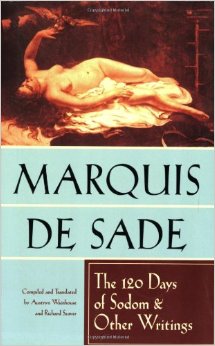
Until recently, I’d never given much thought to 120 Days. It was one of those books that remains a cultural point of reference, and as a classic of transgressive fiction, I knew it was something I should peruse someday. But, well, it didn’t really strike me as a must-read.

Certainly, nothing penned in the 1700s could still be shocking today.

Then two years ago I read Georges Bataille’s essay on de Sade in Literature and Evil. Then I watched the film translation, Salò, which, despite its reputation, is like a PG-13 version of the book. This is not because Salò is tame (it is one of the most troubling films ever made), but because 120 Days is so beyond anything that could be recreated on screen.

So where to begin when discussing this notorious tome?

Bataille may have said it best, “Nobody, unless he is totally deaf to it, can finish Les Cent Vingt Journées de Sodome without feeling sick.”

This, from the author of The Story of the Eye (which, if you haven’t read it, do so ASAP). The Story of the Eye is an absurd tale of ovular fixation, blasphemy and transgressive eroticism. In it, the narrator and his teenage lover embark on a journey of extreme sexual awakenings. There are blood orgies, spree murders, gratuitous body fluids and a gleeful desecration of the eucharist.

But in both content and exhaustiveness, it’s a viral kitten video compared to de Sade.

Bataille is right. There are some brutally sickening moments in 120 Days. I recoiled more than a few times, and Salomight have even thrown up in my mouth a little. This is not good reading before dinner, as the book’s “heroes” have an insatiable taste for excrement.
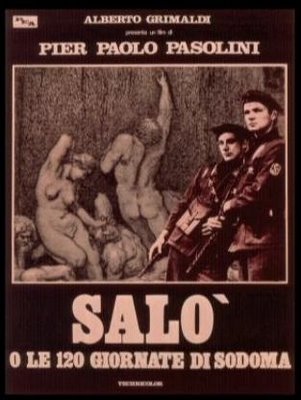
However, though it can be thoroughly unsettling at times, for the most part my response was laughter while reading 120 Days. I was enthralled with the prose, appalled by the brutality and intellectually challenged by the philosophy, yet laughing out loud throughout. What other response is there to a purported sexual fantasy of screwing a goat via the nostrils in order that its tongue can work the undercarriage?

You have to laugh, because you just can’t take an anecdote like that at face value. It is these moments that temper the more gruesome scenes. The outrageousness of it creates a buffer for the reader. It’s like that groan-moment in a horror film when the monster is finally revealed in all its plastic-prop foolishness.

In her essay “Must We Burn Sade?” Simone de Beauvoir offers a more sophisticated analysis: “Not only does he tell tall stories, but most of the time he tells them badly.”

Agreed. Does de Sade really expect us to suspend disbelief when a local aristocrat pays a hooker to be dipped in shit so he can lick her clean, head to toe? I was much more disturbed by transgressive classics like Lolita and Evan S. Connell’s The Diary of a Rapist, both of which employ a rational tone that is far more upsetting than the description of their exploits.

But let’s return to de Sade.

What about 120 Days’ plot and characters? It was surprising to me that, despite the book being a cultural touchstone, despite the author having an entire genre of sex and a commonly used adjective named for him, I had no idea what 120 Days was actually about.

Consider it the Winter of Disquiet. In a remote castle, a quartet of wealthy, powerful men indulge their darkest Libertine desires. To assist them are four experienced prostitutes/brothel madames, a handful of servants, hired studs (selected for their endowment) and a harem of kidnapped children, elderly women and the Libertine’s own daughters.

It does not end well for most of them.

Each day, one of the prostitutes tells five tales of her most interesting clients, in ascending levels of depravity.Eroticism Afterward, the Libertines act out the stories on their captives, each page more horrifying than the last. Think you’ve got a dirty mind because you read 50 Shades of Grey? Please. 120 Days makes 50 Shades look like a Disney picture book.
By the way, what’s with all the numbers? De Sade was methodical in outlining the book, and the numbers are very important here. The 120 days are divided into four 30-day sections, each showcasing one of the prostitute story-tellers. They tell 150 stories apiece, so altogether there are 600 sexual acts performed in the book. However, only the first 30 days were actually drafted (the tales of Madame Duclos). The unfinished manuscript was lost when the Bastille was stormed in 1789. (While the remaining 90 days and 450 sex acts were never fleshed out in narrative, de Sade meticulously outlined the entire book, so each of the sex acts, as well as the full plotline and character arcs, are described.)

Supposedly, de Sade’s obsession with numbers played out in his real-world rendezvous as much as in his fiction, and, according to Bataille, “His own stories are also full of measurements.” In a story told by one of the many prostitutes he frequented, he savored the lashings of the whip, but hurried to record how many blows he had received when it was finished.

De Beauvoir weighed in on this anecdote: “What was peculiar in his case was the tension of a will bent on fulfilling the flesh without losing itself in it.

“He never for an instant loses himself in his animal nature,” she adds, “he remains so lucid, so cerebral, that philosophic discourse, far from dampening his ardor, acts as an aphrodisiac.”

Despite its occasional absurdity, the book has a very serious side to be reckoned with.

We’ll address that in the next installment.

Review: The Sex Lives of Siamese Twins

The Sex Lives of Siamese Twins

Irvine Welsh

Longtime fans will not instantly recognize the author in this new work. Rather than the gray-skied schemes of twinsScotland, the drama unfolds in sun-kissed Miami, and missing is the phonetic text and colorful British slang.

Not absent, however, are the troubled characters, existential peril and sharp-tongued satire expected from the author of Trainspotting.

In his brilliant new book, Welsh entangles the lives of a body-obsessed fitness instructor, an overweight artist and a child-abuse victim bent on his pound of flesh. The three meet on a bridge, when Lucy, seeing a gunman chasing after two homeless men, intercedes to stop the attack. All of this is caught on tape by Lena, who becomes obsessed with the feisty trainer.

Lucy, of course, becomes an instant celebrity, and entertains visions of her own television show and fitness empire. Until it is learned that the men she saved were sexual predators.

Though functioning as satire of social networking, media voyeurism and the fickleness of fame, Sex Lives becomes the story of Lucy and Lena’s budding and devolving codependent and abusive relationship. We are taken for more than a few dark turns by an author famous for dark turns.

I’m a longtime fan of Welsh’s work, but I have to admit that I’ve found his newer books hit and miss. Recent novels have entertained, but lacked the gut-punch of Marabou Stork Nightmares, Filth and Glue. The Sex Lives of Siamese Twins is different from his other novels, but reveals a skilled author straining the old vinegar and aiming it at fresh targets.

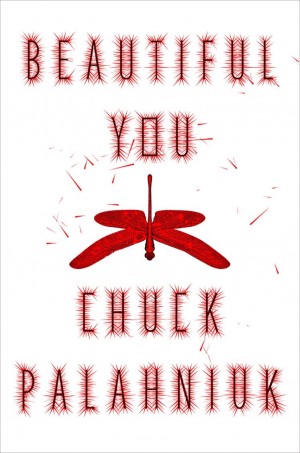
Pleasuring the Collective Unconscious: A review of Chuck Palahniuk’s Beautiful You

I’ll start with a confession: This review has come along sluggishly. Time I’ve set aside for writing has instead been frittered away on mindless online gaming. It’s an affliction we’ll call Beautiful Youwritus interruptus, and it’s likely to become an epidemic worse than any zombie apocalypse.

(Speaking of, my current addiction is The Last Stand: Dead Zone, and before I completed this sentence I had to stop to check on the construction status of a barricade.)

This isn’t anything new, really. In the 1950s, scientists discovered that if a rat could stimulate its brain’s pleasure center by pressing a bar, it would do so furiously until it passed out from exhaustion and, in many cases, died for lack of food and water. Mind you, the rats had access to food and water, but they couldn’t keep their paws off that pleasure bar.

This should sound familiar to any gamer who has missed a meal in order to level up.

It’s sick and wrong. I know this, but I need someone to hold up a mirror to face this absurdity directly.

This is why I love Chuck Palahniuk, whose new book, Beautiful You, is his best in a few years.

Fittingly, it concerns arousal addiction, and serves an electric shock to our collective conscience (or perhaps unconscious would be the better term).

Palahniuk took on male malaise with Fight Club, and mocked cultural over-consumption with Choke. Snuff (ostensibly a novel about pornography) lampooned self-destructive excess and exploitation in a manner that could very well have served as a hyper-sexualized predictor of the impending financial crisis of 2008.

In Beautiful You, he wanted to write what he calls gonzo erotica, and in the process has penned an anthem for an overstimulated, multi-tasking, computer-coma society.

Penny Harrigan is a nice Nebraskan girl working in New York City when she catches the eye of the world’s richest man, C. Linus Maxwell. Next thing you know, Penny is the talk of the tabloids and the envy of her coworkers.

Behind closed doors, however, is where Penny is truly transformed. Maxwell introduces her to a world of unimagined, if clinical pleasure. Penny has her reasons to question Maxwell’s motives (especially after a bizarre bathroom tryst with his bitter ex-lover), but is too enraptured with her newfound fame and sexuality.

Oozing with plot twists only Palahniuk’s sardonic tone could make palatable, Beautiful You aspires to remarkable levels of absurdity, but is it any more absurd than the daily inundation of product and marketing? Many reviewers have criticized the gratuitous satire in this novel, but is the idea of world domination via dildo really that farfetched in a culture that has financially sustained multiple cable shopping channels for three decades?

Beautiful You put me in mind of Rancid’s “Born Frustrated,” which asked, “Is this human freedom, hedonistic excess? Junky consumerism, mass production, toxic sickness?”

It’s why Romero’s Dawn of the Dead was set inside a shopping mall—can you truly be sure there aren’t a few zombies among you inside the IKEA? Ever been to a restaurant where a group of supposed acquaintances are each focused on their own smartphone or tablet?

We are a culture of instant gratification. We are a culture of distraction.

We are the lab rats hammering away at the pleasure bar for a taste of sweet, sweet oblivion.

And much like Maxwell, Palahniuk is there wearing a lab coat, taking copious notes and holding up a funhouse mirror to our cage, so that we might catch a distorted glimpse of what we’ve become.

Review: Justice, Inc.

In the introduction to his short story collection, Justice, Inc., Dale Bridges prepares us for the satirical rapture he is about to unleash: God, discouraged by his failed attempts to killjustice-inc-cover off the human race, comes to the realization that “…when left to their own devices, they appeared to do a fair job of exterminating themselves.”

And thus the chain catches on the death-coaster, drags it to the summit and lets that fucker drop.

Hang on.

These are masterful tales of human obsolescence, cruel absurdities and species self-deliverance. Albert Camus wrote: “Man is mortal. That may be; but let us die resisting; and if our lot is complete annihilation, let us not behave in such a way that it seems justice!”

He would love this book.

In Bridges’ world, justice is self-imposed, whether or not his characters realize it. You want the convenience and savings of a Wal-Mart? Fine, but you have no one else to blame when you wake up in a world controlled by Wal-Marts. Punishment fits the crime.

This is the type of justice that runs through this collection. The settings are typically dystopian and of our own making. It is human nature to barricade the doors or erect walls to repel that which threatens us, only to realize that we have constructed our own prison cell.

Just ask Poe’s Prospero, whose harlequin fortress was child’s play for the Red Death.

Justice, Inc., published by the formidable Monkey Puzzle Press, manages to be both observational and engaging, philosophical yet lyrical at the same time. You’ll find yourself caring as much for the characters and their plights as for the underlying philosophy within each tale.

The opening story, “Welcome to Omni-Mart,” is reminiscent of Kurt Vonnegut’s “Deer in the Works” updated for the big-box generation. Leonard was adopted by Omni-Mart as a child and now, at forty-two, lives, works and philosophizes within its walls, deathly afraid of The Outside.

It’s a synthetic, corporate dystopia that is, sadly, all too familiar.

“Life After Men” is a sardonic take on dysfunctional relationships and how we, inevitably, are drawn to, and driven by, the things that destroy us. Oh, and did I mention this plays out against the backdrop of some wild, gender-specific apocalypse?

This segues into the darkly comic (and karmic) “The Girlfriend™” in which the protagonist, Derrick, blurs the line between physical and factitious love. For Bridges, the femme fatale has been replaced by the sentient sex robot. (Of all the dystopias in all the dystopian universe, she had to walk into mine.)

Bridges writes not with a pen but a skewer, piercing the absurdity of our cosmic sitcom with clarity and humor. Justice, Inc. is philosophical satire in the vein of Vonnegut and George Saunders—fellow madmen who have stared into the abyss and come away laughing.

Obligatory disclaimer: Bridges is a friend and former coworker. We worked (and suffered) together at the Boulder Weekly newspaper, where he succeeded me as arts and entertainment editor. We also worked together on Transgress magazine, where three of these stories originally appeared.

I can attest to the quality of the man, his writing and his conviction.

I can also warn you, from first-hand knowledge, that Bridges may very well be the madman Nietzsche wrote about—and the bringer of the end times.

Be warned that there is a fifth steed of the apocalypse, and its name is Justice—and Bridges is lashing the whip, breathing fire and coming for us all.

Last-Minute Literature

The tick-tock of the holiday shopping season is winding down (or perhaps gearing up with desperation). If you’re still needing a last-minute book for the literati in your life, these blurbs should help differentiate the Red Ryder BB gun from the lumps of coal.

Diary of Edward the Hamster (1990-1990)

Miriam and Ezra Elia

I didn’t think anyone anthropomorphized animals more than me until I read this diary,Hamster translated from the notes left behind by Edward the Hamster. Much like the Marquis de Sade, who wrote extensively while in prison and only achieved literary fame posthumously, this artifact of Edward’s incarceration is certain to elicit pathos in readers.

It’s clear that Edward has studied the likes of Heidegger and Sartre. His reflections are wrought with defiance, despair and existential angst. He searches for meaning within his cage. There is food, water, a wheel.

“Is there nothing else!” he cries.

Filled with wit and wisdom, this graphic novel is a black comic tribute to a beloved hamster—the most existential beast within the animal kingdom. The drawings are cute, the entries are funny, but sprinkled throughout the book are philosophical nuggets like, “Why write? Life is a cage of empty words,” and “Is this cage of my own making?”

Along the way, we follow Edward through failed escapes, domestic discord and bliss and a final, bloody insurrection. This is a quick and playful read, with clever artwork, and will bring a smile to the philosopher in your life.

The Never List

Koethi Zan

There is a bitter synchronicity to Koethi Zan’s debut novel, The Never List. Concerning the-never-listthe lives of three women held captive in a madman’s basement, The Never List hit shelves 10 days before Ariel Castro pled guilty to holding three women hostage in his Cleveland basement.

I’m reminded of the Alice Cooper tale of his first trip to England. According to legend, a woman died during the flight, and it fueled his notoriety when he emerged on UK soil trailing a cadaver. Serendipity may not be the polite word, but by dictionary definition…

So, I read this book in July and loved it. The writing is solid and the narrative compelling, and I intended to review it at that time. Unfortunately, it got lost in the barrage of new releases.

There is a news hook, though, as the book is being adapted for television, and will be written by transgressive author A.M. Homes, which should make for wonderfully disturbing television.

The First Thanksgiving

Nathaniel Philbrick

This short work, a reworking of a chapter from Philbrick’s Mayflower: A Story of ThanksgivingCourage, Community, and War, is a great introduction to anyone interested in historical nonfiction who may be daunted by Philbrick’s longer works. There aren’t enough superlatives for Philbrick’s writing, and this appetizer will make any reader want to read the Mayflower, or any of his works, in full.

It’s the history of a holiday that we still celebrate, yet holds little connection to its origin. Here, we get the story we never learned in elementary school—such as the high mortality rates of the Pilgrims. Thanksgiving is now a spectacle of consumption and consumerism. Yet of the roughly 150 passengers and crew aboard the Mayflower, only half survived that first winter. Suffice to say, reading about the hardships of the settlers at the time of the first Thanksgiving will shame anyone who dares complain about Black Friday checkout lines.

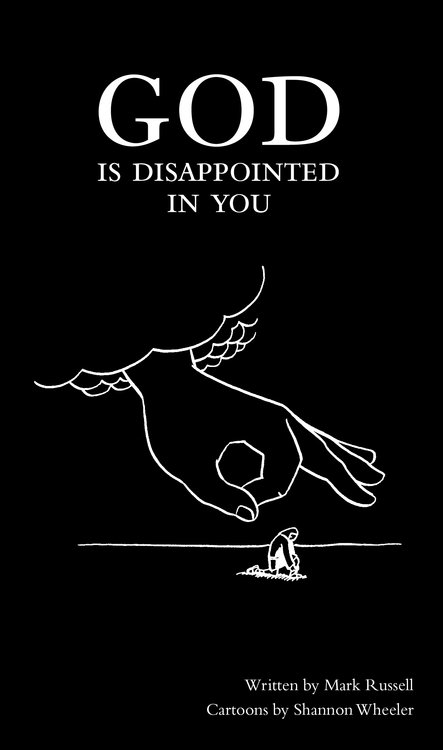
God is Disappointed in You

By Mark Russell and Shannon Wheeler

Some jokes never get old, as evidenced in this irreverent abridging of The Bible. The god_is_disappointed_in_you_cover_lghumor is sharp, varying from silly to satirical, and the illustrations add to the humor. While it is funny, there is also an earnestness within the narrative, as Russell attempts to condense the entire text to its core concepts.

Ambitious idea, and one not to be taken too seriously, but I dispute the author’s claims of accuracy. For example, which version of The Bible? If biblical scholars have been unable to agree on the official canon, I won’t expect it to be decoded in a humor book.

But taken for what it is, God is Disappointed in You is good, clean fun, filled with soul-lightening humor. If the publisher is smart, they’re already compiling a 365-frame calendar version to market over the holidays.

If so, sign me up.

Doomed

Chuck Palahniuk

Chuck, we love you. Please remember that. Lullaby is one of the most amazing booksdoomed-us_0 I’ve ever read, and I even found a way to work it into my master’s thesis. Choke is cutting social satire of the first order, Fight Club one of the greatest films ever made. Survivor is brilliant in plot, character and execution, and don’t get me started on the thrill-ride that is Haunted.

But I do have a few pet peeves that pop up in Doomed, the sequel to Damned.

First, I don’t have much patience for fiction written in the voice of a child. No matter the skill of the writer, an adult giving voice to a child always comes across as inauthentic and, in the worst cases, foolish. Also, exactly what are we to learn from a child narrator? It certainly won’t shock or disturb any hardened reader of horror or transgressive fiction.

Second, humor in horror is an iffy proposition. When it works, it’s organic, or the comedy is more disturbing than the tragedy (for example, many of the stories in Haunted). Better incidental humor than intentional. Doomed reads more like a Christopher Moore novel (albeit an extremely dark and cynical one).

I’m a fan of Moore’s, but his brand of humor is expected. When I read Palahniuk, I look forward to that nausea that lingers and ultimately consumes me, which I’ve found absent in Doomed.

Review, On Dissent: Its Meaning in America

On DissentNot many books from Cambridge University Press make it to the summer reading list, but On Dissent: Its Meaning in America is one of the better ways to revolt against the light-hearted beach-readers out there. Hell, it’s patriotic. America was born in dissent, and we celebrate it still. With fireworks—even illegal ones (though from now on I argue that M-80s are not outlaws, but rather the tools of dissent).

But why is dissent so much of our DNA? What does it even mean to dissent? These were the questions nagging at Ronald K.L. Collins and David M. Skover, two esteemed political scholars who were surprised to find that there was no true analysis of the concept of dissent.

That’s what they set out to create with this short, thought-provoking work.

For the most part, Collins and Skover accomplish their goal. The tone is philosophical in nature, and the authors begin by attempting to define dissent and identify its practitioners. Sure, anyone can point to the examples of Thoreau, King and Paine, but the authors take on trickier issues, such as how clear the line is (or isn’t) between civil disobedience and criminality. What role does violence play in dissent, or does an action cease to be dissent once it becomes violent?

Collins and Skover do a great job, and scholarly service, by identifying the fundamental traits of dissent, such as its being goal-oriented and indicative of a power dynamic. They buttress their definition by exploring hypotheticals and philosophical dilemmas (is a hired protester a dissenter?), and they do it all with an accessible writing style that will appeal to non-academic readers who might not otherwise seek out this book.

Of course, it’s not perfect, and the biggest issue I have is with the authors’ overreliance on expert commentary, such as that of Howard Zinn and Ralph Nader. The quotations are often redundant and unnecessary. The collective intellect of Collins and Skover is authoritative enough, and I recommend skimming through the offset commentary.

But there’s nothing else I would skim over in this book—particularly the epilogue. Here, the authors move away from definitions and thought experiments and present their own take on dissent—that contrary to rebellion, dissent is a vital and cohesive component of a democracy:

“Consent and dissent are two sides of the same coin. Without dissent, consent is meaningless; without consent, dissent loses much of its animating purpose” (152).

On Dissent is a quick and wonderful read. It will get you thinking. It will get you talking. It will remind you that though we may disagree, the freedom to disagree and express opposing viewpoints is what makes us strong.

Saki and Edward Gorey: The Unrest-Cure and Other Stories

In a wet-dream coupling worthy of GothicMatch.com, New York Review Books Classics has reissued a collection of Saki short stories illustrated by Edward Gorey.gorey

This twisted ballet of Edwardian sensibilities is darkly hilarious, and Gorey breathes new life into Saki’s drawing-room nightmares. Saki’s black humor shines in the dark delicacies “Sredni Vashtar,” “The Stampeding of Lady Bastable,” and “The Open Window.”

Like Saki, Gorey had a love of macabre humor, particularly set in the dramatic Victorian and Edwardian periods. His drawings incarnate the grim, merciless caricature of the English elite.

My favorite is the story “Tobermory,” which concerns the titular cat who discomfits house-party guests when he acquires the ability to speak. Gorey, a devout cat lover, must have enjoyed drawing this twisted tale. As a cat lover myself, I think Saki captured the spirit of how a cat would talk, if he could. He tells the ugly truth about the superficiality of the aristocrats, and he has little use for small talk: “It was obvious that boring questions lay outside his scheme of life.”

This makes him a threat to the partiers because he is the only one willing to scratch (if you’ll pardon the pun) beneath the surface and capable of exposing their dirty laundry and has no vested interest in status to keep him quiet.

So, of course, they set out to kill him.

When Mr. Appin, who taught Tobermory to speak, protests, the others suggest he experiment with less-independent animals “who are under proper control.”

The rich, absurdly disastrous ending both lampoons the artifice of the elite and the dangers one faces when speaking truth to power.

June Recommendations

In another day we’ll be heading off to London, and around this time Transgress will publish its annual summer book preview/review. In the coming days, we’ll be dishing out smaller portions of the issue, beginning with today’s blurbs about some books you may have missed this past month.

Joyland, Stephen King

I plan on devouring this little beauty on the first leg of the transatlantic flight. As joylandyou know, we at Ensuing Chapters and Transgress Magazine are all about funhouses and noir. So, a Stephen King paperback original about a funhouse for the imprint Hard Case Crime?

Bring it.

King’s previous offering through Hard Case was The Colorado Kid, a wonderfully creepy tale about an unsolved murder in a small Maine town. Some of you may also know it as the SyFy program, Haven.

I’ve got my ticket, and I’m already chilled thinking of the horrors that await in Joyland.

Creation: How Science is Reinventing Life Itself, Adam Rutherford

I recommend Adam Rutherford’s Creation for any fan of science writingcreation. However, my endorsement comes with a disclaimer: The electronic review copy I downloaded was corrupted and difficult to navigate. The result is that I didn’t read this book front to back, as I normally do. However, I was able to access about half of it, and what I read I thoroughly enjoyed.

Of particular interest to Transgress readers are the graphic details of surface cuts when explaining how the skin recovers from a wound. The squeamish reader might want to tag this book as horror for this reason alone.

Though I doubt there are any squeamish readers this blog.

Stylistically, Creation blends wit and storytelling with fair doses of hard science. Fans of Sam Kean, Mary Roach and Malcolm Gladwell will find much to love in its pages.

The Ocean at the End of the Lane, Neil Gaiman

Not since Joseph Campbell has an author had both a profound understanding oceanof mythology and the ability to present it to a general audience with such passion. I see Gaiman and Campbell as two sides of an intergenerational coin: the academic who deconstructs myths and the author who creates them.

His new novel, his first for adults since 2005’s Anansi Boys, concerns a young boy returning home–and reconsidering odd events from summers past.


The Hole, William Meikle

And what summer would be complete without a subterranean adventure? This twisted treat comes from one of my favorite publishers, DarkFuse, and concerns a chasm (literally, not figuratively) snaking through a rural town. What comes next promises to be delightfully morbid. I’ve got this on my to-read list and can’t wait to descend into its depths. A review will come later this summer.

Come back tomorrow for a review of The Unrest-Cure and Other Stories by Saki, illustrated by Edward Gorey.

A Playground for Insomniacs

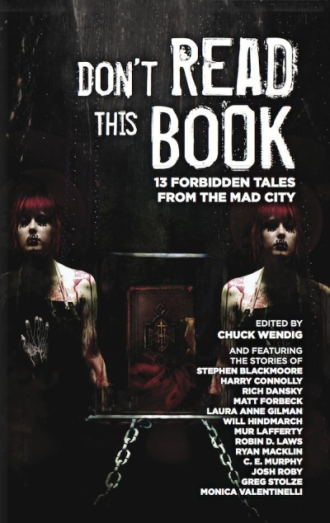
For some, sleep is a peaceful proposition. For others, like me, lights out has always been more of a punishment. The latter is the intended audience of Evil Hat Productions’DRTB Don’t Read This Book, a collection of 13 waking nightmares for the hard of sleeping.

These stories are set in the world of the Don’t Rest Your Head RPG, which I haven’t played, but seems perfectly designed for someone like me. My loose understanding of the game, based on reading this book (despite the admonition of its title) and researching a little about the RPG, is that it takes place in a dystopian dreamland (Mad City) populated with clockwork cops, shadow stalkers and any other gritty creature your mind can conjure up. You are among the Awake—insomniacs who have stayed up far too long and find themselves within the freak show of Mad City.

The Awake are in quite the pickle. Fall asleep and you die. But stay awake for too long and you’ll go mad and permanently inhabit the nightmare.

This is genius. Having been lifelong frenemies with the Sandman, I recognize this world, and it is more terrifying than most fictional places. Probably because I know what it feels like to go to work on your fourth day awake. I know the psychedelic side effects of clocking out from your graveyard shift and then clocking in at your day job a few minutes later. Things move in ways they shouldn’t, you lag a few seconds behind in every conversation and, worst of all, a mechanical noise fills your ears—not a buzz or a ring, but a machine-like pulsing that clouds thought and creates the sensation that someone is constantly following you.

Hallucinate from staying awake? Been there. That’s why the nightmares within Don’t Read This Book, edited by Chuck Wendig, are familiar territory for me.

And thoroughly enjoyable.

Standouts include Stephen Blackmore’s “Don’t Lose Your Patients,” Mur Lafferty’s “Don’t Bleach Your Memories” and Harry Connolly’s “Don’t Chew Your Food,” but this is a solid anthology front to back.

Gamers, steampunks, urban fantasists and horror fiends will find something to love in here. But those who may enjoy it most are us insomniacs.

Those of us who know that the torture of falling to sleep is worse than any nightmare that may be lurking on the other side.

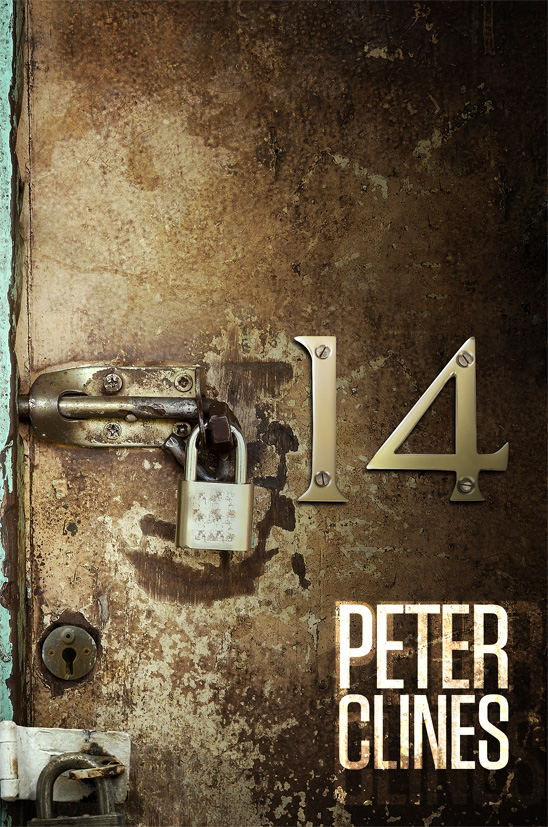
Peter Clines: 14

If I’ve learned anything from my lifelong obsession with horror, it’s that:14

  1. If someone introduces you to an opportunity too good, and too convenient, to be true, you probably shouldn’t take it because it can only mean trouble. And,
  2. If someone introduces you to an opportunity too good, and too convenient, to be true, you definitely should take it because you are guaranteed adventure—most likely one shadowed with conspiracy and gore.

So it goes in 14, by Peter Clines, in which an apathetic data-entry temp (Nate) is referred to a cheap apartment, where rents are suspiciously low, utilities shockingly free and the neighbors… well, the ones who stick around are… interesting.

The setting for this quasi-Lovecraftian, quasi-apocalyptic story is the Kavach building, which seems odd even by L.A. standards. Early in his stay, Nate notices some curious features of the old building: all the units have different dimensions; the plumbing is an inefficient web of pipes; there are discolored lights; green, mutant cockroaches; and, best of all, certain apartments are padlocked shut.

Among them, apartment 14.

This is where Clines truly excels. He develops a chilling atmosphere and social dynamic within the walls of the Kavach, and I absolutely devoured the first half of the book. The dialogue is shallow in spots, but the characters are as mysterious as the building, and as more secrets unfold, we follow a resilient crew of tenants into the deep tunnels beneath the Kavach.

Of all that I loved about the first half of this book, the tunnels were by far my favorite. The subterranean setting is magnificently drawn, and it’s that sweet spot in the book where the characters are fully realized and revealed, and the reader is absorbed in their struggle.

The second half of 14 is very entertaining, particularly the third quarter, but lacks the literary muscle of what came before. The first half was tight, focused, suffocating. It narrows until we get to the bottom of the tunnels, but then we begin expanding and things get a bit turbulent. Clines does a solid job of planting intriguing clues to be sussed out later, but the ending suffers from too much revelation.

I’d like to illustrate this with an anecdote.

My first apartment was a crumbling duplex on Tamplin Street in Sharon, Pennsylvania. It was dumpy and narrow, but the perfect incubator for two eventual writers (me and my roommate, Todd).

Particularly inspiring was the basement.

There was a biohazard sign on the basement door, with the words “Fallout Shelter.” The house was old enough that the sign could have been legit, though we suspected it was decoration. The basement itself was a throwaway slab of concrete—functional, boring, filled with spiders. The only thing scary about it was the rickety set of stairs.

And the unexplained, nailed-shut door on the northern wall.

The mystery door was almost a square, shaped more like a large window than a door, and rather than starting at the floor, the bottom edge was two feet off the ground. The top edge was only a few feet higher. It was the size and shape of a cupboard or a crawlspace. But why was it nailed shut?

Horror fanatic that I am, I tried to pry it open at least enough to glimpse what was on the other side. Thankfully, I wasn’t able to. Most likely, it was just a collapsed storage space (this was a mining/steel town, and it was fairly common for back yards to become ravines). It contained probably nothing more than the earth-packed remnants of a sinkhole.

But because I never got a look behind the mystery door, it has never lost its magic. Instead of a sinkhole, in my mind that door seals off a series of tunnels that burrow beneath our town, perhaps an old Prohibition-era bootlegging route, or perhaps it connects with the old cemetery two blocks away. Instead of storage space, there is a cache of forbidden scrolls. Or, befitting my Poe-obsessed youth, this is the subterranean vault where our slumlord buries alive his tenants.

Who knows, maybe even a bomb shelter.

The point is, I’m still fascinated by that shuttered basement door.

And that’s why the first half of 14 is an absorbing read. This is literature for anyone who has searched every new apartment for secret passages, hiding spots or trapdoors. Crawled through cobwebbed eaves, the musky underbelly of mobile homes and believes, always, that every building has a secret history to tell.

But unlike that basement door on Tamplin Street, we do learn what’s inside those padlocked rooms at the Kavach building. What we find there is original, for sure, but it dispels the magic. Each new revelation takes us further away from believability until 14 enters camp territory. And I’ve got nothing against camp. Truly, this part of the book is fun.

But it doesn’t mesh with the earnestness of the setup.

The action-packed finale further untethers the reader. The sequences are rushed, and where dialogue and observations from the characters should anchor us, we get snarky quips and CGI visuals. There is a nice homage to Lovecraft throughout, but HPL’s great trick was that we seldom saw what his creatures did. Rather, he hinted at what they could do.

Clines is a hell of a writer and storyteller, but here, he opens one door too many.

But that’s not entirely a bad thing, and certainly not a deal breaker (I just have a preference for more existential horror). This is a book I highly recommend. It’s fun, engaging, and I only give it four stars instead of five because of the overload of revelation at the end.

I’d prefer to leave a door or two shut. I want to imagine what’s behind it. A body? A tunnel? Treasure? Or nothing?

The best part is that I’ll never know.