Horror

Review: The Sluts, Dennis Cooper

Dennis Cooper and I have been on a collision course my entire life. I’m embarrassed for having taken so long to discover him, but I am making up for lost time (I’ve read seven of his books this year and am currently on my eighth).

It started with The Sluts. After having this book recommended to me constantly on GoodReads and other book sites, not to mention popping up routinely on BookTube, I finally took the plunge. Not knowing anything about him, I feared that maybe he was less a novelist and more a shock merchant. I’ve been burned by extreme authors in the past.

I read it in a day, and it immediately rocketed into my top ten all-time favorite books. The prose is electric and the text moves at a reckless pace.

Published, and set, in 2004, The Sluts came out right before the social media boom. It’s an epistolary novel told through the tools of the old Internet: dedicated websites, bulletin boards, even faxes. I won’t pretend that I didn’t enjoy the nostalgia of it.

But though it is twenty years old, The Sluts is a novel for our current time. It is a metafiction filled with unreliable narrators and all the hallmarks of the post-truth world. It occurs in an insular and mistrusting web community and incorporates a healthy dose of fan fiction.

The star of the show is Brad, a sex worker of exceptional beauty and questionable age and mental health. He is the soiled dove who captures the imagination of dozens of connoisseurs on an escort review website. Some want to save him. Some want to abuse him. Everybody wants to hire him.

At a certain point, it becomes clear that whatever you want Brad to be, he is, so while Brad is the central character of the novel, in the end we know nothing about him. The only information we have about him is discussion board gossip posted pseudonymously.

Ultimately, this turns the focus of The Sluts back on the reader. What do we know of any character in any book other than what a faceless author has provided on the page? How do we distinguish between true fictions (primary storylines) and artful lies (metafictions), and why do we distinguish between them in a book that we already know isn’t real?

It’s fitting that Cooper essentially places the reader in front of the computer in this story. Every day, we’re fed information from a screen. It’s up to us to discern truth and fallacy. We interact with strangers, read their reviews of movies, appliances, restaurants… even (gasp) books.

In the end, though, it comes down to the user, alone behind their keyboard. We find whatever we seek online. It’s a digital Plato’s cave where not only are we seduced by a false reality, but we are tricked into believing that we have agency over that reality.

The reader chooses which Brad reviews to believe and which to discard, thereby projecting our own fantasies and anxieties onto this ethereal sex worker who is pure dream or pure nightmare.

Trust me, this is a deeply engaging novel that will shake you to your philosophical core.

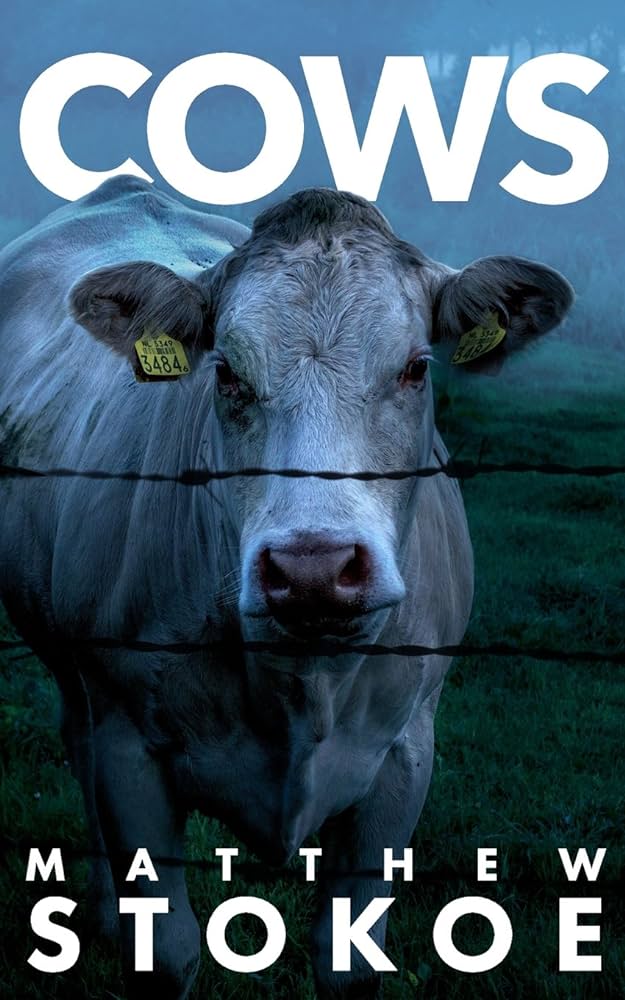
Review: Cows, Matthew Stokoe

Cows is the rare book that can be filed under both extreme horror and literary fiction. It earns its notoriety for its unflinching descriptions of despair, abuse, bestiality and coprophagia, but what elevates it above the edgelording of most extreme horror is Matthew Stokoe’s beautiful, evocative and squirm-inducing prose.

“Riding the backs of his corpuscles, leaping onto them from his stomach wall and through the thick gray coils of his intestines, not giving a shit what his heart wanted, the hard black grit of Mama’s catabolized meals jammed itself into his flesh and fat and gristle.”

Friends, that’s page one.

The story follows Steven, a young man whose life is like something out of a Quay Brothers film. There’s no origin story. He just exists in a dreary and oppressive Skinner box with his abusive, corpulent mother on the outskirts of an unnamed city.

When we meet Steven, he is starting a new job at the meat processing plant. He spends his day shoving chunks of butchered bovids into a grinder. At home, his mother feeds him rancid food to keep him weak and belittled.

Thanks to television, however, he strives to one day be normal and happy — just like a perfect sitcom family. He wants to share that life with Lucy, his upstairs neighbor.

When his foreman, Cripps, promises to turn Steven into an alpha male, he follows his lead, believing it will win him the happiness he seeks. So, along with a freakshow of co-workers, he commits rites of passage that will send even the strongest gag reflex into hyperdrive.

At first, it appears to work. Steven begins a paraphilic relationship with Lucy and stands up to his mother. He even assumes the duties of preparing his mother’s meals (read the book to get the irony of that last statement).

But that changes after Steven has a dialogue with one of the cows.

*Record scratch*

No, I didn’t say he has a monologue (or even a moo-ologue). He has a conversation with a cow that has escaped the slaughterhouse and tells Steven that he’s headed down a bad path. The cow also asks for his help in getting revenge on Cripps.

OK, that’s a lot, and I’ve barely scratched the surface. It’s not an easy book to discuss because, well, it’s strange and it inspires strong and varied feelings. It amuses as much as it disturbs and is at times deeply existential (wonderfully so) and at others surreal (mixed bag).

It felt a lot like reading The 120 Days of Sodom. At first it’s horrifying and difficult to read. Then it becomes comical and over-the-top. By the end, you’re reckoning with the novel’s philosophical intentions — not in spite of, but because of that journey.

Without a doubt, the most compelling relationship in the book is between the complementary spirits of Steven and Lucy. Steven attributes his unhappiness to what he lacks. He believes it exists out there, same as it’s portrayed on TV. If he could just get past the obstacles in his way he could be happy.

Lucy, on the other hand, chalks up her unhappiness to something sick within her. She is on an endless quest to find and destroy the poison she believes lives inside her body. She dissects animals, looking for this diseased part of the anatomy. She urges Steven to examine the cow innards on her behalf. She has an endoscopy hose that she uses to map her discontent.

The result is an endless cycle of drudgery, abuse and disappointment. The only moments of joy Steven experiences is when he’s having sex with Lucy, having sex with his side piece (ahem… a cow) or torturing and killing his various enemies. Those are the moments when he feels vital, alive, powerful.

But it turns out the talking cows were right. The path he’s on will not lead him to happiness. Ironically, Cripps is also right, when he tells Steven, “Don’t be frightened by the sickness. It lessens each time until it ceases to be felt.”

It reminded me (too much) of when I worked in an animal shelter years ago. For the mental health of the staff, we were only required to perform euthanasias one day a month — and those were some of the worst days of my life.

After the first time, I spent twenty minutes dry-heaving in a bathroom stall and sobbing like a child. The next time, I needed some alone time, but didn’t feel as sick, and I felt less so with each procedure. The last time, my eyes watered, but no tears fell. The sickness was gone.

In Cows, that’s a feature, not a bug. If you eat enough shit, you get used to the taste (literally, in the case of this book). Likewise, if exposed to enough killing, abuse and exploitation, you become desensitized to that as well.

But as Steven learns, that is a very different feeling than happiness.

GoodReads: The Cipher

The Cipher by Kathe Koja

My rating: 4 of 5 stars


Reading this in 2023 was like opening a time capsule. As with many of my favorite books of the early ’90s, it features acerbic humor, feral sexuality, over-stylized prose and a gutter-punk aesthetic that dares the reader to keep turning pages. High-octane body horror.


View all my reviews

Review: The Book of Accidents

Meet the Graves: Nate, a Philadelphia cop; Maddie, an artist; and their teenaged son, Olly, an empath who is a routine target of bullies at his school. When the family has a chance to move to Nate’s rural childhood home, they see it as an opportunity to escape the craziness of the big city.

But they soon learn that rural Pennsylvania is the scariest place of all.

Strange things happen immediately: Maddie’s sculptures begin coming to life. Nate begins seeing the ghost of his abusive father, except slightly different than he was while alive (left-handed, for example).

As for Olly, the change of scenery doesn’t make much difference at first — he’s still a bully magnet. In his darkest moment, though, a one-eyed stranger shows up and chases off two jocks who are trying to drown him. The mysterious stranger introduces himself as Jake, a fellow teenager, who lives by himself, doesn’t go to school and seems to have magical abilities.

With his new friend to protect him, it seems that Olly’s nightmare is over, but in truth, he’s about to sink to depths he never could have imagined.

The Book of Accidents is an entertaining and well-written book. It’s a page-turner with classic horror tropes such as the struggle between good and evil, supernatural entities and the power of underdogs when they’re forced to tap into a strength they didn’t realize they had.

Personally, I like my horror to be on the darker side, so while this was a fun read, I didn’t find it scary or disturbing. I also couldn’t put it down, so I definitely recommend it as a summer read.

Spoilers below

Wendig does not give us a color-by-numbers haunted house tale. There is a science behind the supernatural. What at first appear to be ghosts turn out to be the product of parallel timelines bleeding over into this one. This creates opportunities for characters to make peace with their pasts through alternate versions of themselves and others.

I found the scenes between Nate and his dead father particularly touching.

There were some structural shortcomings, however. The magical system, for lack of a better term, is never fully understood by either the reader or the characters, giving the ending a deus ex machina feel. And while using a multiverse setting was useful for the plot, it also lowers the stakes for the reader — if there are multiple versions of each character, an individual death isn’t as devastating.

It also negates the freewill that drives a good vs. evil narrative. Is the Graves family good by choice or by chance? If an evil version of them necessarily exists (as it must in a many-worlds reality), is that version truly evil?

At a certain point, I put quantum mechanics aside and just enjoyed the book for what it was: a fun, unique, well-constructed horror novel that probably won’t keep you up at night — but it will keep you reading through to the end.

Review: Plain Bad Heroines

Going in, I knew very little about Plain Bad Heroines. After the holidays, and in the thickest part of winter, I was in the mood for something epic and escapist. At more than 600 pages, Emily M. Danforth’s Plain Bad Heroines seemed like it might be just what I was looking for.

It was exactly that and more.

It put me in mind of Marisha Pessl’s Special Topics in Calamity Physics (one of my all-time favorite novels), with its richly layered mysteries and plot twists, and Erin Morgenstern’s The Night Circus, due to the fairy tale-esque narration.

There are three narratives driving the story. First, we have the historical storyline concerning a series of odd deaths at a New England boarding school for girls in the early 1900s. Running parallel with that is a modern-day attempt to adapt the tragedy into a horror movie. Meanwhile, the film’s director — clearly a student of auteur theory — has secretly rigged the entire set with hidden cameras and jump scares to incorporate a found-footage element that will blur the line between film and documentary.

As intended, it drives the actors to question their sanity and wonder whether the old boarding school truly is cursed. And if so, was it cursed by the tragedy or had it been hexed long before the school even existed?

Finally, we have the meta narrative, which glues the timelines together with the help of an omniscient, unidentified narrator. The meta narrative weaves in the true story of Mary MacLane, a turn-of-the-century author and feminist whose scandalous 1902 memoir documented her same-sex affairs and is central to the plot.

The use of paratext in the form of footnotes and postscripts further blurs the lines of fact and fiction. I’ve always found footnotes in fiction kind of gimmicky, and, from my days in an MFA program, overdone. But in the postscript, Danforth explains their significance: it’s a nod to the many historical queer narratives that have been lost, destroyed, altered and buried within small-font annotations throughout history. “You can often find us,” she writes, “quite literally, in the margins.”

It adds another layer to an already sad and beautiful tale — a tale perfect for the dark night of winter.

Review: Silvia Moreno-Garcia, Mexican Gothic

Silvia Moreno-Garcia’s Mexican Gothic takes on racism, misogyny and New Imperialism with Gothic symbolism in this highly acclaimed novel.

Set in 1950s Mexico, Noemí Taboada is a young socialite with diverse and ever-changing interests — anthropology being her most recent obsession. Her traditional family, however, would rather she pursue a husband than a graduate degree.

But when a distressed letter arrives from her newlywed cousin, Catalina, Noemí strikes a deal with her father — he will grant her permission to enroll in graduate school if she serves as the family´s ambassador. While her father fears the shame of a well-publicized divorce (or that Catalina´s mysterious new husband is after the family’s fortune), Noemí is concerned for her cousin´s life. So she travels to the rural mountain village where Catalina lives at her husband’s family estate.

Enter the ominous castle — High Place.

The Doyle family are English expats who had once amassed a fortune in a Mexican silver mine, but whose exploitation of local labor and environmental resources eventually led to financial ruin. The mansion is now crumbling and overrun with mold and fungi. There is spotty electricity, little access to the outside world and seemingly no way to escape.

Extricating Catalina is not as easy as planned. Noemí has no legal recourse to take Catalina away from her husband, even if she fears her life is in danger. With only the help of a few villagers and an unlikely ally within the family, Noemí must take on both the Doyles and an ancient presence that lives within High Place.

For fans of the genre, such as me, the beloved tropes of the remote castle, dead brides, haunted legends and dream visions make for a delightful read on their own.

But Moreno-Garcia understands that the brilliance of Gothic horror lies not merely in the trappings, but in what they represent.

Probably the most obvious symbolism is the dying patriarch of the Doyle family, representing social destabilization and the end of the colonial era. But the paterfamilia has concocted a way to achieve immortality, even if it makes all of them prisoners of High Place.

It would be a horrible, oppressive fate, to waste away in a dilapidated mansion built on a crumbling ideology.

Noemí is the breath of fresh air that just might blow the whole thing down.

Fun read with social commentary and ancient curses. Well worth your time.

Review: Parable of the Talents

Parable of the Talents

Octavia E. Butler

This book broke my heart a dozen different ways, many of which were unexpected. I anticipated the gloominess of social and racial injustice and the ugliness of weaponized patriotism.

But in this prophetic 1998 novel, that presaged 2015-2020 America by nearly two decades (in which a demagogue becomes president, campaigning on the slogan, “Make America Great Again”), the gut-punches come from unexpected directions.

There is the heartbreak of destroyed families, both physically (the murder and enslavement of non-Christian and minority communities) and personally (the ideological divide that has pushed loved ones to opposite extremes of the culture war).

There is the heartbreak of those who have been rescued from slavery and trafficking turning against the ones who saved them.

But I think what I find most heartbreaking is the cognitive dissonance that pervades society. In perhaps the most prescient aspect of the novel, when the atrocities committed by the Church of Christian America are exposed, the church’s followers deny the enslavement, rape and execution of the “heathens” within the church’s network of “reeducation camps.”

It is eerily reminiscent of the way revisionists are already trying to distort the facts of the January 6 insurrection, despite an absurd amount of video evidence provided by the perpetrators themselves. It befits a country where the only defense that 40 percent of the population can muster is to shout “fake news” over and over like pull-string talking dolls.

This was honestly one of the most disturbing books I’ve ever read, and I am a connoisseur of the disturbing. Butler does not shy away from the depressing truth of human nature. She doesn’t try to tack on a happy ending or hint at a brighter future.

She presents humans as they are, not how she’d like them to be. This is a book for truth-seekers, not escapists. Nietzsche rather than Pascal.

The reality is that victory lies not in winning, but in persevering. Victory is speaking the truth when the truth has become criminal, no matter the costs.

If there is any misguided optimism in Parable of the Talents, it is the notion that we can colonize other planets for the betterment of humanity. The protagonist, Olamina, has devised a peaceful philosophy called Earthseed that she hopes to expand to other planets — despite the fact that we can’t even stop destroying our current one.

Though in Butler’s defense, that is a lot more obvious now than it was in the mid-’90s, which was a time of great optimism.

Like the members of Butler’s Church of Christian America, humans will believe what they want to believe, regardless of evidence. A beautiful lie will always be more welcome than an ugly truth.

No matter the atrocities committed in their name, having pride in a country’s mythology is always easier than building a country worth being proud of.

Review: Tender is the Flesh

Tender is the Flesh

Agustina Bazterrica

I have recently developed a preference for Impossible Burgers, a plant-based meat alternative, over ground beef. Reading Agustina Bazterrica’s Tender is the Flesh did not cause me to second-guess this decision.

To be clear, the novel is not simply a polemic about factory farming or a futuristic retelling of Upton Sinclair’s The Jungle. It is a deeper critique of the entire global economy, our class structure and a food supply chain designed to minimize consumer guilt.

Tender is the Flesh takes place in a future where a virus has made animal meat lethal to humans. Animals have been eradicated, and for a while, the world went vegan out of necessity.

That didn’t last long. Craving a meat fix, consumers (I use that word intentionally) turned to the only viable meat option remaining: humans. Dubbed the “Transition,” the world’s meat counters were once again stocked with product — now referred to as “special meat.”

Marcos, our protagonist, manages a meat processing plant and is highly regarded in the field. His father had operated a renowned slaughterhouse prior to the virus, but was unable to cope with the Transition. He was “a person of integrity, that is why he went crazy.”

Marcos also struggles with the Transition, but reminds himself that he does it to pay for his father’s care in a nursing home. Marcos is also dealing with the death of his child and the resulting estrangement from his wife.

He copes by detachment:

“He wishes he could anesthetize himself and live without feeling anything. Act automatically, observe, breathe, and nothing more. See everything, understand, and not talk. But the memories are there, they remain with him.”

His attempt at dissociation fails when a supplier, hoping to make nice for a botched order, gifts him with an expensive delivery — a young female “head” who is certified First Generation Pure (FGP), the most prized and costliest grade of “special meat.”

Like all “head,” her vocal chords have been severed so that she can’t complain and when it’s time to slaughter, the butcher won’t be upset by her screaming. Marcos ties her up in the barn while he decides whether he should sell her for a tidy sum, breed her or use her for food. (In a clever bit of world-building, foodies have perfected the technique of butchering “head” piecemeal so that they always have fresh meat available.)

Tender is the Flesh is broken into two parts. The first covers a very compressed timeline where we get to know Marcos, learn of his family tragedies and bear witness to the new method of meat processing. This is gut-churning stuff, even for a hardened horror lover such as myself.

But as hardcore as this first part may be, it is the second half where the book goes to a dark place even I wasn’t expecting.

Throughout part one, Marcos tries to distance himself from the horrors of reality. He’s a vegetarian who is disgusted by the business of human meat processing. He is also troubled by the reliance on euphemisms that legitimize (and dehumanize) the whole business.

In the second half, detachment is no longer an option. The gift of the FGP forces him to reckon with reality. He names her Jasmine, even though that is a crime punishable by death. He cleans her up and moves her into the house.

Once forced to action, Marcos is both a passionate idealist and a ruthless businessman. He connives to protect Jasmine, visits an abandoned zoo and prepares for his father’s death.

This culminates in a gut punch of an ending that is a reminder that being human isn’t the compliment some people want it to be.

Tender is the Flesh is an incredible book that is beautiful, well-written and dark beyond dark. It has one of the bleakest endings of any book I’ve ever read. In other words — I loved it.

And yeah, it makes the Impossible Burgers taste even better.

Review: Grotesque

Natsuo Kirino

Grotesque

This is a book that lives up to its name. Beauty and deformity drip from every page in this transgressive thriller. It put me in mind of Flannery O’Connor, not in the aspect of prose but in the weight of oppression and despair.

There is no escape hatch for either the reader or the characters. The female leads — Yuriko, the monstrous beauty; Kazue, whose determination is greater than her social awareness; and the unnamed narrator, who is Yuriko’s older sister and self-described shadow to her sister’s light — are born into a system built for them to fail. Any path they tread is treacherous.

For Yuriko and Kazue, that path is sex work, though they arrive by different means and with different motivations. Their ends, however, are similar. They are both murdered by a client.

For the narrator, the path is a “sea of hatred” — she develops an armor of malicious wit, bitterness and resignation. She comes to relish the confused reactions people have upon learning that she and Yuriko are sisters.

Grotesque is epic in scope and haunting in execution. As with O’Connor, the writing sticks to the bone and the moral philosophy weighs on the mind long after. I can’t rave enough about this book. This is the second book of Kirino’s I’ve read — the other being the amazing Out — and I look forward to reading more.

As much as I loved Out, I think I love Grotesque more. Recency bias? Maybe, but the books deviate so much from each other in style and perspective that I don’t think that’s it. Out is a page-turner, whereas Grotesque is more like a Russian novel.

The former you can’t put down. The latter crawls under your skin, just the way I like it.

Review: Kill Creek

Scott Thomas

Kill Creek

I would categorize Kill Creek as a cozy horror novel, and I mean that in the best possible way. This is a book built for a windy night and a warm beverage. Sometimes I’m in the mood for a format-busting novel like House of Leaves, Horrorstor or Marabou Stork Nightmares. Other times I’m in the mood for a classic tale, well told, such as Kill Creek.

Scott Thomas plays the hits in his debut novel. He takes on classic themes and pays tribute to a long lineage of gothic/ghost stories: the writer protagonist with a troubled past; a house haunted by an historic injustice; curses that spread like a virus to destroy all infected; and a supernatural presence that preys on its victims’ emotional vulnerabilities.

Our protagonist is Sam McGarver, an author who has had some initial success but has hit a creative dead-end. He spends most of his time teaching at the local university and trying to keep his marriage from falling apart.

Out of the blue, he’s asked to participate in an online publicity stunt–a Halloween sleepover with three other horror authors in one of the most haunted houses in America. Reluctantly, Sam agrees.

Joining him are T.C. Moore, the take-no-shit weaver of extreme horror that likely would have been labeled splatterpunk three decades ago. Sebastian Cole, the elderly statesman/Stephen King type who has had decades of both commercial success and literary street cred. And Daniel Slaughter, who writes young-adult Christian horror with strong moral lessons.

The dynamic between the characters is intriguing, and I enjoyed the action when they were all together for the first time. For me, those were the strongest parts of the book. Unfortunately, their time together at the beginning is too short, and when they reconvene at the house for the final act, they don’t have the emotional bond that would’ve made me more invested in their outcomes.

There are some other shortcomings, such as the characters of Moore and Slaughter. Moore, at least, is an intriguing character, and I wanted more of her at centerstage. For the first half of the novel she’s a badass, but becomes more two-dimensional as the novel progresses. She more or less disappears in the final act, which is a shame.

Unfortunately, there isn’t much to Slaughter’s character. He’s likeable and pitiable when we first meet him, and his affection for his daughter is endearing. There seemed to be a lot of potential there that was left unfulfilled, and I found him to be sadly unbelievable by the end.

Overall, I found Kill Creek very fun and enjoyable, and for the first half of it, I considered it a five-star read. However, the second half really dragged due to an overlong action sequence and predictable plot points.

I was discouraged near the end, but ultimately Thomas delivers a solid ending with an unexpected turn.

Kill Creek was an incredibly fun book to read. It’s a fast and furious adventure as comfortable as a campfire tale. The nights are getting cooler, and pretty soon we’ll be in Halloween season. This is the perfect book to get you in the mood.