Fiction

Stephen King, Joyland

JoylandJoyland by Stephen King

My rating: 3 of 5 stars

The first three-fourths of
Joyland
are amazing, some of King’s best recent work. The ending, however, is a bit too easy and familiar. King’s previous offering through Hard Case Crime, The Colorado Kid, subverted convention and was far more challenging to the reader.

Infused with heart and the nostalgic thrills of boardwalk carnivals, Joyland is worth the ticket price. The novel begins as a rail-rattling thrill ride, but, in the end, eases too gently into the station.

View all my reviews

Saki and Edward Gorey: The Unrest-Cure and Other Stories

In a wet-dream coupling worthy of GothicMatch.com, New York Review Books Classics has reissued a collection of Saki short stories illustrated by Edward Gorey.gorey

This twisted ballet of Edwardian sensibilities is darkly hilarious, and Gorey breathes new life into Saki’s drawing-room nightmares. Saki’s black humor shines in the dark delicacies “Sredni Vashtar,” “The Stampeding of Lady Bastable,” and “The Open Window.”

Like Saki, Gorey had a love of macabre humor, particularly set in the dramatic Victorian and Edwardian periods. His drawings incarnate the grim, merciless caricature of the English elite.

My favorite is the story “Tobermory,” which concerns the titular cat who discomfits house-party guests when he acquires the ability to speak. Gorey, a devout cat lover, must have enjoyed drawing this twisted tale. As a cat lover myself, I think Saki captured the spirit of how a cat would talk, if he could. He tells the ugly truth about the superficiality of the aristocrats, and he has little use for small talk: “It was obvious that boring questions lay outside his scheme of life.”

This makes him a threat to the partiers because he is the only one willing to scratch (if you’ll pardon the pun) beneath the surface and capable of exposing their dirty laundry and has no vested interest in status to keep him quiet.

So, of course, they set out to kill him.

When Mr. Appin, who taught Tobermory to speak, protests, the others suggest he experiment with less-independent animals “who are under proper control.”

The rich, absurdly disastrous ending both lampoons the artifice of the elite and the dangers one faces when speaking truth to power.

A Playground for Insomniacs

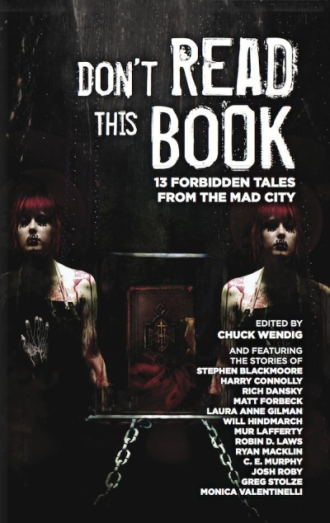
For some, sleep is a peaceful proposition. For others, like me, lights out has always been more of a punishment. The latter is the intended audience of Evil Hat Productions’DRTB Don’t Read This Book, a collection of 13 waking nightmares for the hard of sleeping.

These stories are set in the world of the Don’t Rest Your Head RPG, which I haven’t played, but seems perfectly designed for someone like me. My loose understanding of the game, based on reading this book (despite the admonition of its title) and researching a little about the RPG, is that it takes place in a dystopian dreamland (Mad City) populated with clockwork cops, shadow stalkers and any other gritty creature your mind can conjure up. You are among the Awake—insomniacs who have stayed up far too long and find themselves within the freak show of Mad City.

The Awake are in quite the pickle. Fall asleep and you die. But stay awake for too long and you’ll go mad and permanently inhabit the nightmare.

This is genius. Having been lifelong frenemies with the Sandman, I recognize this world, and it is more terrifying than most fictional places. Probably because I know what it feels like to go to work on your fourth day awake. I know the psychedelic side effects of clocking out from your graveyard shift and then clocking in at your day job a few minutes later. Things move in ways they shouldn’t, you lag a few seconds behind in every conversation and, worst of all, a mechanical noise fills your ears—not a buzz or a ring, but a machine-like pulsing that clouds thought and creates the sensation that someone is constantly following you.

Hallucinate from staying awake? Been there. That’s why the nightmares within Don’t Read This Book, edited by Chuck Wendig, are familiar territory for me.

And thoroughly enjoyable.

Standouts include Stephen Blackmore’s “Don’t Lose Your Patients,” Mur Lafferty’s “Don’t Bleach Your Memories” and Harry Connolly’s “Don’t Chew Your Food,” but this is a solid anthology front to back.

Gamers, steampunks, urban fantasists and horror fiends will find something to love in here. But those who may enjoy it most are us insomniacs.

Those of us who know that the torture of falling to sleep is worse than any nightmare that may be lurking on the other side.

Hilary Davidson: Evil in All Its Disguises

If I were writing a one-word review of Hilary Davidson’s Evil in All Its Disguises, released March 5, that word would be: incongruous. And it would be a massive compliment.Evil Cover

In this subtle crime novel, the third in the Lily Moore series, Davidson drops us in an Escher-like room of distorted realities. Everything looks normal, just slightly askew, and it’s these atmospheric incongruities that make Evil such an enjoyable read.

For series initiates, such as myself, Lily Moore is a travel writer with a checkered past: a mentally unstable family history; a deceased, junkie sister; a quasi-gangster business tycoon ex who will do anything to get her back. This is the baggage she takes with her to Acapulco to review the once-glamorous Hotel Cerón.

It’s nothing unusual: just another press junket with a circle of travel writers, and a PR flak, she’s known for years. Yet, when she arrives at the hotel, Moore is surprised to find it in disrepair, and disturbed to learn that one of her closest friends on the trip, Skye, is in over her head on an investigative piece. During their brief and baffling conversation, Skye expresses concern for her safety, and then steps away to take a call.

And so the unraveling begins. Skye doesn’t return from that phone call, and nobody at the isolated resort seems concerned. Through her exploration, Lily learns that the hotel is a recent acquisition by her ex’s company, manned by his henchman, Gavin, and before long she realizes she’s been lured to the Hotel Cerón under false and deadly pretenses.

There is a breathless quality to the prose that I enjoyed. The action is tightly contained (the plot unfolds in around 48 hours), and, from one chapter to the next, I couldn’t put it down. Aside from a superfluity of internal dialogue and redundant flashbacks, the writing is well-paced and tightly organized, and Davidson manages to give us a tour of the resort, including the unfinished bungalows, the empty wings and even the rotting interior, without feeling like a travelogue—probably due to her actual background as a travel writer. (To my fellow gluten-intolerants I recommend her Gluten-Free Guidebook blog.)

But as with a travel review, the pros must be weighed against the cons. Evil suffers from an overload of plot twists. The phrase “trust no one” certainly applies. This isn’t all bad, as the finer twists reveal character complexity (and that delicious incongruity). But as the plot turns pile up, they begin to lose credibility.

Evil diverges from the transgressive and brutal horror literature usually reviewed in this space. There’s a cozy quality to the story that is actually kind of refreshing. The book kept me up at night not because it was disturbing, but because it was engaging.

I predict big things for this book, and I’m sure it will earn a deserved place on the best-seller list.

Peter Clines: 14

If I’ve learned anything from my lifelong obsession with horror, it’s that:14

  1. If someone introduces you to an opportunity too good, and too convenient, to be true, you probably shouldn’t take it because it can only mean trouble. And,
  2. If someone introduces you to an opportunity too good, and too convenient, to be true, you definitely should take it because you are guaranteed adventure—most likely one shadowed with conspiracy and gore.

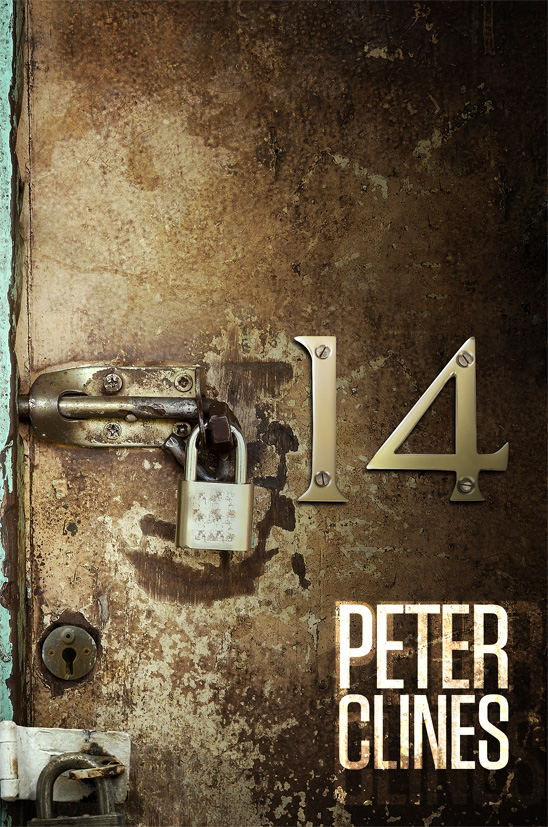
So it goes in 14, by Peter Clines, in which an apathetic data-entry temp (Nate) is referred to a cheap apartment, where rents are suspiciously low, utilities shockingly free and the neighbors… well, the ones who stick around are… interesting.

The setting for this quasi-Lovecraftian, quasi-apocalyptic story is the Kavach building, which seems odd even by L.A. standards. Early in his stay, Nate notices some curious features of the old building: all the units have different dimensions; the plumbing is an inefficient web of pipes; there are discolored lights; green, mutant cockroaches; and, best of all, certain apartments are padlocked shut.

Among them, apartment 14.

This is where Clines truly excels. He develops a chilling atmosphere and social dynamic within the walls of the Kavach, and I absolutely devoured the first half of the book. The dialogue is shallow in spots, but the characters are as mysterious as the building, and as more secrets unfold, we follow a resilient crew of tenants into the deep tunnels beneath the Kavach.

Of all that I loved about the first half of this book, the tunnels were by far my favorite. The subterranean setting is magnificently drawn, and it’s that sweet spot in the book where the characters are fully realized and revealed, and the reader is absorbed in their struggle.

The second half of 14 is very entertaining, particularly the third quarter, but lacks the literary muscle of what came before. The first half was tight, focused, suffocating. It narrows until we get to the bottom of the tunnels, but then we begin expanding and things get a bit turbulent. Clines does a solid job of planting intriguing clues to be sussed out later, but the ending suffers from too much revelation.

I’d like to illustrate this with an anecdote.

My first apartment was a crumbling duplex on Tamplin Street in Sharon, Pennsylvania. It was dumpy and narrow, but the perfect incubator for two eventual writers (me and my roommate, Todd).

Particularly inspiring was the basement.

There was a biohazard sign on the basement door, with the words “Fallout Shelter.” The house was old enough that the sign could have been legit, though we suspected it was decoration. The basement itself was a throwaway slab of concrete—functional, boring, filled with spiders. The only thing scary about it was the rickety set of stairs.

And the unexplained, nailed-shut door on the northern wall.

The mystery door was almost a square, shaped more like a large window than a door, and rather than starting at the floor, the bottom edge was two feet off the ground. The top edge was only a few feet higher. It was the size and shape of a cupboard or a crawlspace. But why was it nailed shut?

Horror fanatic that I am, I tried to pry it open at least enough to glimpse what was on the other side. Thankfully, I wasn’t able to. Most likely, it was just a collapsed storage space (this was a mining/steel town, and it was fairly common for back yards to become ravines). It contained probably nothing more than the earth-packed remnants of a sinkhole.

But because I never got a look behind the mystery door, it has never lost its magic. Instead of a sinkhole, in my mind that door seals off a series of tunnels that burrow beneath our town, perhaps an old Prohibition-era bootlegging route, or perhaps it connects with the old cemetery two blocks away. Instead of storage space, there is a cache of forbidden scrolls. Or, befitting my Poe-obsessed youth, this is the subterranean vault where our slumlord buries alive his tenants.

Who knows, maybe even a bomb shelter.

The point is, I’m still fascinated by that shuttered basement door.

And that’s why the first half of 14 is an absorbing read. This is literature for anyone who has searched every new apartment for secret passages, hiding spots or trapdoors. Crawled through cobwebbed eaves, the musky underbelly of mobile homes and believes, always, that every building has a secret history to tell.

But unlike that basement door on Tamplin Street, we do learn what’s inside those padlocked rooms at the Kavach building. What we find there is original, for sure, but it dispels the magic. Each new revelation takes us further away from believability until 14 enters camp territory. And I’ve got nothing against camp. Truly, this part of the book is fun.

But it doesn’t mesh with the earnestness of the setup.

The action-packed finale further untethers the reader. The sequences are rushed, and where dialogue and observations from the characters should anchor us, we get snarky quips and CGI visuals. There is a nice homage to Lovecraft throughout, but HPL’s great trick was that we seldom saw what his creatures did. Rather, he hinted at what they could do.

Clines is a hell of a writer and storyteller, but here, he opens one door too many.

But that’s not entirely a bad thing, and certainly not a deal breaker (I just have a preference for more existential horror). This is a book I highly recommend. It’s fun, engaging, and I only give it four stars instead of five because of the overload of revelation at the end.

I’d prefer to leave a door or two shut. I want to imagine what’s behind it. A body? A tunnel? Treasure? Or nothing?

The best part is that I’ll never know.

Steven Schwartz: Little Raw Souls

Here’s a link I forgot to post last week. Steven Schwartz’s Little Raw Souls. We’ve got a review, an interview and full audio on this one. Enjoy!

http://transgressmagazine.com/2013/02/07/interview-steven-schwartz-little-raw-souls/

Stephen Dobyns: The Burn Palace

Stephen Dobyns‘ new novel, The Burn Palace, is a difficult book to deconstruct. TheDobyns narrative is a tangle of shifting perspectives and sharp turns, and stylistically, is a bit disarming at first.

However, we’re in the hands of an old master. What Dobyns does better than most is capture the quirks and suspicions of small-town America, and similar to his 1997 masterpiece, The Church of Dead Girls, The Burn Palace offers us an eagle-eyed, warts-and-all perspective of residents of Brewster, Rhode Island.

As with the loose-ended Church, the horror lives not so much in the conflict, but rather in how the residents respond to the conflict. In this novel, Dobyns’ first in more than a decade, the catalytic event is a dramatic kidnapping. A newborn has been stolen from the local hospital, replaced with a corn snake, and thus, the town of Brewster is shrouded in mystery and controversy.

And fear.

From the local diner to holistic healing centers, Brewster is that odd amalgamation of new age/old age found in many small towns. It is also a town of secrets and tragedy and disaster. Dobyns brings to life the town’s diverse personalities, going to door to door in a literary trick or treat.

It’s kind of like Winesburg, Ohio—if Sherwood Anderson had grown up on Stephen King’s street.

Of course, the prose is excellent, and only someone like Dobyns could reconcile this many narratives and POVs in one book. That said, this is a dense work, more so for the constant shifting of perspectives, never setting us on stable ground.

But then again, isn’t that the point? Rather than simply using his words to construct a referent, Dobyns, with his background in poetry, uses the words themselves to disorient, to make us confused, uncomfortable and always uncertain, but excited, about what comes next.

Review: Tenth of December

Proud to be a Dystopian

by Vince Darcangelo

It was a warm autumn evening at the Gramercy Theater, Oct. 5, opening night of the 2012 New Yorker Festival. The room was thick with literati, and on stage were threeSaunders heavyweights: Jennifer Egan (A Visit From the Goon Squad), Margaret Atwood (The Handmaid’s Tale) and George Saunders, whose new collection of short fiction, Tenth of December, was released on Tuesday, Jan. 8.
The theme of the panel was “Utopia/Dystopia,” and Atwood led off with a brief history and deconstruction of the genre. Utopias and dystopias go hand in hand, she said, because with any utopian idea “there’s always a catch, and the catch is this: Everything’s going to be fine, but first we’ve got to get rid of these people.”

And then we came to Saunders, whose works, such as the exquisite CivilWarLand in Bad Decline, often contain dystopian themes or settings, along with healthy doses of humor and satirical absurdism.

“I never really thought I’d write a dystopian (story),” he said, adding that he first tried to emulate iconic writers like Hemingway and Raymond Carver. It wasn’t working, so he tried something different.

“If I set something in a theme park or the near future,” he said, “the language comes alive.”

And thus, a great writer, and celebrated literary subversive, emerged.

#

Tenth of December is a short and bittersweet 10-tale offering of gripping short fiction, incorporating science fiction and otherworldly elements (similar in tone, in my opinion, to Kurt Vonnegut). The book’s opening tale, “Victory Lap,” which originally appeared in The New Yorker in 2009, concerns an attempted abduction of a teenage girl and the hijinks that ensue.

That’s right, hijinks.

As silly as it is serious, it is the humor that sharpens the dark edge of “Victory Lap.” This is a bold piece of work. Saunders takes chances by shifting points of view and writing from the interior voice of teenagers, but he pulls it off as only he can. There’s a jazzy rhythm and flow to the piece, and it deserves to be read aloud. The story really came to life for me when I heard Saunders read it at the University of Northern Colorado in 2010.

Probably my favorite story from Tenth of December is “Escape from Spiderhead.” It has the classic elements of his fiction: people in the near-future in a seemingly powerless position; the intertwining of corporate and institutional control; wacky goings-on; funny, yet fitting, product names; and an unlikely hero who somehow manages to carve out his acre of humanity within this madhouse.

Specifically, our hero, Jeff, is a convict in a research prison, where his punishment is to be a lab rat for chemical experimentation. As part of a sex study, he is given drugs that create feelings of intimacy and attraction to another person; another that induces loquacity; a performance enhancer (Vivistiff™) that makes Viagra seem like a sugar pill; and another chemical that lowers one’s “shame level.”

The experiments take a dark turn when he is enlisted in a Darkenfloxx™ study. As Jeff describes the drug: “Imagine the worst you have ever felt, times ten. That does not even come close to how bad you feel on Darkenfloxx™.”

The scene is reminiscent of the notorious Milgram experiments, and it concludes brilliantly—somehow both uplifting and tragic. It’s a reminder that great literature doesn’t resolve with the hero winning or losing, but rather redefines what it means for that character to win or lose.

“CivilWarLand in Bad Decline,” for example, is set inside a rundown theme park overrun with violent gangs (to the point that the Civil War re-enactors pack live ammunition in their muskets). The protagonist is a working-class dreamer and father of two who endures disappointment and the threat of violence for the sake of his family. But his idea of winning and losing changes in this theme park.

“Sea Oak,” from his 2000 collection, Pastoralia, is a genre-bending story incorporating new-wave male strippers, a post-industrial ghetto and a dead aunt who refuses to go away. Likewise, it concerns a poor family burdened with violence, and takes a fantastical turn that recalculates the stakes for all involved.

“Sea Oak” won an O. Henry Award Prize and was also nominated for a Bram Stoker Award. How many Bram Stoker nominees have received gushing praise from the New York Times?

#

At the heart of Saunders’ fiction are class issues (he comes from a working-class background and earned an engineering degree from the Colorado School of Mines); the impact of an ever-invasive corporate culture (see “I CAN SPEAK!™” from 2006’s In Persuasion Nation); and the absurdity of the modern workplace.

An example of the latter in Tenth of December is the story “Exhortation,” which is told in the form of a memo from a boss to his underperforming crew. The memo is in reference to “March Performances Stats” and attitudes toward the work being done. He begins by comparing their duties to cleaning a shelf, but of course, it becomes apparent that their labor is far more sinister:

“Even you guys, you who do what must be done in Room 6, don’t walk out feeling so super-great, I know that, I’ve certainly done some things in Room 6 that didn’t leave me feeling so wonderful, believe me…”

Whatever goes on in Room 6, it clearly has nothing to do with shelves. This story calls to mind Saunders’ classic short story, “The 400-Pound CEO,” concerning a worker drone whose job is to kill raccoons for the company Humane Raccoon Alternatives.

In both of these stories, Saunders guides us through a sausage mill as unpleasant as any Upton Sinclair encountered. We see characters doing menial and often unpleasant work, and manipulative and often cruel bosses attempting to put a positive spin on their duties, if for no other reason than to create a healthy façade for the buying public. Greed and rampant corporatization has left the working class in the absurd position of having to abase themselves and others to get by.

I can’t think of a better description of dystopian fiction. Often, the term calls to mind an enslaved, automated world gone grey: a dramatic vision complete with conflicts worthy of the Thunderdome. But with Saunders, the dystopia is more workaday, which makes it all the more chilling.

For Saunders, it’s a way “to say here’s the way we look at habituated reality,” he said at the New Yorker Festival. His fiction breaks the surface of this habituated reality, and it offers us a fresh and not-always-pleasant look at our daily lives.

But it’s not all bad. It’s a world filled with humor, even if it’s of the gallows variety. It’s populated with colorful and unexpected heroes, bizarre-yet-feasible scenarios, and it’s always a fuzzy line between winning and losing.

“For me, the ideal position is to say, yes, it’s horrible,” Saunders said, “but yes, it’s wonderful and let these two things play out.”

Review: Legion

Author Brandon Sanderson is one evil dude. That was my reaction to finLegionishing his novella, Legion, concerning the peculiar (and haunted) Stephen Leeds. To be clear: Sanderson is a master storyteller, and this is one of the greatest works of short fiction I’ve read in years.

What makes Sanderson evil (in that bad-ass writer sort of way) is the fact that the story came to an end.

In December, Audible offered a free copy of Legion, which I greedily downloaded and enjoyed in one sitting. This story is compelling on so many levels that when it ended I needed complete silence to process everything.

Leeds is a peculiar man with a mental condition akin to dissociative identity disorder (a dubious diagnosis; see Debbie Nathan’s Sybil Exposed). However, Leeds doesn’t have multiple personalities. He has what he calls “aspects,” sort of like imaginary friends with benefits — meaning they sleep in their own rooms, require seats on a plane and bail you out of jams.

In truth, the aspects are the manifestations of Leeds’ genius. He is smart to the point of insanity, and, in my opinion, his aspects allow him to maintain his self-view as a “regular guy.” For example, he doesn’t perform critical analysis of arguments. He leaves that to Ivy. He isn’t a skilled marksman, so he leaves the self-defense to his munitions expert, J.C. And when he attempts to learn Hebrew during the course of a transatlantic flight, he manifests a new aspect who is already fluent.

This is a master stroke, in my opinion. A functioning protagonist who had all these skills wouldn’t be credible, unless they were super-human. And a functioning human who had all these skills would be, well, dysfunctional if they had to store all this knowledge and know-how in their brain.

So Leeds, in cerebral self-defense, delegates the multi-tasking to his apparitional A-Team, and they are a source of depth, humor and revelation. This is a great device, but something of a literary high-wire with little room for error.

Sanderson deftly manages the narrative so that it never becomes silly or gimmicky. In fact, the presence of the aspects deepens the protagonist, as his inner conflicts and contradictions play out before us.

This is played to maximum effect when the novella takes a philosophical turn. The premise of the story is that a scientist has invented a camera that can photograph the past — and now he has gone missing. Leeds determines that the scientist has gone to the Middle East in search of photographic evidence to confirm or deny Biblical history.

The nature of this quest, by a scientist in particular, leads to an interesting discussion among his various aspects, each offering a different take on religion. Here, Sanderson captures the internal struggle that comes with asking the big questions: How does one reconcile science and spirituality? Theological desire and empirical evidence?

No matter your conclusion, I’m sure we’ve all had similar conversations in our heads.

In Leeds, the discussion is thoughtful and entertaining, and enriches the story with a pensive undertone. And mention must be made of the terrific narration of Oliver Wyman.

Featuring compelling action, organic dialogue and complex characters and situations, Legion is a must-read (or must-listen).

I’m not surprised. As a longtime fan of the podcast Writing Excuses, which Sanderson co-hosts (along with Dan, Howard and Mary… who are that smart), I’ve joked that I’ve learned more from Sanderson and company than I did during my three-year MFA.

And I’m only sort-of kidding about that.

But I’m serious when I say that we need more Stephen Leeds adventures. And soon. A full-length novel, series of stories, film, TV… all of the above.

Leeds is a character brilliantly devised and fully realized. I didn’t want this story to end, and I hope to read more of Legion in the (near) future.

Review: The Mourning House

Ronald Malfi, The Mourning House (Delirium Books)

Dr. Sam Hatch is a soul adrift. Since losing his wife and child a year before, mourning_househe’s tried to outrace his pain, literally, with a series of taped-together cars and sometimes his thumb. Now a transient, he squats for a night in a “vacant shell of a house” in Maryland.

Here is where the past catches up with Hatch.

Ronald Malfi’s The Mourning House (published Dec. 18 by Delirium Books as an e-book and limited edition hardcover) is a short tale of grief, obsession and the fragility of physical and mental structure. It is also a haunted house story, if there is such a thing (I’ll explain in a moment).

Malfi, whose previous novels include the IPPY-award winners Floating Staircase and Shamrock Alley, adds to this great literary tradition, and The Mourning House is a thoroughly enjoyable tale that is more of a character study than a plot-driven thriller. It hooked me with the opening chapter and kept me burning through the pages to the end.

It also got me thinking about the lure of the haunted house. Why is it such an enduring trope? There are the familiar literary explanations: the house as manifestation of the self (“The Fall of the House of Usher”); the lingering energy (aka back story) of past inhabitants (The House of the Seven Gables); the narrative tale that leaves you wondering whether the characters are occupying the house or the other way around (The Shining).

But The Mourning House is part of a lesser-discussed subgenre: the malleable or ever-shifting house. This also happens to be my favorite kind of haunted house story.

I don’t subscribe to the supernatural. I’m not afraid of ghosts, and I’ve yet to fall victim to a family curse. But “The 5 1/2 Minute Hallway” in Mark Z. Danielewski’s House of Leaves is one of the most terrifying passages I’ve ever read. Here, new residents of an old house discover that the interior and exterior dimensions of a hallway are incongruent. There is a geometric dissonance that disturbs the occupants (and the reader).

Malfi taps into that feeling of dissonance. Hatch isn’t visited by apparitions in The Mourning House, and there’s nothing a poltergeist could do that would torment him as severely as his own memories. What is troubling is that items around the house have moved while he was out; his closet seems to be of variable dimensions; and a curious subfloor is revealed beneath his feet.

Each morning, Hatch awakes in, essentially, a new house, and that, my friends, is the crux of great horror fiction. It tickles that spot in our lizard brains that burns for shelter. It’s why the haunted house is a timeless premise—and why I argue that there is, ironically, no such thing.

At the core of every haunted house story is a protagonist troubled long before they ever set foot in the house. The house becomes a metaphor, a hallucination, a projection of mental disturbance. The nature of the haunting reflects the nature of one’s troubles. For Hatch, the ever-shifting house is symbolic of helplessness and fragility. He was a successful doctor with a happy marriage, but in an instant it was taken from him.

Our homes are extensions of ourselves. That’s why home invasions are more traumatic than street muggings. For Hatch, it’s only natural that his haunting plays on his vulnerability. At any moment, the place where he should feel safest could shift forever. And he is helpless to do anything about it.

Malfi handles this masterfully in The Mourning House. The beginning and ending are magnificent, as is the bulk of what comes between. For the most part, the novel is well-paced, the prose solid and the action compelling. Here and there, scenes feel rushed or we get an overload of description without the emotional interiority that anchors us to the story (see chapter two).

But there’s no sense nitpicking over these few moments. Malfi is an excellent storyteller and a demon of description. This is a great piece of writing, and I recommend it for any fan of quality horror fiction or anyone who may fit that description on your holiday shopping list.

For more information, visit the Delirium Books Web site.