science

Review: The Upside of Your Dark Side

The Upside of Your Dark Side

Todd Kashdan and Robert Biswas-Diener

So, I’m not exactly the target audience for this book, as I long ago embraced my Upside of Your Dark Sidedark side, but I’m glad that Kashdan and Biswas-Diener, a pair of psychologists and professors at George Mason and Portland State Universities respectively, are promoting widespread awareness.

And no, this isn’t a Darth Vader-style enticement to evil, but rather a commitment to intellectual and emotional honesty. Embracing the dark side is being an anti-Pollyanna, acknowledging negative states of consciousness rather than suppressing them. Realizing that feeling bad is inevitable and natural.

Or, to let the scientists speak for themselves, “…we, the authors, reject the notion that positivity is the only place to search for answers. We reject the belief that being healthy is marked by a life with as little pain as possible.”

Perhaps it’s my love of Eastern philosophy, but I’ve always subscribed to an elastic emotional outlook: the greater the highs, the greater the lows. Inoculating oneself from pain only serves to numb one’s experience of joy.

It’s a conundrum that dates at least as far back as the dueling philosophies of the Cynics and the Stoics, but has become especially germane in the decades of post-WWII prosperity. At some point in the past 50 years, the fantasy that you could enjoy the thrills without enduring the chills became an accepted philosophy.

To seek comfort and happiness is natural, but now, the authors argue, it has become an addiction.

The self-help and pharmaceutical industries, along with positive psychology (to a lesser extent), have cultivated a bubble-wrapped culture where discomfort is treated as an abnormal condition. Not only is this unrealistic, it’s not healthy. There’s nothing wrong with feeling down sometimes, feeling angry sometimes.

“People who are whole, those of us who are willing and able to shift to the upside or the downside to get the best possible outcomes in a given situation, are the healthiest, most successful, best learners, and enjoy the deepest well-being.”

I’m reminded of my own experiences in therapy. I was the difficult patient who used my session time to challenge my therapist with my grim view of humanity. I would rattle off atrocities and injustice and point out that our culture rewards the worst kind of people and punishes the good. No, not just our culture—our species. Then I would grin triumphantly as the counselor struggled to argue against that.

I knew I’d finally found the right therapist when, during our first session, I gave her my misanthropy spiel. Her response: “Yeah, you’re right. So what?” Sometimes things are shitty.

This was the jolt I needed to crack my defiant shell and get to work on getting better.

Kashdan and Biswas-Diener hope to provide the same jolt to readers acclimated to a self-help mantra of “I’m OK, You’re OK,” and hopefully they are successful in this task.

They should be, as this is a very interesting read. What I like about The Upside of Your Dark Side is how the authors incorporate scientific research, positive psychology theory and personal anecdote to construct a cogent warts-and-all perspective of the human experience. Even though it features plenty of scientific research, the narrative is very accessible to lay-readers.

The shortcoming of the book, for me, is that the authors can be overly expository—they do a good job of illustrating a point, but then summarize said point as though they don’t trust the reader to draw the correct conclusion. But I wouldn’t mark down a letter grade for that. That’s the inherent risk with science writing. The authors have to take arcane material and present it to an audience that, for the most part, doesn’t share the authors’ background or familiarity with the topic.

Kashdan and Biswas-Diener by and large hit the sweet spot between academic and accessible. This is a book to be enjoyed by all—and to some a revelation.

Review: Waking Up

Waking Up: A Guide to Spirituality without Religion

Sam Harris

My anticipation for the new Sam Harris book turned to anxiety when I learned it would be about spirituality. Was the firebrandtype philosopher and scientist—co-founder of Project Reason and author of The End of Faith and Letter to a Christian Nation—changing teams?

Nah.

Perhaps a better title for this book, though, would be The Atheist’s Guide to Meditation.

At its core, Waking Up is about mindfulness, and as a fellow atheist who has attended a fair share of Buddhist retreats (including a recent one on Mindfulness-Based Stress Reduction), I can relate to some of the conflicts Harris encounters. No matter how secular the retreat, I get nervous when I find myself in a room full of people following the direction of a group leader offering spiritual betterment.

Harris takes out the touchy-feely and goes straight for the scientific foundation of a mindfulness-based approach to life. The result is a book heavy on Buddhist philosophy and refreshingly light on bullshit.

What makes Waking Up different is that it’s also what Harris calls a “seeker’s memoir.” We follow his journey from a skeptical teen to an adult struggling with the feelings of “unsatisfactoriness”—which is his interpretation of the concept of dukkha, rather than the traditional definition of suffering.

He had my attention early in the book, when describing the disquiet of his solitary thoughts and the relief he felt when experimenting with MDMA, LSD and DMT: “It would not be too strong to say that I felt sane for the first time in my life.”

Through his seeking, Harris reveals that, for him, spirituality is not the existence of a higher being in the ethereal realm, but rather the cognizance one has of an immaterial self. “Subjectively speaking, the only thing that actually exists is consciousness and its contents. And the only thing relevant to the question of personal identity is psychological continuity from one moment to the next.”

Speaking of continuity, Harris gets a little far afield the deeper we delve into the book. Beyond memoir, he explores the scientific underpinnings of consciousness and meditation, drops some knowledge about psychedelic drugs and, justifiably, rants on the silliness (and scientific dishonesty) of Proof of Heaven and other accounts of near-death experiences.

While I really enjoyed many of these sections, they didn’t have the cohesion of a linear narrative. It read more like a collection of essays on a single topic—which is fine, just not what I was expecting.

Harris’ informed and enlightened discussion of psychedelics resonates the most with me. Not only do I agree with his observations (and share some of his experiences), but Harris also challenges some of my long-held assumptions.

For instance, Aldous Huxley’s Doors of Perception is a seminal bit of psychedelic literature, and for years I bought in fully to Huxley’s description of the brain as a “reducing valve.” Harris debunks this by drawing on modern neuroscience, causing me to think about mind-manifesting drugs in a new way.

All told, Waking Up is an interesting and enjoyable read. There’s a bit of science writing, philosophy, memoir and a unique take on spirituality and meditation.

A Trinity of Science and Spirituality

Faith and Wisdom in Science

Tom McLeish

As much as I love a good intellectual debate, when it comes down to it, I’m a sucker for a good reconciliation faith and wisdom in sciencethesis—a text that searches for common ground, or at least common interests. It’s why I loved Jonathan Haidt’s The Righteous Mind, and why, despite my passions, I do my best to avoid polemics, with varying degrees of success (I think Christopher Hitchens should be required reading, while I didn’t care for Richard Dawkins’ The God Delusion, though I agree with his premise).

Reading only what supports your beliefs leads to entrenchment and intellectual idleness. Equally lazy is cherry-picking only the extreme views on the opposite side, as it offers a skewed perspective that is easily caricaturized and dismissed (e.g. thinking the Westboro Baptist Church is representative of all Christians or that Ann Coulter is speaking on behalf of human beings).

So it was with great interest that I cracked open (does that expression apply to e-books?) Faith and Wisdom in Science by Tom McLeish, a physics professor at Durham University.

I liken it in tone and intention to Buddhist Biology, by David Barash, a brilliant book in which the author explicates his self-proclaimed Buddhist atheism. However, while Barash delivers a very personal narrative, McLeish takes a more historical focus.

McLeish is a talented writer, which makes Faith an easy and enjoyable read. He explores the history of both scientific discovery and biblical narrative, finding commonalities in the ways humans in each arena are awestruck and inspired by the natural world. Here, he points out parallels, but I don’t think he presents a strong argument. Yes, people from biblical days share our fascination with reality, and myth-making was our earliest stab at explaining the world.

That doesn’t mean that biblical passages are relevant to modern science.

I do appreciate his discussion of the individual’s experience with the natural world. There is room, he argues, for the sublime in science. “By actually working through some real science ourselves, so that we are reminded what it ‘feels like’, we have found it to run rather deeper and to touch more nerves…”

Which segues to McLeish’s strongest topic: The unfortunate divide between the sciences and the humanities. The earliest scientific studies were not the cold, heavily controlled research we have today, he writes, but passionate probes of the natural world. There has since developed a rift between the science and humanities. Science got custody of the brain in the divorce, and humanities, the heart.

Somewhat tangential, though I think relevant, is an article in the Summer 2014 issue of Philosophy Now, “Are There ‘Other’ Ways of Knowing?” The author, philosophical science correspondent Massimo Pigliucci, revisits a conversation on science and philosophy he had with heavyweights Dan Dennett and Lawrence Krauss.

The takeaway is that science, he writes, is too quick to dismiss non-scientific, or non-empirical, knowledge, such as mathematical knowledge, phenomenological experience and intuition (as in subconscious processing, not precognition).

I found it a helpful companion to McLeish’s book, as it shows how easy it is to become dogmatic in the sciences.

But to finish with McLeish, I will draw one final comparison: Cosmos. Both the original and the reboot are classics because they impart knowledge without diminishing the wonder of the natural world. In fact, I would argue that the more we learn of the natural world, the more wondrous it appears.

And like Neil deGrasse Tyson, McLeish is affable, informative and, in my opinion, has written a book not so much about science and religion, but rather on that greatest of virtues that we should never lose, but often do: childlike wonder.

If you still feel the sublimity of mountain peaks, marvel at existence at the subatomic level or can be moved to tears by a sunrise, you’ll enjoy Faith and Wisdom in Science.


Why Be Catholic?

Patrick Madrid

I would love to grab a beer with Patrick Madrid. Beginning by analogizing the Catholic Church with Noah’s Ark—andwhy be catholic not always in a flattering manner—he comes across as funny and self-effacing, and very likeable.

It’s easy to see why Madrid is a popular blogger, lecturer and apologist. It’s this accessibility that will draw readers to Why Be Catholic?: Ten Answers to a Very Important Question, a short work with a lot of personality—but little to offer in terms of intellectual debate.

Going into this book, I had hoped it was intended for a general audience. Unfortunately, it is directed toward the choir. As I’m not part of the choir, I had hoped there would be a substantive argument drawing on scholarship and exegesis, but Madrid’s answers appear to have been composed to reinforce the faithful and educate believers of other denominations on the customs of the Catholic Church.

It is not an argument for Catholicism for nonbelievers, but rather for non-Catholics.

Madrid makes reference to atheists, agnostics and others, but never directly addresses these groups. Case in point: He mistakenly writes of the “miracle” of Lanciano that “Scientists have not been able to explain it, nor have atheists been able to debunk it.” Well, the burden of proof is on the believers, not the scientists. The church is in possession of a bit of human tissue and blood, allegedly consecrated from bread and wine ~700 C.E. No dispute there. They have human tissue and blood. So does Dexter. What proof exists that they started as tapas?

But to be fair, that’s not the point of Why Be Catholic?. This book is for readers for whom issues of existence or nonexistence have already been decided. If you count yourself among them, then I recommend this book as a light, enjoyable read.

For theological debate, try elsewhere.

My preference would be to discuss it with Madrid over a beer. Or maybe tapas.


Blood: A Critique of Christianity

Gil Anidjar

I’m not sure where to begin with Blood, except to say that it may well be defining its own genre. It’s challenging, bloodcontroversial, lyrical, overly referential, meandering, meta-everything and modest.

OK, I lied about the last one. This book is quite full of itself.

But don’t take that as a bad thing. It’s a book that demands its own terms, and I respect any author willing to challenge their reader. Anidjar does present a challenge. The fault, though, is that he doesn’t appear to address it to the reader.

Reading this felt like missing the first day of class and coming to the second with no review. There is a conversation happening that I don’t seem to be a part of. Perhaps that’s because I’m a lay reader. Academics and the many readers smarter than me may have better luck, but I struggled with this one.

While that’s partly on me, there is also a lack of clarity in Anidjar’s writing. He has a penchant for winding sentences, extended parentheticals and pivots of thought that left me in the weeds. He strikes me as a brilliant thinker, but struggles with communicating those ideas.

Again, this is partly on me and partly on him.

This is a worthy challenge for any reader.

Review: The Tale of the Dueling Neurosurgeons

The Tale of the Dueling Neurosurgeons

Sam Kean

The fact that Sam Kean has yet to win a major publishing prize is an oversight that must The Tale of the Dueling Neurosurgeonsbe righted this year. Kean’s previous books, The Disappearing Spoon (2010) and The Violinist’s Thumb (2012), were critically acclaimed best-sellers, but garnered no love from the folks at the Pulitzer and National Book Award.

Spoon was nominated by the Royal Society as one of the top science books of 2010, and Thumb was a finalist in the PEN literary science writing category, but the former is based in London and the latter prize went to another author.

The Tale of the Dueling Neurosurgeons: The History of the Human Brain as Revealed by True Stories of Trauma, Madness, and Recovery provides the prize judges with a chance to make it right.

As with his other books, The Tale of the Dueling Neurosurgeons is a brisk and engrossing read. Kean’s appeal is his ability (like that of Mary Roach) to equally entertain and educate. He keeps you so absorbed in the narrative that you’re unaware how much you’ve learned until you hear yourself dropping scientific factoids at a dinner party.

With Kean, scientific advancement is never dull. He has a nose for the quirky, the quacky and the querulous.

However, his new book may be his most impressive yet, on a personal level. Part of what made Spoon and Thumb so interesting to me was the thrill of discovery. I knew little of chemistry and DNA before cracking them open.

Therefore, the true test of his writing prowess would be The Tale of the Dueling Neurosurgeons, a subject a bit closer to my wheelhouse. I never scored high in chemistry or biology, but I graduated with honors with a degree in psychology.

How interesting could he make this familiar subject?

Kean dug deep into the archives of psychology to discover little-known and sometimes forgotten gems that have had a great impact on modern science, and he infused newfound wonder into time-worn stories, such as Phineas Gage. You will laugh. You will learn. At times you will pick your jaw off the floor and ask yourself, “That happened?”

If you’ve never read Sam Kean, start now. You will devour all three books in a week. If you’re a longtime fan, prepare to be wowed once again.

And if you’re a judge for any of the big literary prizes, in the name of all that is just and good, start etching Sam’s name into the trophy.

Review: The Humor Code

The Humor Genome Project

A journalist and a scientist walk into a bar… travel the world, return to the lab and come out with what is likely the best book you’ll read all year

by Vince Darcangelo


In my graduate form and technique class, our instructor, Steven Schwartz, devoted a three-hour class period to humor. I was shocked to learn that there was a dearth of The Humor Codecomic literature to study.

Why had so few serious writers ventured down that rabbit hole?

“Comedy is not kind,” Schwartz explained to us. “There is blood in comedy, which is why most people shy away from being comic writers.”

Joel Warner and Peter McGraw would agree.

“We’re here to explore the dark side of humor, how comedy can divide and degrade,” they write in their new book, The Humor Code: A Global Search for What Makes Things Funny.

“Here,” in this case, is Denmark, but also Japan, Palestine, Peru and beyond. For more than two years, this odd couple of comedy—Warner a journalist (Westword, Wired, Slate) and McGraw a humor researcher/marketing instructor (at the University of Colorado at Boulder)—traveled the world to learn what incites nasal milk projectiles in other cultures.

Specifically, the intrepid twosome tested whether McGraw’s Benign-Violation Theory (BVT) of humor applied to an international audience.

The theory itself is quite intuitive and elegant in its simplicity: Humor arises from the violation of a norm (be it political, social, personal), but in a way that is recognized as harmless or good-natured (“jk”) by all involved.

The prime illustration is tickling. Taken outside of its traditional context, tickling is a clear violation of personal space, yet it sometimes elicits laughter.

More importantly for the BVT, sometimes it does not.

If a stranger on the bus jabs his fingers in your armpits and begins to wiggle them, the appropriate response is a slap or the tossing of a hot beverage in his face. This is a close encounter of the non-benign kind.

Now, pause for a moment and try to tickle yourself. Go ahead, no judgment. Couldn’t do it, could you? Your fingers go through the motions, but it’s just not the same. That’s because though your intention was benign, it was not a violation of personal space.

Therefore, not funny.

But let your personal tickle monster have at the back of your ear lobes, and you just might cry with laughter. It’s a violation of personal space, but by someone on the guest list—ostensibly with good intentions.

*

So that’s the theory of BVT, how about the application?

For that, Warner and McGraw visit a humor science library in Japan; deliver clown therapy to a Peruvian barrio alongside Patch Adams; interview notorious Danish cartoonists; participate in laughter yoga (yes, that’s a thing); attend comedy festivals; and McGraw even gives stand-up comedy a try in Denver’s toughest room.

That’s a lot to fit into a single book, but you’ll want to read every word. The Humor Code is an engaging blend of science writing, travel writing and narrative nonfiction. This is one of the best books you will read this year, and it is deserving of major awards.

*

Here I’ll pause for a short disclaimer. Let it be noted that Joel Warner is a friend of mine. I have cat-sat for him on occasion, not to mention the numerous times we’ve helped each other stumble home from the Boulder bars at 2 a.m.

For three years, Warner and I were co-workers at an alternative newsweekly in Colorado, and on a daily basis I was witness to his talent, integrity and work ethic. From our earliest days in the newsroom, the editorial team knew he would be writing best-selling books someday.

That day is today.

*

If I had to make comparisons, I would liken The Humor Code to Sam Kean’s The Disappearing Spoon and Eric Weiner’s The Geography of Bliss. Like those two books, the reader comes away knowing more about the topic, and about the world at large, than they would’ve thought when they first cracked the spine—and in a way that makes you laugh as much as you learn.

Mixing the experimental with the anecdotal, here are a few of their discoveries:

  • “Japan is a high-context society. The country is so homogenous, so unified in its history and culture, that most zingers don’t need set-ups at all.” (“The United States, on the other hand, is as low context as you can get.”)
  • “…A sense of humor is seen as a sign of intelligence, social desirability and overall genetic fitness. In other words, good jokes are a guy’s version of colorful peacock plumes…”
  • “We found humor designed to ease people’s pain, a laughter shared by Palestinian street kids and Israeli Holocaust survivors alike.”

The latter observation is the exclamation point to a friendly interaction between a Palestinian shopkeeper and an Israeli policeman. It was a beautiful moment that even had this cynical bastard singing “We Are the World.”

*

But there’s more to humor (and The Humor Code) than just the har-hars and the touchy-feelies. Alongside the camaraderie is the reality of political and cultural blowback. For the tender moments observed in Palestine, there is the reminder that the sketch comedy television show was shut down when it became too controversial. We learn that real life goes on for Patch Adams after his Hollywood ending. There is personal tragedy and, lest we forget, reminders of the embassies and churches that were set on fire, the people who were murdered and those who remain captives in their own homes for fear of their lives because of a newspaper comic.

Yes, because of a newspaper comic.

In a commentary that would do Professor Schwartz proud, Warner and McGraw write:

“We laugh loudest at the most arousing humor attempts, the stuff that’s laced with a bit of danger. So in order to come up with the best comedy, we have to skirt ever closer to the realm of tragedy, hurt and pain. For some people, the result will hit that perfect, hilarious sweet spot. For others, it goes over the line.”

Warner and McGraw aren’t afraid to get their hands dirty, whether they’re mining gallows humor in war zones, dissecting the world’s funniest joke or bombing onstage before a crowd of angry drunks, these guys bravely submerse themselves in the blood sport that is comedy.

They write: “It’s almost as if making people laugh during dark and troubling times is so vital, so crucial, that it outweighs common sense, and maybe even self-preservation.”

Their observations are sharp, insightful and they’re not afraid to explore the breadth of emotions comedy elicits. They’re even bold enough to be funny on five continents.

Their conclusions? Well, you’ll have to read the book for those, but of course, as with all great literature, you’ll soon learn that the joy is in pursuing the question, not necessarily finding a definitive answer.

The journey might take you to some dark places, so be sure to pack a clown nose with your Band-Aids.

And may all your violations be benign.

Review: Newton’s Football

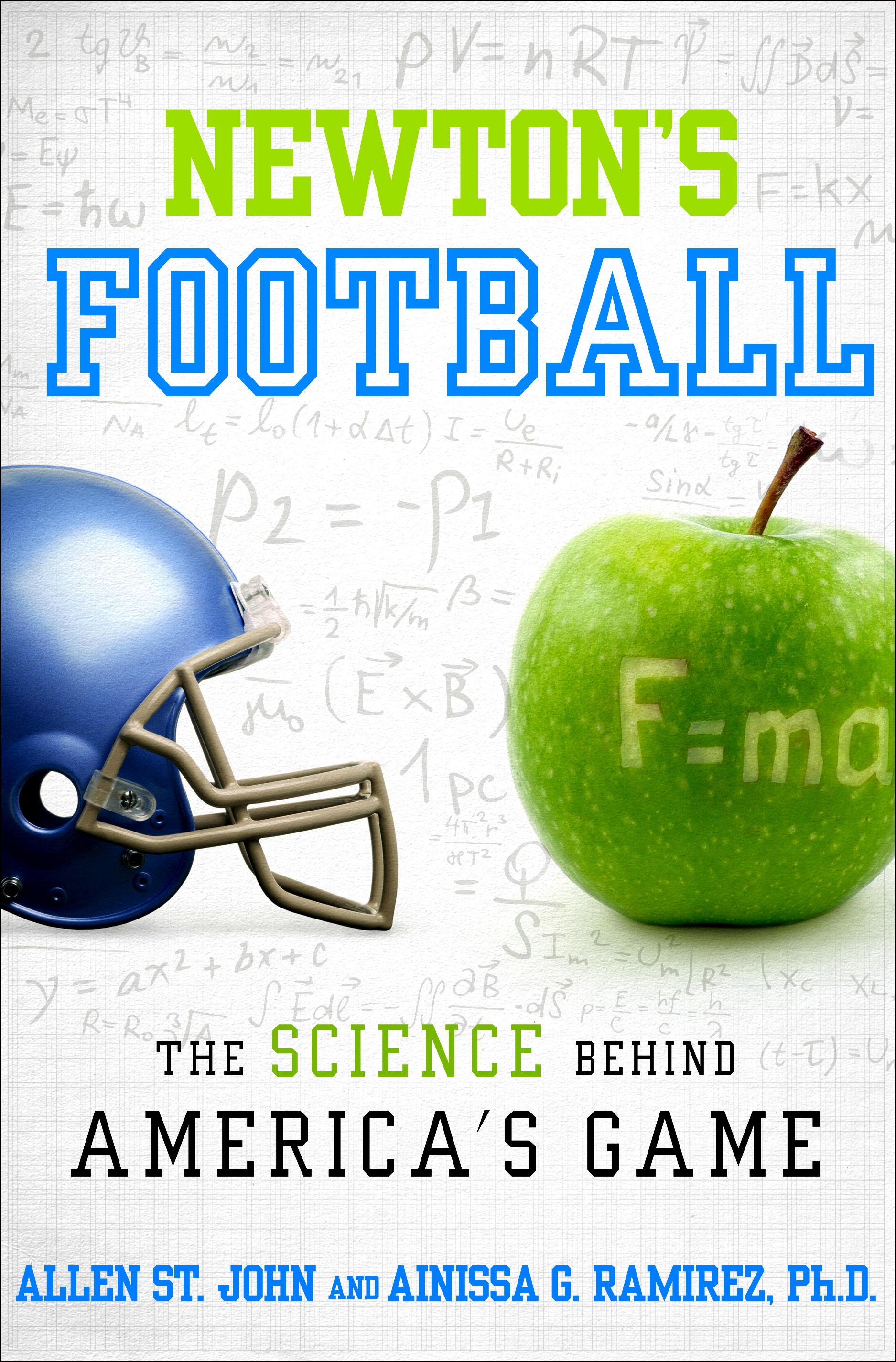
Newton’s Football: The Science Behind America’s Game

Allen St. John and Ainissa G. Ramirez

Here’s a book combining two of my favorite things: science writing and football. Turns Newtons Footballout they go together as naturally (and tastily) as Dorito’s and M&Ms, and like that classic combo, I binged on it until it was all gone. The authors write with passion and knowledge, and in every chapter there was something I didn’t know, either about science or the sport I love.

It begins, fittingly, with an interview with Stephen Wolfram (the theoretical physicist and author of A New Kind of Science), who explains the role chaos theory plays in your team’s game plan. I had always considered the 12th man to be the home crowd, but it turns out to be initial conditions. “Change the initial conditions and the outcomes diverge exponentially,” Wolfram says, leading the authors to extrapolate that “The no-huddle offense was chaos theory at work.”

My new dream is to hear Chris Berman reference initial conditions during a highlight reel.

The ball itself has an interesting history—and a physics all its own. There is no such thing as a tight spiral, for example, since the pigskin (which isn’t really pigskin) requires gyroscopic torque to remain in flight. Knowing that, you might just feel empathy rather than outrage the next time your quarterback lofts a lame duck over the middle.

This book transforms the gridiron into a laboratory. And much like those “Eureka” moments in the lab, serendipity and circumstance had a hand in the game’s innovation, such as the introduction of the West Coast offense and the soccer-style kick. St. John and Ainissa also prove that not all penalties are created equal: The more important stat is not penalty yardage but the breakdown between offensive and defensive infractions.

There is a serious side to Newton’s Football as well. While advances in neuroscience have revealed the extent of football’s brutality, many are wondering if football will exist in another 25 years—and if so, will it be recognizable to today’s fans. The authors explore the current concussion research and uncover some possible solutions.

Along the way, the authors revisit some of the game’s most famous plays and players, and combine physics and football with narrative journalism in one of the easiest and most interesting reads I’ve encountered all year (and that’s no small amount of books). Definitely in my top 10.

Newton’s Football is a must-have for fans of football and/or science. Not everyone is a fan of both, which is all the better because this book offers a chance to expand one’s horizons.

By the final page it will have armchair quarterbacks running statistical analysis and lab rats rubbing elbows at the sports bar. Does it get more interesting than that?

Review: Buddhist Biology

Buddhist Biology

David P. Barash

Forgive me a nostalgia trip to 1994, when alt-jazz rockers Soul Coughing released their Buddhist Biologydebut album Ruby Vroom. The lead track was “Is Chicago, Is Not Chicago,” a hypnotic, oddly existential number allegedly inspired by a bad acid trip in which singer Mike Doughty must distinguish between himself and his surroundings.

It made for a great song, but any biologist will tell you it doesn’t hold up to modern science. Or, for that matter, not-so-modern philosophy.

But Doughty was working toward something significant in that trippy little tune: Where does the “I” end and the “everything else” begin?

It may very well be at the intersection of science and spirituality, according to scientist and self-described Buddhist atheist David P. Barash, author of the brilliant Buddhist Biology.

He admits at the beginning that his goal is an ambitious one: to locate common ground where science and spirituality may coexist. Whereas the Abrahamic religions have long been at odds with science, he argues that Buddhist thought is compatible with high school textbooks.

“Why? Because among the key aspects of Buddhism, we find insistence that knowledge must be gained through personal experience rather than reliance on the authority of sacred texts or the teachings of avowed masters, because its orientation is empirical rather than theoretical, and because it rejects any conception of absolutes.” (18)

That is to say, it allows for the scientific method.

Barash eloquently connects the principles of anatman (not-self), anitya (impermanence) and pratityasamputpada (interdependence) to current biological knowledge. Science has shattered the duality of the actor and the environment, and in doing so has validated thousands of years of Buddhist philosophy.

I am particularly interested in anitya, which leads us into discussions regarding the illusion of time and motion. In considering life as a sequence of moments, Barash distinguishes between the experiencing self and the remembering self (which is similar to Sartre’s Pre-Reflective Cogito, but don’t get me started on my boy Jean-Paul).

The main idea is that each moment is unique and temporary. Nothing lasts, except for in memory, through which we develop a narrative and impose continuity.

Now, I’ll leave the scientific explanations to Barash, as I’m not very qualified to give a proper breakdown, and only slightly more so to discuss eastern philosophy. What I am qualified to provide, though , is a recommendation of Buddhist Biology. Barash takes difficult concepts and presents them in a thoroughly readable and enjoyable narrative. You’ll learn new things, brush up on your philosophy and find it difficult to close this book.

You’ll come away with the realization that there is no distinction between Chicago and Not Chicago, Is and Is Not. There is only this moment.

Or more simply put, There Is.

Review: Best American

The Best American series has designed such a unique identity that I can recognize a volume through the thickest wrapping paper. The symmetry of the books is soothing, Best American Science 2013and they look dynamite aligned on the shelves. A friend recently stared in awe of their arrangement on my bookcase (thanks OCD).

But it’s the content that really makes Best American stand out.

My three favorite editions are the science, essay and mystery writing editions, with lots of love for the sports, short stories and nonrequired reading, but that’s part of what makes the series so successful: everybody has a favorite, but is usually willing to take a gander at the others.

So when I see a Best American beneath the tree, I’m not worried about which one it is. I know I’ll enjoy it no matter what.

Here is a sampling of what you’ll find in this year’s editions:

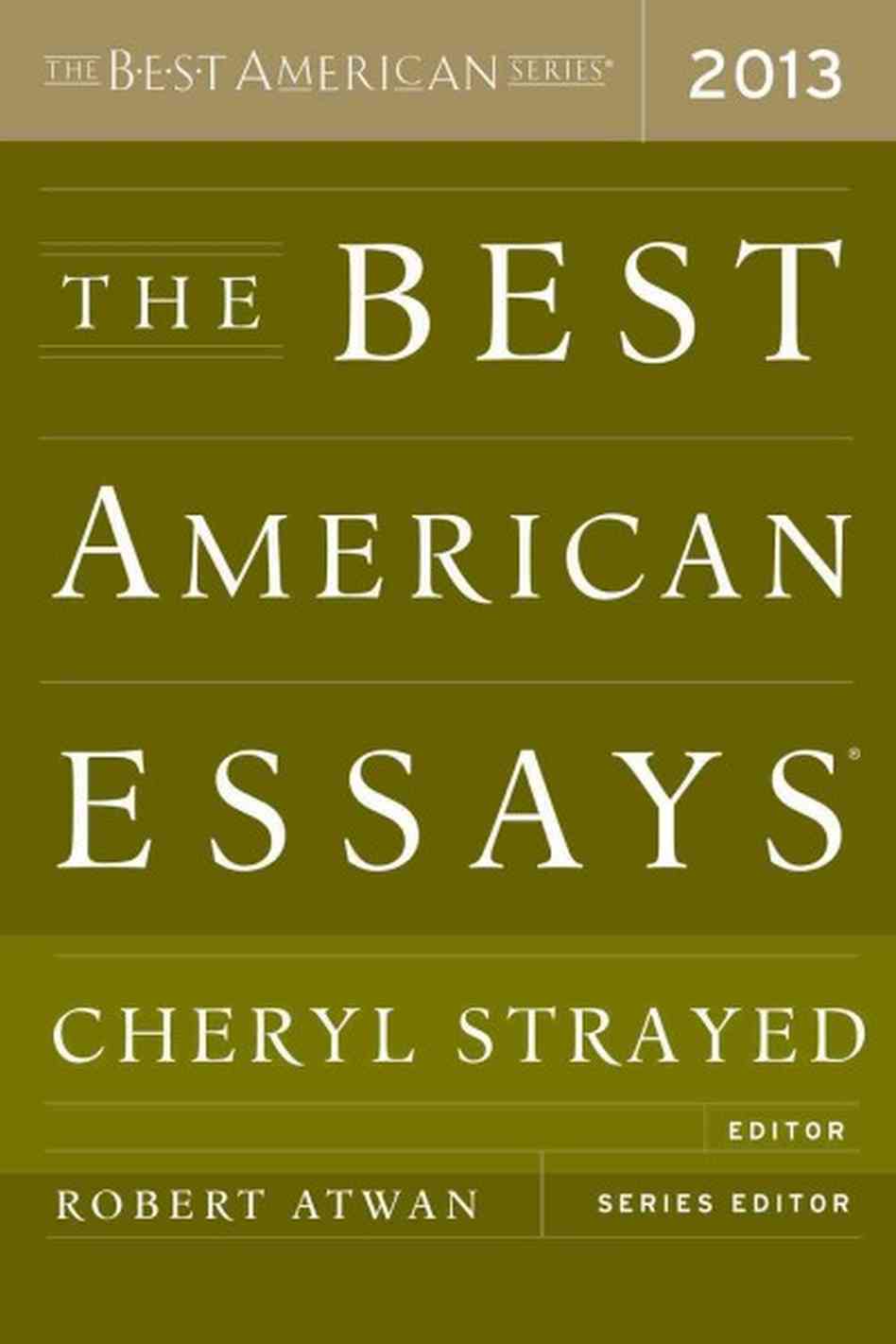
For me, the 2013 headliner is The Best American Science and Nature Writing, edited by Siddhartha Mukherjee (The Emperor of All Maladies). Standouts include Kevin Dutton’s “What Psychopaths Teach Us About How to Succeed,” adapted Best American Essays 2013from his book, The Wisdom of Psychopaths, as well as Oliver Sacks’ “Altered States,” and Gareth Cook’s “Autism Inc.”

The Best American Sports Writing is edited by J.R. Moehringer, whose magazine feature, “Resurrecting the Champ,” inspired a wonderful fictionalization on the big screen. Must-reads include Rick Reilly’s “Special Team,” Paul Solotaroff’s “The NFL’s Secret Drug Problem,” and Erik Malinowski’s “The Making of ‘Homer at the Bat,’ the Episode that Conquered Prime Time 20 Years Ago Tonight.” For top-shelf nonfiction, look no further than The Best American Essays, featuring Zadie Smith, Michelle Mirsky and Alice Munro.

Joyce Carol Oates, Michael Connolly and Hannah Tinti headline The Best American Mystery Stories, while Junot Diaz, George Saunders and Steven Millhauser take the spotlight in The Best American Short Stories. Elizabeth Gilbert guest edits The Best American Travel Writing.

Once again, The Best American Nonrequired Reading slays us with its Best American Comics 2013combination of literati and irreverence. Case in point: there are pieces by Walter Mosley, Sherman Alexie and Kurt Vonnegut, while the “best of” categories include “Best American Poem About a Particle Accelerator,” “Best American Apocryphal Discussion Between Our Nation’s Founding Fathers” and “Best American Comic That Ends in Arson.”

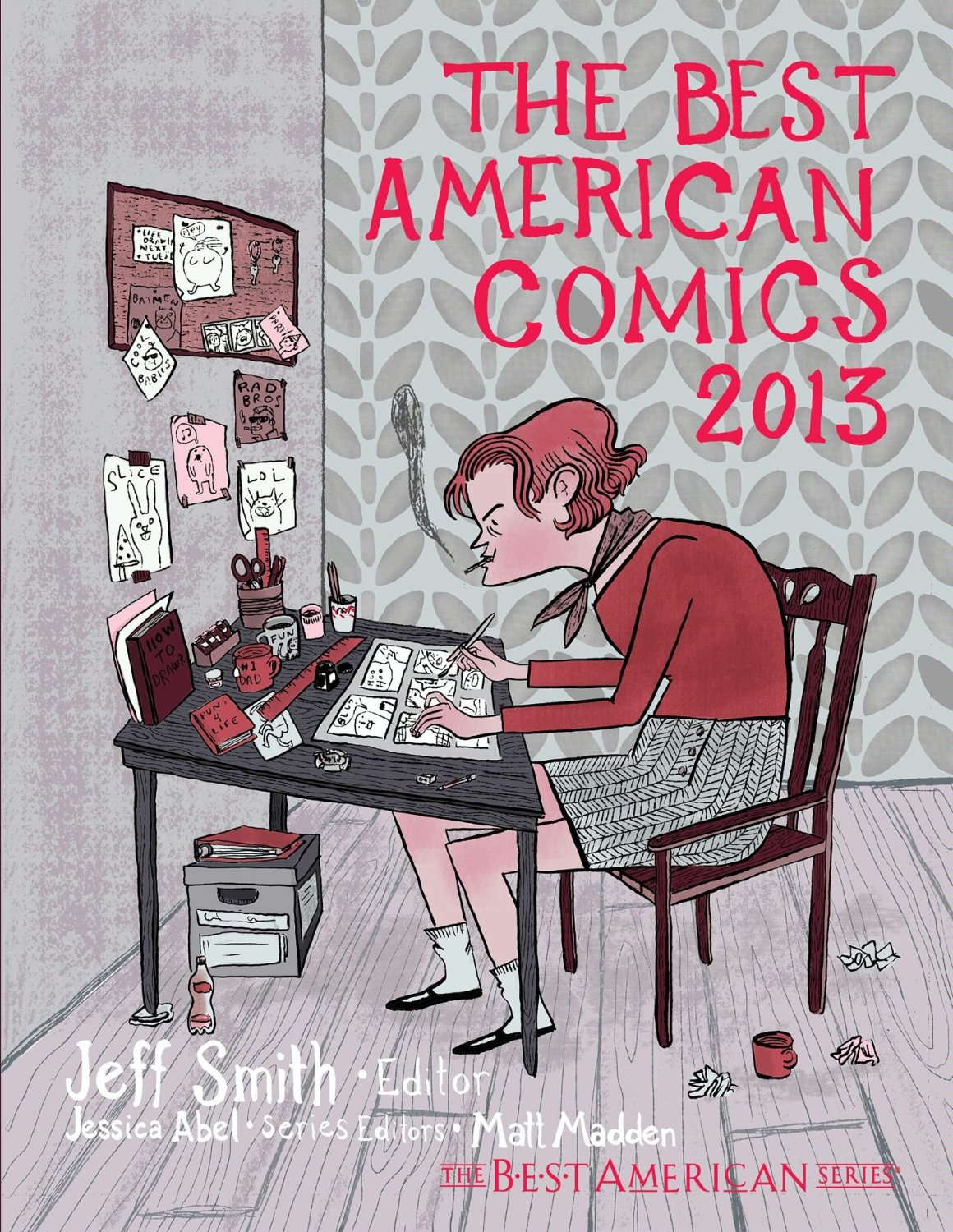
Speaking of comics, one of my favorite new editions is The Best American Comics, featuring fiction and nonfiction art work, from the “funny pages” to graphic novels. There’s now even The Best American Infographics. With an introduction by David Byrne. Go figure.

Review: Language, Cognition, and Human Nature

Language, Cognition, and Human Nature: Selected Articles

Steven Pinker

I love science and science writing, and when people ask me why, I have a simple answer: Because I really don’t get most of it. I have a scientific curiosity and Pinker2mathematical brain, but if it weren’t for the grading curve, I’d still be taking Freshman biology.

I’ll never fully grasp the writings of Richard Dawkins or Stephen Hawking, but I love reading them. They pique my interest, and I always come away learning something. Maybe it’s my fear of becoming cognitively rigid in middle age, but the prospect of a static or shrinking intellect keeps me up at night. I’m well past the point of exploring texts that merely reinforce my current knowledge base.

Which brings us to Steven Pinker and his new collection of articles, Language, Cognition, and Human Nature: Selected Articles.

While pursuing my master’s degree, I wasn’t feeling challenged in my English coursework, so I signed on for a semester of Philosophy of Language. I loved it, but I can still barely understand half of it. I did learn one thing, though: I kick ass at propositional logic, but predicate logic turns my brain to creamed corn.

So I was excited to read this collection, which Pinker prefaces with a curious introduction concerning general interest science writing. He talks of the popularity of scientists who are able to write for a popular audience (and science writers who can serve as a go-between), but argues that we’re underestimating readers with this approach. Rather than spoon-feeding the masses distilled information, Pinker provides us with the source material: his actual academic articles.

This is not light reading, and be warned it is challenging.

But it is enjoyable and enlightening. If you haven’t tried to wrap your mind around language theory, you need to read this book. Even if you don’t understand half of it, what information you glean will radically affect your relationship with language and the mind.

If nothing else, it’s a head trip—no lab coat required.

Review: Abominable Science

If you were like me growing up, you had a stack of Weekly Reader books about the spooky and the supernatural at your bedside. These were the source of maAbominable_Science_cover-576px-300x450ny restless nights for me, in particular books on Bigfoot and the Loch Ness Monster. My friend Todd still speaks with reverence about the Bigfoot episode of In Search Of… with Leonard Nimoy.

We are the ideal audience for Abominable Science, co-authored by a scientist and a writer who was obsessed with the mythology of cryptids (a fancy term for a creature of legend whose existence has not been documented).

The nuts and bolts of the book are simple, yet genius. The authors examine the cases of legendary cryptids (Bigfoot, Nessy, the Yeti) and consider the scientific evidence, essentially disproving, or at least discrediting, their existence.

The first part of this equation is great fun. The second part is like when the mean kids first tell you there is no Santa Claus.

In other words, buzz kill.

The authors devote too much space to debunking the “evidence” of cryptids. Look, we know they’re not real. What makes these creatures so interesting is not whether or not they exist, but rather in the mysteries and folklore that surround them. If Bigfoot did exist, he would no longer be a mystery. He’d be a zoo exhibit. While it is important to show where the science doesn’t add up, the debunking feels a bit like a deposition at times, which isn’t nearly as much fun. (Just ask Paula Deen.)

The other issue I have with Abominable Science is redundancy. The book is divided into sections addressing each of the cryptids individually. Unfortunately, the commonalities between the cases make parts of the narrative redundant.

The result is diminishing returns.

The Bigfoot section is riveting. The Loch Ness section is interesting and very well written, but replace an American forest with a Scottish lake and you’ve got more or less the same storyline. By the third section, we know what to expect: unreliable eyewitness accounts, grainy photographs, unidentified footprints, overactive imaginations and outright deceptions, etc.

So, the book might have been arranged so that it addressed the similarities between the legends at once rather than divided by cryptid.

I also wish the authors had a bit more fun with it. The narrative is playful at times, but the hyperactive debunking misses the point that these legends are, more than anything, fun. Look, we know professional wrestling isn’t true competition along the lines of football or baseball, but its appeal lies not in its verisimilitude, but rather in the storytelling, the characters and the spectacle itself.

Otherwise, wouldn’t WWE have implemented instant replay a long time ago? (Even Bud Selig would have the sense to review and overturn illegal tags and errant three counts.) They would also probably do something about those metal folding chairs that always seem to find their way into the ring.

But perhaps I doth protest too much. At its heart, Abominable Science is not intended to be a buzz kill. It is an enjoyable read that will have you laughing out loud at times—and you might even learn a little science along the way.

So, if you’re the type that can’t pass up a Bigfoot or ghost hunting special on cable television, you will love this book. And though it will confirm that the cryptids in question don’t exist, it won’t stop us from tuning in. If anything, it reinforces the universality of creature mythology and our attraction to fantasy and mystery. (Earlier this year, Syfy debuted its new show, Joe Rogan Questions Everything, with a
full hour devoted to hunting Bigfoot.)

We will always be obsessed with the unknown. We will be happily drawn into those blurry shadows of the natural world. I’m happy to report that we will always remain… In search of…