philosophy

Review: Divine Fury

Divine Fury

Darrin M. McMahon

Since 1981, the MacArthur Foundation has bestowed its “genius grant” on 873 Divine Fury(ostensibly) geniuses—“talented individuals who have shown extraordinary originality and dedication in their creative pursuits and a marked capacity for self-direction,” reads the MacArthur Web site.
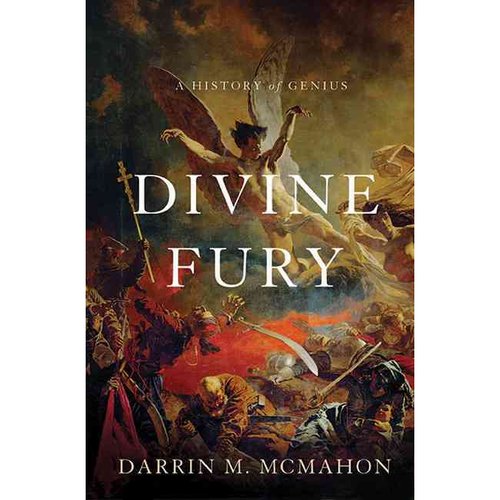
But is this the truest definition of “genius”? Considering that the title is so commonly conferred upon basketball coaches, celebrities and rock stars (a recent Rolling Stone article referred to Kanye West as a “mad genius”—seriously), is being a “genius” even that impressive anymore?

In Divine Fury, historian Darrin M. McMahon isn’t questioning MENSA credentials so much as tracing the history of this loaded term and how it’s changed over the centuries.

Our etymological quest begins with the ancient Greeks, for whom being a genius was a form of madness. McMahon culls pithy quotes from Plato revealing a lesser-known side of Socrates: He was quite haunted. (This from the Phaedrus dialogues—no wonder the brilliant 20th century philosopher/madman Robert Pirsig chose Phaedrus as his alter ego in Zen and the Art of Motorcycle Maintenance.)

Whereas contemporary culture views genius as something you possess, ancient philosophers believed the inverse: Genius possesses you. More specifically, a demon possesses you, for good and ill, and this was the belief for centuries. McMahon documents many cases of “genius,” from the ancients to modern times, and how the concept evolved and then devolved into our current celebrity-obsessed culture.

It’s a curious evolution, and one I wouldn’t have thought about much before reading Divine Fury. McMahon deftly illuminates this secret and complicated history through literary accounts, keen observation and a strong narrative. His writing can be a bit tangential and academic at times—but hey, the man’s an academic! What do you expect?

I certainly wasn’t expecting to think about genius as a populist concept, but there it is. In some ways, the history of genius is the flow of agency from the elite to the proletariat. While I would rate that as a good thing, an unfortunate consequence is that genius has become just another noun that anyone can claim.

The change is due in part to advanced medical knowledge. In ancient Greece, Socrates believed a demon was whispering in his ear. Today, we’d slip him some Paxil.

Or give him his own TED talk.

Ultimately, it remains a fuzzy line between madness and genius. Is it the possessed or the possessor? Are 98th percentile test-scorers (the threshold for MENSA membership) the elite or merely outliers? Or is each of us capable of becoming an Einstein?

No matter, from now on I’ll be slower to label someone a genius.

Unless that “mad genius” Kanye West splits the atom in his next video.

Trending Now: Trollies

 Thomas Cathcart

The Trolley Problem, or Would You Throw the Fat Guy off the Bridge?: A Philosophical Conundrum

David Edmonds

Would You Kill the Fat man?: The Trolley Problem and What Your Answer Tells Us about Right and Wrong

Not since Rice-a-Roni has the trolley car been so popular.

What started as a philosophical thought experiment (first posed in the 1960s by Trolley ProblemBritish philosopher Philippa Foot) has become fodder for barroom chautauquas and classroom debates. It goes a little something like this: You are the conductor of a runaway trolley, and you’re headed toward five men working on the track. You have no way to stop or slow down, and you know that all five men will die.

Then, you notice a side track, and by simply pulling a switch, you’ll reroute the trolley and spare the workers. However, you see another man on this side track. The worker will surely die, but this lone death will save five.

Do you pull the switch?

What makes the trolley problem so interesting is that it can be reframed in many ways, all essentially asking the same question: Is it better that one person dies in order to save five lives?

The utilitarian gut response is usually affirmative, but the problem gets trickier as you introduce different scenarios. The darkest and most humorous of these is the fat guy on the bridge. Rather than the conductor, you and an obese stranger are on an overpass looking down at the track. In this scenario, there is no side track and no way to reroute the train away from the workers. The only way to spare their lives is to stop the trolley… and the only way to do that is by pushing the obese man off the bridge.

That’s quite the game-changer. But yet, the principle question remains the same: Is it better that one dies to save five?

This dilemma has moved from the classroom to cultural conscience thanks to the work of philosopher Michael J. Sandel and his book/mooc/PBS lectures on justice. This fall, two more intellectual titans offer their take on this ethical dilemma.

In The Trolley Problem, or Would You Push the Fat Guy off the Bridge?: A Philosophical Conundrum, published Sept. 10, Thomas Cathcart presents the arguments before a judge and jury, albeit fictitious. Cathcart is best known for a series of books coauthored with Daniel Klein that explains complicated philosophical ideas through jokes and anecdotes, and as with these bestsellers, like Plato and a Platypus Walk Into a Bar…, the tone is light and irreverent.

Though the jests overshadow the ethics, there is some substance to the work. Ethical arguments are accompanied by short bios of their progenitors, and the introduction and conclusion put forth serious thought.

That said, the jokes amount to insider baseball. The greatness of Cathcart’s other books is that they serve a general audience. The humor in The Trolley Problem, or Would You Push the Fat Guy off the Bridge? is geared toward a readership already familiar with the thought experiment.

Those familiar with the work of Sandel and Foot will enjoy this short, light-hearted laugher. Those looking to explore the complexities of the dilemma should look elsewhere, get up to speed, and then dig into this trial by philosophy.

At least Cathcart gives us something the others don’t (sort of): a juried decision. The final verdict?

You’ll just have to read it for yourself.

The trolley debate gets a deeper look on Oct. 6, with David EdmondsWould You Kill the Fat man?: The Trolley Problem and What Your Answer Tells Us about Right and Wrong.

Edmonds is co-host of one of my favorite podcasts, Philosophy Bites, which has spawned two books and Trolley Problem Edmondsbrought contemporary and historical philosophical concepts to a general audience.

His treatment of the trolley problem traces the history of moral philosophy and modern ethics with the entertaining flair he brings to Philosophy Bites.

Though covering the same topic, these two books offer complementary takes on this complicated thought experiment. Fans of philosophy, moral inquiries or deep thinking in general will enjoy both of these fine book.

Review, On Dissent: Its Meaning in America

On DissentNot many books from Cambridge University Press make it to the summer reading list, but On Dissent: Its Meaning in America is one of the better ways to revolt against the light-hearted beach-readers out there. Hell, it’s patriotic. America was born in dissent, and we celebrate it still. With fireworks—even illegal ones (though from now on I argue that M-80s are not outlaws, but rather the tools of dissent).

But why is dissent so much of our DNA? What does it even mean to dissent? These were the questions nagging at Ronald K.L. Collins and David M. Skover, two esteemed political scholars who were surprised to find that there was no true analysis of the concept of dissent.

That’s what they set out to create with this short, thought-provoking work.

For the most part, Collins and Skover accomplish their goal. The tone is philosophical in nature, and the authors begin by attempting to define dissent and identify its practitioners. Sure, anyone can point to the examples of Thoreau, King and Paine, but the authors take on trickier issues, such as how clear the line is (or isn’t) between civil disobedience and criminality. What role does violence play in dissent, or does an action cease to be dissent once it becomes violent?

Collins and Skover do a great job, and scholarly service, by identifying the fundamental traits of dissent, such as its being goal-oriented and indicative of a power dynamic. They buttress their definition by exploring hypotheticals and philosophical dilemmas (is a hired protester a dissenter?), and they do it all with an accessible writing style that will appeal to non-academic readers who might not otherwise seek out this book.

Of course, it’s not perfect, and the biggest issue I have is with the authors’ overreliance on expert commentary, such as that of Howard Zinn and Ralph Nader. The quotations are often redundant and unnecessary. The collective intellect of Collins and Skover is authoritative enough, and I recommend skimming through the offset commentary.

But there’s nothing else I would skim over in this book—particularly the epilogue. Here, the authors move away from definitions and thought experiments and present their own take on dissent—that contrary to rebellion, dissent is a vital and cohesive component of a democracy:

“Consent and dissent are two sides of the same coin. Without dissent, consent is meaningless; without consent, dissent loses much of its animating purpose” (152).

On Dissent is a quick and wonderful read. It will get you thinking. It will get you talking. It will remind you that though we may disagree, the freedom to disagree and express opposing viewpoints is what makes us strong.

The End of Righteousness

OK, the title of this book review is admittedly ambitious, but now that the election has finished, perhaps we can all sheath our knives for a week or so–and stop screaming long enough to breathe.

Or better yet, to read a good book.

To nurse that campaign hangover, I recommend moral psychologist Jonathan Haidt‘s new book, The Righteous Mind: Why Good People Are Divided by Politics and Religion. I read this over the summer, and I think it should be required reading for anyone running for office. And it’s the perfect antidote for any residual post-electoral rage.

Haidt begins with a simple, yet quite genius premise. He looked around at his countrymen, divided by a vicious culture war, and discovered more commonalities than differences. For all our diversity, American culture is quite homogenous. (No surprise: “Melting pots” are designed to synthesize many ingredients into a unified whole, not keep them separated.)

We have common experiences, languages, and yes, values. No matter what the campaign ads say, is there anyone on either side that doesn’t want the economy to improve, for their family to be safe from attack, to have excellent health care and receive a good education?

There are philosophical differences on how to achieve these goals, true, but when it comes down to it, all any sane person wants is to be happy, to provide for their loved ones and live a good life.

So why all the vitriol? How can a society with such common goals claw at each others’ eyes with such entitlement? How can we so easily demonize and dismiss someone who disagrees with us?

Well, it’s complicated, to be sure. But Haidt sifts through scientific research, anthropological findings and the evolution of intellectual thought to divine some underlying truths. One of the biggest is the notion that intuition guides our beliefs more than reason. This is why logical arguments are often ineffectual against deep-rooted beliefs–why discussions become debates, and debates devolve into bumper-sticker slogan shouting.

“…don’t take people’s moral arguments at face value. They’re mostly post hoc constructions made up on the fly, crafted to advance one or more strategic objectives.”

In other words, it is not evidence that shapes our worldview. We are naturally and subconsciously drawn to evidence that confirms are worldview. We intuit our morality first and support it with arguments later. That’s why it’s so easy to become entrenched in our beliefs and intolerant of opposing viewpoints.

The Righteous Mind does skew toward the academic, and can be challenging at times. But hey, nobody said bipartisanship was easy! Once you’ve grasped the science and moral theory, you’ll have a better grasp of Haidt’s conclusion.

And this is where the author truly shines.

“Part III: Morality Binds and Blinds” synthesizes all that came before and presents an insightful view of human beliefs and behaviors. How would conservatives fare without liberals? Liberals without conservatives? Haidt makes a compelling case that each would fail without the other. This book is worth it for this section alone.

Here, Haidt summons the great utilitarian thinker John Stuart Mill and his take on both sides of the aisle. “A party of order or stability, and a party of progress or reform, are both necessary elements of a healthy state of political life.”

Perhaps after reading this book, we’ll treat one another with a little more respect and a little less righteousness.