nonfiction

Review: Skull in the Ashes

Skull in the Ashes: Murder, a Gold Rush Manhunt, and the Birth of Circumstantial Evidence in America

by Peter Kaufman

University presses aren’t usually known for producing pot-boiling thrillers, but that’s Skull in the Asheswhat the University of Iowa Press has done with Skull in the Ashes. In 1897, the quiet eastern Iowa town of Walford was awoken by a fire at the general store. When the flame had died, they discovered a charred corpse with some belongings of the store’s owner, Frank Novak, who often slept there.

The timing was curious as Novak, heavily in debt, had recently purchased multiple life insurance policies.

Oh yeah, and the skull they found in the ashes had been bashed in, which is atypical behavior for your run-of-the-mill house fire.

Here, the lives of three men intertwine: Novak; M.J. Tobin, the new county attorney; and Red Perrin, a near-superhero whom we’ll discuss later.

There may have been a time when folks wouldn’t have asked too many questions about the fire, odd though it was, but Tobin utilized emerging forensic tools—such as dental records—to identify the corpse as someone other than Novak. Tobin’s quest crossed multiple state lines and even involved the famed Pinkerton National Detective Agency. But the trail went cold in the Pacific Northwest.

Enter Red Perrin.

Perrin was a detective in Arizona who had a reputation for tenacity and toughness. He was the only one trusted to venture into the Yukon and return Novak alive.

The amount of research that went into this book is evident. Kaufman worked his butt off on this book, and he does a good job of balancing information with narrative. Where he is strongest, though, is following Perrin—which, ironically, was probably the toughest to recreate. The trek through the mining territory is difficult. Perrin hires a team, hikes for days through the mountains and brings along with him a boat builder.

That’s right, a boat builder.

On the other side of the mountain pass was a treacherous waterway, which Perrin would need to traverse to get up to the mining camp where he suspected Novak was living under an assumed name. But they couldn’t carry a boat through the mountains, so once completing that leg of the journey, Perrin and his partner chopped down trees and built a craft sturdy enough for the rapids.

That’s pretty bad ass.

Skull in the Ashes is divided into three parts, and this is by far my favorite. Part one is the story of Novak and Tobin; the town of Walford; and the crime and initial investigation. It’s a bit like a murder-mystery, although we already know whodunit. The narrative here is about history and evidence, and I really enjoyed this section.

Part two is an adventure tale. Kaufman creates lavish scenery, strong characters, high tension and the thrill of a pulp wilderness expedition. I think of it as Thoreau’s The Maine Woods meets The Fugitive. The plotting is well-paced, and Kaufman rightly pulls back on the history and lets the action take center stage.

Which brings us to part three: the aftermath. Unfortunately, this is where Kaufman runs out of bullets. It’s not his doing, but simply the climax of the story. The final part covers Novak’s trial and incarceration and ties up the storylines of all involved. As with the other sections, it is well-researched and –written, but we spend too much time on the trial.

I did enjoy the sociological aspects of the book’s conclusion. Kaufman describes prison life at the time and reforms that were making it more humane. There is also the importance of the Novak trial for its use of forensics and circumstantial evidence. Kaufman clearly describes a time of transition in American history: the advance of science, the sophistication of law enforcement, and the expansion and opening of the world, such that a local crime committed in small-town Iowa would involve the federal government, multiple states, two countries and a wilderness chase.

And so Iowa, and America, looked ahead to the 20th century.

To sum up, Skull in the Ashes is a thrill ride for history buffs and fans of narrative nonfiction and an unexpected, and delightful, blend of pulp and scholarship.
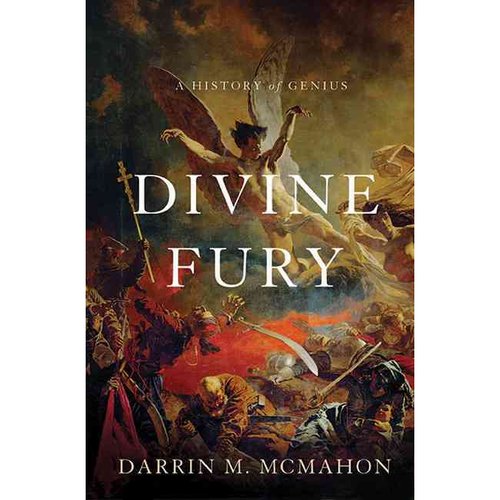
Review: Divine Fury

Divine Fury

Darrin M. McMahon

Since 1981, the MacArthur Foundation has bestowed its “genius grant” on 873 Divine Fury(ostensibly) geniuses—“talented individuals who have shown extraordinary originality and dedication in their creative pursuits and a marked capacity for self-direction,” reads the MacArthur Web site.

But is this the truest definition of “genius”? Considering that the title is so commonly conferred upon basketball coaches, celebrities and rock stars (a recent Rolling Stone article referred to Kanye West as a “mad genius”—seriously), is being a “genius” even that impressive anymore?

In Divine Fury, historian Darrin M. McMahon isn’t questioning MENSA credentials so much as tracing the history of this loaded term and how it’s changed over the centuries.

Our etymological quest begins with the ancient Greeks, for whom being a genius was a form of madness. McMahon culls pithy quotes from Plato revealing a lesser-known side of Socrates: He was quite haunted. (This from the Phaedrus dialogues—no wonder the brilliant 20th century philosopher/madman Robert Pirsig chose Phaedrus as his alter ego in Zen and the Art of Motorcycle Maintenance.)

Whereas contemporary culture views genius as something you possess, ancient philosophers believed the inverse: Genius possesses you. More specifically, a demon possesses you, for good and ill, and this was the belief for centuries. McMahon documents many cases of “genius,” from the ancients to modern times, and how the concept evolved and then devolved into our current celebrity-obsessed culture.

It’s a curious evolution, and one I wouldn’t have thought about much before reading Divine Fury. McMahon deftly illuminates this secret and complicated history through literary accounts, keen observation and a strong narrative. His writing can be a bit tangential and academic at times—but hey, the man’s an academic! What do you expect?

I certainly wasn’t expecting to think about genius as a populist concept, but there it is. In some ways, the history of genius is the flow of agency from the elite to the proletariat. While I would rate that as a good thing, an unfortunate consequence is that genius has become just another noun that anyone can claim.

The change is due in part to advanced medical knowledge. In ancient Greece, Socrates believed a demon was whispering in his ear. Today, we’d slip him some Paxil.

Or give him his own TED talk.

Ultimately, it remains a fuzzy line between madness and genius. Is it the possessed or the possessor? Are 98th percentile test-scorers (the threshold for MENSA membership) the elite or merely outliers? Or is each of us capable of becoming an Einstein?

No matter, from now on I’ll be slower to label someone a genius.

Unless that “mad genius” Kanye West splits the atom in his next video.

Trending Now: Trollies

 Thomas Cathcart

The Trolley Problem, or Would You Throw the Fat Guy off the Bridge?: A Philosophical Conundrum

David Edmonds

Would You Kill the Fat man?: The Trolley Problem and What Your Answer Tells Us about Right and Wrong

Not since Rice-a-Roni has the trolley car been so popular.

What started as a philosophical thought experiment (first posed in the 1960s by Trolley ProblemBritish philosopher Philippa Foot) has become fodder for barroom chautauquas and classroom debates. It goes a little something like this: You are the conductor of a runaway trolley, and you’re headed toward five men working on the track. You have no way to stop or slow down, and you know that all five men will die.

Then, you notice a side track, and by simply pulling a switch, you’ll reroute the trolley and spare the workers. However, you see another man on this side track. The worker will surely die, but this lone death will save five.

Do you pull the switch?

What makes the trolley problem so interesting is that it can be reframed in many ways, all essentially asking the same question: Is it better that one person dies in order to save five lives?

The utilitarian gut response is usually affirmative, but the problem gets trickier as you introduce different scenarios. The darkest and most humorous of these is the fat guy on the bridge. Rather than the conductor, you and an obese stranger are on an overpass looking down at the track. In this scenario, there is no side track and no way to reroute the train away from the workers. The only way to spare their lives is to stop the trolley… and the only way to do that is by pushing the obese man off the bridge.

That’s quite the game-changer. But yet, the principle question remains the same: Is it better that one dies to save five?

This dilemma has moved from the classroom to cultural conscience thanks to the work of philosopher Michael J. Sandel and his book/mooc/PBS lectures on justice. This fall, two more intellectual titans offer their take on this ethical dilemma.

In The Trolley Problem, or Would You Push the Fat Guy off the Bridge?: A Philosophical Conundrum, published Sept. 10, Thomas Cathcart presents the arguments before a judge and jury, albeit fictitious. Cathcart is best known for a series of books coauthored with Daniel Klein that explains complicated philosophical ideas through jokes and anecdotes, and as with these bestsellers, like Plato and a Platypus Walk Into a Bar…, the tone is light and irreverent.

Though the jests overshadow the ethics, there is some substance to the work. Ethical arguments are accompanied by short bios of their progenitors, and the introduction and conclusion put forth serious thought.

That said, the jokes amount to insider baseball. The greatness of Cathcart’s other books is that they serve a general audience. The humor in The Trolley Problem, or Would You Push the Fat Guy off the Bridge? is geared toward a readership already familiar with the thought experiment.

Those familiar with the work of Sandel and Foot will enjoy this short, light-hearted laugher. Those looking to explore the complexities of the dilemma should look elsewhere, get up to speed, and then dig into this trial by philosophy.

At least Cathcart gives us something the others don’t (sort of): a juried decision. The final verdict?

You’ll just have to read it for yourself.

The trolley debate gets a deeper look on Oct. 6, with David EdmondsWould You Kill the Fat man?: The Trolley Problem and What Your Answer Tells Us about Right and Wrong.

Edmonds is co-host of one of my favorite podcasts, Philosophy Bites, which has spawned two books and Trolley Problem Edmondsbrought contemporary and historical philosophical concepts to a general audience.

His treatment of the trolley problem traces the history of moral philosophy and modern ethics with the entertaining flair he brings to Philosophy Bites.

Though covering the same topic, these two books offer complementary takes on this complicated thought experiment. Fans of philosophy, moral inquiries or deep thinking in general will enjoy both of these fine book.

Review: Of Dice and Men

D&D is a cultural phenomenon that has lasted decades, survived the sophistication of video games and artificial intelligence, rival RPGs and even the Satanic Panic. It’s goneDice and Men from nerd pastime to geek chic to sociological interest, and now its history has been documented in the wonderful Of Dice and Men: The Story of Dungeons & Dragons and the People Who Play It, a nostalgic romp through the author’s (and my) childhood.

Ewalt, a senior editor at Forbes and self-described “writer, gamer, geek,” has done a great service to anyone who, with sweaty palms, has had to make a campaign-defining saving throw (or at least knows what that means). His smooth writing style and flair for narrative pacing makes the story of this greatest of games one of general interest, even if you’ve never tossed the 20-sided die.

There are two key threads running through the book. The first, of course, is the history of D&D, from its precursors through its growing pains, its competitors and controversies, and finally its legacy as second- and third-generation dungeon crawlers have been drawn to the table. The second thread is Ewalt’s personal tale of rekindling his love for D&D in adulthood.

While both storylines are interesting, the content of the historical narrative is a bit more compelling, particularly due to the big personality of its founder, Gary Gygax. But the personal narrative is most affecting because it traces a familiar thread: Imaginative loner boy discovers D&D; becomes hooked; discovers women; hangs up the broad sword and chainmail; rediscovers D&D; realizes you can take the halfling out of the dungeon, but you can’t take the dungeon out of the halfling.

Ewalt and I have a lot in common.

The book has been described as being similar to Michael Lewis’ Moneyball, but I disagree with that description. Economics are addressed, but this book is truly about passion, not money. Which is fitting. At the end of every D&D campaign comes the distribution of treasure that the group has acquired, but this is not the reason for playing. The true reward is the quest to find and slay the dragon guarding that treasure.

The only downside to the book is the fantasy sequences in which Ewalt recounts fictional events from his weekly campaigns. Unfortunately, these feel forced and, for me at least, didn’t really add much to the narrative. I feel comfortable in critiquing this element of the book as I have done this myself.

But aside from that, this is an amazing book, a perfect summer read and hopefully the first of many books from Ewalt.

Douglas Murray, Islamophilia

I must confess: About a third of the way through Douglas Murray’s Islamophilia, I tossed it onto the discard pile. (islamophiliaOK, not really, since I was reading it on my Nook.) But before I abandoned this book, my conscience got the better of me. I re-launched the file and read to the end.

I am very glad I did.

If I were to blurb Islamophilia, I would say, “Douglas Murray has provided us with a document that is challenging, bitter, distasteful, and difficult to digest. And it may well be one of the most important books of the past few years.” (Hey Mr. Murray, don’t forget me when the print edition goes to press.)

In this short book (more of an extended essay), Murray vents over post-9/11 media treatment of Islam, which he considers to be inconsistent with treatment of other religions. For Murray, Islam is like an update on the Seinfeld episode when a reporter thought Jerry and George were a couple, prompting qualified denials (“not that there’s anything wrong with that”).

Unfortunately, this is not a book with a strong sense of humor, and it reads more like a polemic than an essay. In the early pages, Murray’s anger overshadows his argument. For example, Murray expends much energy going after the 1001 Inventions multimedia education project, which spotlights Muslim contributions to science and technology. He argues that the exhibit crosses over into historical revisionism, and perhaps he’s right. I’ve never seen the exhibit myself, but he’s not the first person to make this critique. But regardless of the factual accuracy, his mocking tone is more befitting a late-night drunk dialogue.

Here is where I shut it down.

I intentionally avoid politics in this column, particularly because I believe—excepting the extremely polarized rants on the nonfiction bestseller list—that literature is one of the few uniting or at least neutral spaces remaining. (I would say animals and football are the others. Folks love their dogs no matter where they stand on universal health care.)

But due to the subject of this book, I feel some disclosure is appropriate. I am a liberal, yet what drew me to this book is that I agree with Murray, a neoconservative. It’s an area of contention with my liberal friends, who apply inconsistent standards toward Islam. Were the Catholic church to require women to wear hijabs and be accompanied by men in public, it would be denounced as part of the church’s war on women. But when mandated by Islam, it’s dismissed as a cultural difference.

I’m not asking my liberal counterparts to feel one way or another about these religions, but as a matter of intellectual integrity, I do expect them to be consistent.

So, I was drawn to the thesis of this book, but turned off by the tone. What made me pick it back up?

Cartoons.

When it comes to Islam and art, there are three events that are indefensible: the fatwa against Salman Rushdie (for writing a novel); the brutal assassination and near-decapitation of Theo Van Gough (because of an 11-minute film); and the more than 200 people who have been killed in response to Danish cartoons.

And then there was the censorship of the animated show South Park and the death threats aimed at the show’s creators. Murray writes:

“This, however, is the new normal. Cartoons are censored. Any possible offence to Muslims is averted by series and broadcast networks that routinely and enjoyably satirise everything else under the sun, including all other religions.”

Here, Murray hits his stride. He addresses the violent backlash against artists and how it has led to pre-emptive self-censorship. For example, The Jewel of Medina, a book Random House dropped for fear of attack—a merited fear as weeks later a book publisher in Britain was fire-bombed for agreeing to release the book (which Murray says has still not been released in Britain).

What’s happening now, he argues, is self-censorship for fear of reprisal. Something absent following critiques of other faiths:

“Artists and writers have been caught off-guard. Having poked at empty hornets’ nests for so many years they have forgotten the courage required to do the necessary poking at full ones.”

Murray then sounds the call for bravery and the courage to support artistic freedom. He closes with some of the book’s most thoughtful passages and proposes solutions to overcoming both phobias and philias.

It is this last part that really elevates Murray’s argument, and makes me glad I stuck with the book.

Like I said, this is a difficult read, but an important one. I often disagree with Murray, and at times he made me cringe, but in the end, his argument is thorough and thoughtful and worthy of consideration.

Review: Abominable Science

If you were like me growing up, you had a stack of Weekly Reader books about the spooky and the supernatural at your bedside. These were the source of maAbominable_Science_cover-576px-300x450ny restless nights for me, in particular books on Bigfoot and the Loch Ness Monster. My friend Todd still speaks with reverence about the Bigfoot episode of In Search Of… with Leonard Nimoy.

We are the ideal audience for Abominable Science, co-authored by a scientist and a writer who was obsessed with the mythology of cryptids (a fancy term for a creature of legend whose existence has not been documented).

The nuts and bolts of the book are simple, yet genius. The authors examine the cases of legendary cryptids (Bigfoot, Nessy, the Yeti) and consider the scientific evidence, essentially disproving, or at least discrediting, their existence.

The first part of this equation is great fun. The second part is like when the mean kids first tell you there is no Santa Claus.

In other words, buzz kill.

The authors devote too much space to debunking the “evidence” of cryptids. Look, we know they’re not real. What makes these creatures so interesting is not whether or not they exist, but rather in the mysteries and folklore that surround them. If Bigfoot did exist, he would no longer be a mystery. He’d be a zoo exhibit. While it is important to show where the science doesn’t add up, the debunking feels a bit like a deposition at times, which isn’t nearly as much fun. (Just ask Paula Deen.)

The other issue I have with Abominable Science is redundancy. The book is divided into sections addressing each of the cryptids individually. Unfortunately, the commonalities between the cases make parts of the narrative redundant.

The result is diminishing returns.

The Bigfoot section is riveting. The Loch Ness section is interesting and very well written, but replace an American forest with a Scottish lake and you’ve got more or less the same storyline. By the third section, we know what to expect: unreliable eyewitness accounts, grainy photographs, unidentified footprints, overactive imaginations and outright deceptions, etc.

So, the book might have been arranged so that it addressed the similarities between the legends at once rather than divided by cryptid.

I also wish the authors had a bit more fun with it. The narrative is playful at times, but the hyperactive debunking misses the point that these legends are, more than anything, fun. Look, we know professional wrestling isn’t true competition along the lines of football or baseball, but its appeal lies not in its verisimilitude, but rather in the storytelling, the characters and the spectacle itself.

Otherwise, wouldn’t WWE have implemented instant replay a long time ago? (Even Bud Selig would have the sense to review and overturn illegal tags and errant three counts.) They would also probably do something about those metal folding chairs that always seem to find their way into the ring.

But perhaps I doth protest too much. At its heart, Abominable Science is not intended to be a buzz kill. It is an enjoyable read that will have you laughing out loud at times—and you might even learn a little science along the way.

So, if you’re the type that can’t pass up a Bigfoot or ghost hunting special on cable television, you will love this book. And though it will confirm that the cryptids in question don’t exist, it won’t stop us from tuning in. If anything, it reinforces the universality of creature mythology and our attraction to fantasy and mystery. (Earlier this year, Syfy debuted its new show, Joe Rogan Questions Everything, with a
full hour devoted to hunting Bigfoot.)

We will always be obsessed with the unknown. We will be happily drawn into those blurry shadows of the natural world. I’m happy to report that we will always remain… In search of…

Review, On Dissent: Its Meaning in America

On DissentNot many books from Cambridge University Press make it to the summer reading list, but On Dissent: Its Meaning in America is one of the better ways to revolt against the light-hearted beach-readers out there. Hell, it’s patriotic. America was born in dissent, and we celebrate it still. With fireworks—even illegal ones (though from now on I argue that M-80s are not outlaws, but rather the tools of dissent).

But why is dissent so much of our DNA? What does it even mean to dissent? These were the questions nagging at Ronald K.L. Collins and David M. Skover, two esteemed political scholars who were surprised to find that there was no true analysis of the concept of dissent.

That’s what they set out to create with this short, thought-provoking work.

For the most part, Collins and Skover accomplish their goal. The tone is philosophical in nature, and the authors begin by attempting to define dissent and identify its practitioners. Sure, anyone can point to the examples of Thoreau, King and Paine, but the authors take on trickier issues, such as how clear the line is (or isn’t) between civil disobedience and criminality. What role does violence play in dissent, or does an action cease to be dissent once it becomes violent?

Collins and Skover do a great job, and scholarly service, by identifying the fundamental traits of dissent, such as its being goal-oriented and indicative of a power dynamic. They buttress their definition by exploring hypotheticals and philosophical dilemmas (is a hired protester a dissenter?), and they do it all with an accessible writing style that will appeal to non-academic readers who might not otherwise seek out this book.

Of course, it’s not perfect, and the biggest issue I have is with the authors’ overreliance on expert commentary, such as that of Howard Zinn and Ralph Nader. The quotations are often redundant and unnecessary. The collective intellect of Collins and Skover is authoritative enough, and I recommend skimming through the offset commentary.

But there’s nothing else I would skim over in this book—particularly the epilogue. Here, the authors move away from definitions and thought experiments and present their own take on dissent—that contrary to rebellion, dissent is a vital and cohesive component of a democracy:

“Consent and dissent are two sides of the same coin. Without dissent, consent is meaningless; without consent, dissent loses much of its animating purpose” (152).

On Dissent is a quick and wonderful read. It will get you thinking. It will get you talking. It will remind you that though we may disagree, the freedom to disagree and express opposing viewpoints is what makes us strong.

The Perils of Memoir: Author vs. Event, or a review of Hope After Faith

Writing a memoir or personal essay is the literary equivalent of a high-wire act. It’s a thing of awe and wonder when it works, but the possibility of disaster is great. The margin of error is razor thin due to the “so what?” litmus test. All nonfiction needs to address this question, but it becomes far more stringent with memoir, which is the book version of going on a first date and talking only about yourself.

As much as I want to love Hope After Faith (as a fan of atheism, philosophy and memoir), it ultimately fails to meet the “so what?” criteria. This is not the fault of content, but rather infrastructure.

The structure of a memoir varies depending if the reader interest is on the writer or the event. One dives into Tina Fey’s Bossypants to learn more about the person. One picks up David Carr’s The Night of the Gun because they’re intrigued by the titular event, through which the reader will acquire interest in the writer.

Unfortunately, Hope After Faith begins with a chronological account of Jerry DeWitt’s life. Nothing personal, but since I don’t know the author, I’m not yet interested in his life story. The narrative would benefit from a stated thesis or present commentary rather than launching straight into DeWitt’s life story.

I’ve heard DeWitt is a great speaker, and I imagine he’d be a fascinating interview, but this is clearly a case where the prospective reader is drawn to the event more than the author. We hope to find the author interesting as well, of course, but the reason we crack the spine in the first place is to hear about his conversion.

That said, while this memoir didn’t work for me, I can see it being of interest and even value to others. Just know that the emphasis is more on the faith, not as much on the after.

Garry Wills: Why Priests?

Why Priests?, the latest book from author and historian GarWhy Priestsry Wills, is one slippery fish. The provocative title suggests a foundation-shaking argument, but the book is as much biblical history as contemporary critique. At first glance, the title may sound anti-Catholic, but Wills is a Catholic, and even dedicates the book to a priest.

And his argument has nothing to do with church scandals, church politics or past or current leadership.

So slippery is this book that is has two different titles, appearing in most places as Why Priests?: A Failed Tradition and in others as Why Priests?: The Real Meaning of the Eucharist.

I refer to it by the former, as that seems to be most prevalent, but I believe the latter provides a better description of the book. “A Failed Tradition” suggests an accusation or a polemic, but Wills answers the question, “Why priests?” not with slings and arrows, but with scripture and scholarship. It reads more like a history of the priesthood.

And what a curious history indeed. Wills sifts through a Gibraltar-esque mountain of biblical research, interpretation and second and tertiary sources. He explores the familiar (the AAA trinity of theologians: Augustine, Anselm and Aquinas) and the lesser known (Melchizedek). Most of his time is devoted not to priests directly, but to the Eucharist and the New Testament’s Letter to Hebrews.

Overall, this is a fascinating, well-written and -researched book, and I enjoyed the biblical scholarship and moments of philosophy. However, I’m not buying it as an argument against the priesthood. Only in his opening and conclusion does Wills concentrate his energies directly on the issue of priests. The rest is a somewhat tangential flow of information.

I recognize what Wills is doing: He’s searching every back alley and byway for any topic related to the priesthood. But it’s easy for the reader to lose the thread. The subject matter was interesting enough to keep me reading, but at the end of every chapter, I wasn’t quite connecting the material with the thesis.

In the chapter, “A New High Priest,” Wills turns from historian to philosopher, and this is when the book is most compelling. First, he examines the ritual of sacrifice and the logical pitfalls one stumbles upon when making parallels with crucifixion in Letter to Hebrews:

If what Jesus is doing is making out a bequest, the receivers of the bequest are not the receivers of the sacrifice—which is offered to the Father, who can get no benefits from the bequest [147].

Most interesting is the chapter titled, “Who Killed Jesus?” Again, scripture and theology are bound in logical paradoxes. Even Anselm, father of the ontological argument, struggles with the order of the Trinity (a biblical family tree with seemingly circular paternity). Is the Father the prime mover? The Trinity?

Perhaps my favorite paradox is the Eucharist. If the body and blood of Christ is truly present in the bread and wine (transubstantiation), what happens when it comes out the other end? Is Jesus still present post-processing? Apparently, this was, historically, an important topic of theology, and the answer, as you might expect, is a little odd.

In the closing section, Wills lays out his final argument: “If Peter and Paul had no need of priests to love and serve God, neither do we” [256].

I believe this is his elevator pitch. He’s not arguing against Catholicism, he’s not even calling for (nor expecting) the abolishment of the priesthood. He’s simply making a case that, spiritually, priests aren’t a necessary conduit to God.

For that, Wills makes a strong and compelling case.

Best American Essays 2012

The Best American Essays 2012The Best American Essays 2012 by Robert Atwan

My rating: 4 of 5 stars

David Brooks, as expected, compiled a thoughtful and engaging selection of essays.

Faves:

Miah Arnold: “You Owe Me”

Dudley Clendinen: “The Good Short Life”
(“But we don’t talk about how to die. We act as if facing death weren’t one of life’s greatest, most absorbing thrills and challenges. Believe me, it is. This is not dull.”)

Mark Edmundson: “Who Are You and What Are You Doing Here?”
(“In reading, I continue to look for one thing — to be influenced, to learn something new, to be thrown off my course and onto another, better way.”)

Joseph Epstein: “Duh, Bor-ing”
(“One can also tell a great deal about a person by what bores him.”)

Jonathan Franzen: “Farther Away”
(“The allure of suicide, the last big score, may go underground, but it never entirely disappears.”)

Malcolm Gladwell: “Creation Myth”

Alan Lightman: “The Accidental Universe”

Ken Murray: “How Doctors Die”

View all my reviews