books

Review: Newton’s Football

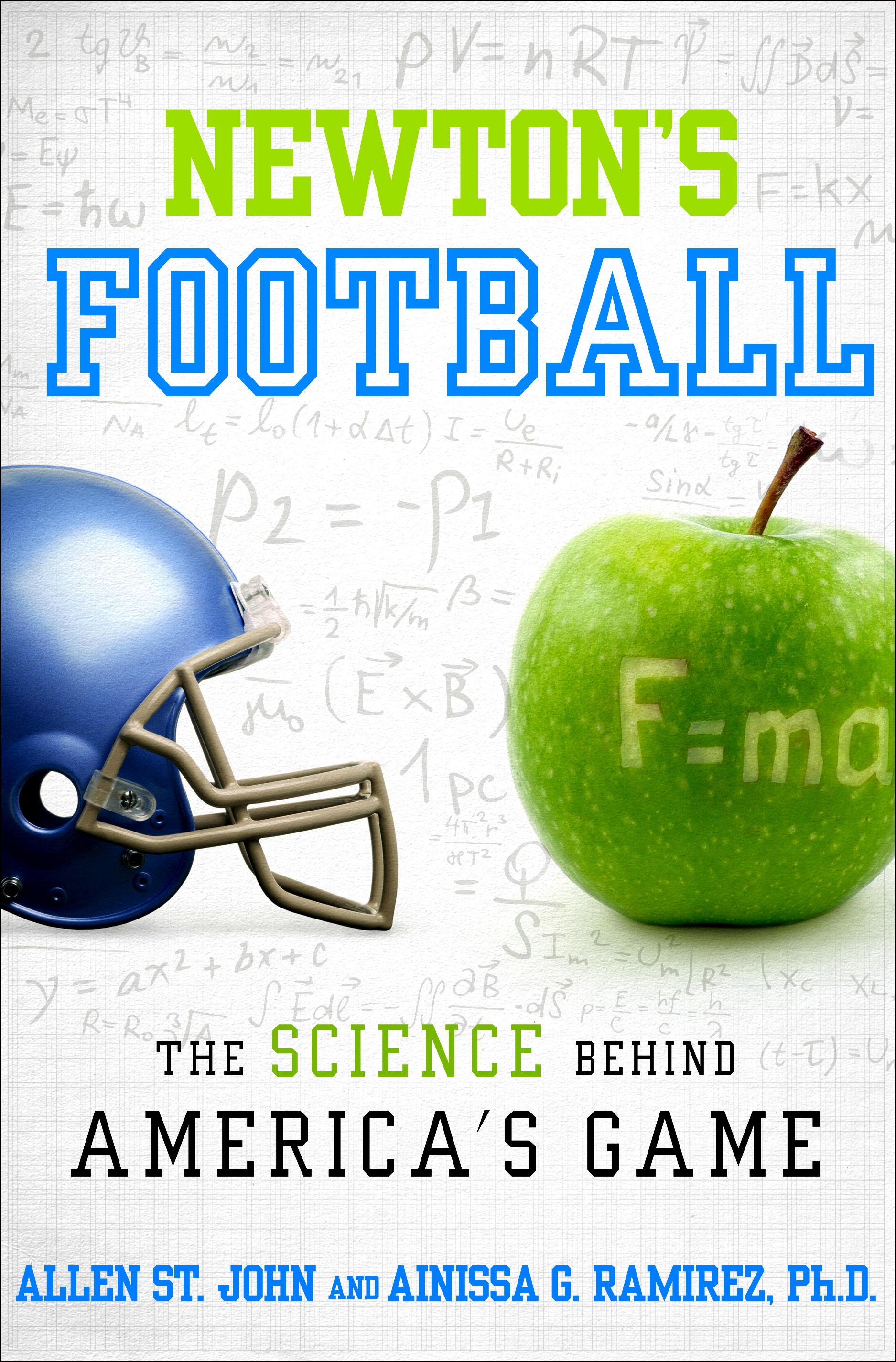
Newton’s Football: The Science Behind America’s Game

Allen St. John and Ainissa G. Ramirez

Here’s a book combining two of my favorite things: science writing and football. Turns Newtons Footballout they go together as naturally (and tastily) as Dorito’s and M&Ms, and like that classic combo, I binged on it until it was all gone. The authors write with passion and knowledge, and in every chapter there was something I didn’t know, either about science or the sport I love.

It begins, fittingly, with an interview with Stephen Wolfram (the theoretical physicist and author of A New Kind of Science), who explains the role chaos theory plays in your team’s game plan. I had always considered the 12th man to be the home crowd, but it turns out to be initial conditions. “Change the initial conditions and the outcomes diverge exponentially,” Wolfram says, leading the authors to extrapolate that “The no-huddle offense was chaos theory at work.”

My new dream is to hear Chris Berman reference initial conditions during a highlight reel.

The ball itself has an interesting history—and a physics all its own. There is no such thing as a tight spiral, for example, since the pigskin (which isn’t really pigskin) requires gyroscopic torque to remain in flight. Knowing that, you might just feel empathy rather than outrage the next time your quarterback lofts a lame duck over the middle.

This book transforms the gridiron into a laboratory. And much like those “Eureka” moments in the lab, serendipity and circumstance had a hand in the game’s innovation, such as the introduction of the West Coast offense and the soccer-style kick. St. John and Ainissa also prove that not all penalties are created equal: The more important stat is not penalty yardage but the breakdown between offensive and defensive infractions.

There is a serious side to Newton’s Football as well. While advances in neuroscience have revealed the extent of football’s brutality, many are wondering if football will exist in another 25 years—and if so, will it be recognizable to today’s fans. The authors explore the current concussion research and uncover some possible solutions.

Along the way, the authors revisit some of the game’s most famous plays and players, and combine physics and football with narrative journalism in one of the easiest and most interesting reads I’ve encountered all year (and that’s no small amount of books). Definitely in my top 10.

Newton’s Football is a must-have for fans of football and/or science. Not everyone is a fan of both, which is all the better because this book offers a chance to expand one’s horizons.

By the final page it will have armchair quarterbacks running statistical analysis and lab rats rubbing elbows at the sports bar. Does it get more interesting than that?

Review: Buddhist Biology

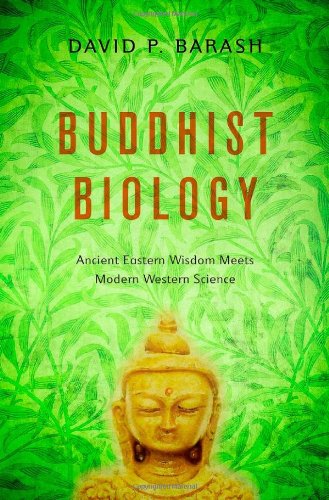
Buddhist Biology

David P. Barash

Forgive me a nostalgia trip to 1994, when alt-jazz rockers Soul Coughing released their Buddhist Biologydebut album Ruby Vroom. The lead track was “Is Chicago, Is Not Chicago,” a hypnotic, oddly existential number allegedly inspired by a bad acid trip in which singer Mike Doughty must distinguish between himself and his surroundings.

It made for a great song, but any biologist will tell you it doesn’t hold up to modern science. Or, for that matter, not-so-modern philosophy.

But Doughty was working toward something significant in that trippy little tune: Where does the “I” end and the “everything else” begin?

It may very well be at the intersection of science and spirituality, according to scientist and self-described Buddhist atheist David P. Barash, author of the brilliant Buddhist Biology.

He admits at the beginning that his goal is an ambitious one: to locate common ground where science and spirituality may coexist. Whereas the Abrahamic religions have long been at odds with science, he argues that Buddhist thought is compatible with high school textbooks.

“Why? Because among the key aspects of Buddhism, we find insistence that knowledge must be gained through personal experience rather than reliance on the authority of sacred texts or the teachings of avowed masters, because its orientation is empirical rather than theoretical, and because it rejects any conception of absolutes.” (18)

That is to say, it allows for the scientific method.

Barash eloquently connects the principles of anatman (not-self), anitya (impermanence) and pratityasamputpada (interdependence) to current biological knowledge. Science has shattered the duality of the actor and the environment, and in doing so has validated thousands of years of Buddhist philosophy.

I am particularly interested in anitya, which leads us into discussions regarding the illusion of time and motion. In considering life as a sequence of moments, Barash distinguishes between the experiencing self and the remembering self (which is similar to Sartre’s Pre-Reflective Cogito, but don’t get me started on my boy Jean-Paul).

The main idea is that each moment is unique and temporary. Nothing lasts, except for in memory, through which we develop a narrative and impose continuity.

Now, I’ll leave the scientific explanations to Barash, as I’m not very qualified to give a proper breakdown, and only slightly more so to discuss eastern philosophy. What I am qualified to provide, though , is a recommendation of Buddhist Biology. Barash takes difficult concepts and presents them in a thoroughly readable and enjoyable narrative. You’ll learn new things, brush up on your philosophy and find it difficult to close this book.

You’ll come away with the realization that there is no distinction between Chicago and Not Chicago, Is and Is Not. There is only this moment.

Or more simply put, There Is.

Last-Minute Literature

The tick-tock of the holiday shopping season is winding down (or perhaps gearing up with desperation). If you’re still needing a last-minute book for the literati in your life, these blurbs should help differentiate the Red Ryder BB gun from the lumps of coal.

Diary of Edward the Hamster (1990-1990)

Miriam and Ezra Elia

I didn’t think anyone anthropomorphized animals more than me until I read this diary,Hamster translated from the notes left behind by Edward the Hamster. Much like the Marquis de Sade, who wrote extensively while in prison and only achieved literary fame posthumously, this artifact of Edward’s incarceration is certain to elicit pathos in readers.

It’s clear that Edward has studied the likes of Heidegger and Sartre. His reflections are wrought with defiance, despair and existential angst. He searches for meaning within his cage. There is food, water, a wheel.

“Is there nothing else!” he cries.

Filled with wit and wisdom, this graphic novel is a black comic tribute to a beloved hamster—the most existential beast within the animal kingdom. The drawings are cute, the entries are funny, but sprinkled throughout the book are philosophical nuggets like, “Why write? Life is a cage of empty words,” and “Is this cage of my own making?”

Along the way, we follow Edward through failed escapes, domestic discord and bliss and a final, bloody insurrection. This is a quick and playful read, with clever artwork, and will bring a smile to the philosopher in your life.

The Never List

Koethi Zan

There is a bitter synchronicity to Koethi Zan’s debut novel, The Never List. Concerning the-never-listthe lives of three women held captive in a madman’s basement, The Never List hit shelves 10 days before Ariel Castro pled guilty to holding three women hostage in his Cleveland basement.

I’m reminded of the Alice Cooper tale of his first trip to England. According to legend, a woman died during the flight, and it fueled his notoriety when he emerged on UK soil trailing a cadaver. Serendipity may not be the polite word, but by dictionary definition…

So, I read this book in July and loved it. The writing is solid and the narrative compelling, and I intended to review it at that time. Unfortunately, it got lost in the barrage of new releases.

There is a news hook, though, as the book is being adapted for television, and will be written by transgressive author A.M. Homes, which should make for wonderfully disturbing television.

The First Thanksgiving

Nathaniel Philbrick

This short work, a reworking of a chapter from Philbrick’s Mayflower: A Story of ThanksgivingCourage, Community, and War, is a great introduction to anyone interested in historical nonfiction who may be daunted by Philbrick’s longer works. There aren’t enough superlatives for Philbrick’s writing, and this appetizer will make any reader want to read the Mayflower, or any of his works, in full.

It’s the history of a holiday that we still celebrate, yet holds little connection to its origin. Here, we get the story we never learned in elementary school—such as the high mortality rates of the Pilgrims. Thanksgiving is now a spectacle of consumption and consumerism. Yet of the roughly 150 passengers and crew aboard the Mayflower, only half survived that first winter. Suffice to say, reading about the hardships of the settlers at the time of the first Thanksgiving will shame anyone who dares complain about Black Friday checkout lines.

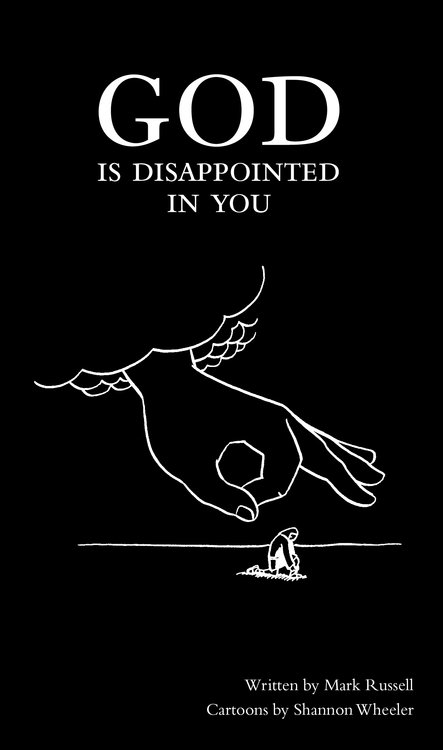
God is Disappointed in You

By Mark Russell and Shannon Wheeler

Some jokes never get old, as evidenced in this irreverent abridging of The Bible. The god_is_disappointed_in_you_cover_lghumor is sharp, varying from silly to satirical, and the illustrations add to the humor. While it is funny, there is also an earnestness within the narrative, as Russell attempts to condense the entire text to its core concepts.

Ambitious idea, and one not to be taken too seriously, but I dispute the author’s claims of accuracy. For example, which version of The Bible? If biblical scholars have been unable to agree on the official canon, I won’t expect it to be decoded in a humor book.

But taken for what it is, God is Disappointed in You is good, clean fun, filled with soul-lightening humor. If the publisher is smart, they’re already compiling a 365-frame calendar version to market over the holidays.

If so, sign me up.

Doomed

Chuck Palahniuk

Chuck, we love you. Please remember that. Lullaby is one of the most amazing booksdoomed-us_0 I’ve ever read, and I even found a way to work it into my master’s thesis. Choke is cutting social satire of the first order, Fight Club one of the greatest films ever made. Survivor is brilliant in plot, character and execution, and don’t get me started on the thrill-ride that is Haunted.

But I do have a few pet peeves that pop up in Doomed, the sequel to Damned.

First, I don’t have much patience for fiction written in the voice of a child. No matter the skill of the writer, an adult giving voice to a child always comes across as inauthentic and, in the worst cases, foolish. Also, exactly what are we to learn from a child narrator? It certainly won’t shock or disturb any hardened reader of horror or transgressive fiction.

Second, humor in horror is an iffy proposition. When it works, it’s organic, or the comedy is more disturbing than the tragedy (for example, many of the stories in Haunted). Better incidental humor than intentional. Doomed reads more like a Christopher Moore novel (albeit an extremely dark and cynical one).

I’m a fan of Moore’s, but his brand of humor is expected. When I read Palahniuk, I look forward to that nausea that lingers and ultimately consumes me, which I’ve found absent in Doomed.
Review: Best American

The Best American series has designed such a unique identity that I can recognize a volume through the thickest wrapping paper. The symmetry of the books is soothing, Best American Science 2013and they look dynamite aligned on the shelves. A friend recently stared in awe of their arrangement on my bookcase (thanks OCD).

But it’s the content that really makes Best American stand out.

My three favorite editions are the science, essay and mystery writing editions, with lots of love for the sports, short stories and nonrequired reading, but that’s part of what makes the series so successful: everybody has a favorite, but is usually willing to take a gander at the others.

So when I see a Best American beneath the tree, I’m not worried about which one it is. I know I’ll enjoy it no matter what.

Here is a sampling of what you’ll find in this year’s editions:

For me, the 2013 headliner is The Best American Science and Nature Writing, edited by Siddhartha Mukherjee (The Emperor of All Maladies). Standouts include Kevin Dutton’s “What Psychopaths Teach Us About How to Succeed,” adapted Best American Essays 2013from his book, The Wisdom of Psychopaths, as well as Oliver Sacks’ “Altered States,” and Gareth Cook’s “Autism Inc.”

The Best American Sports Writing is edited by J.R. Moehringer, whose magazine feature, “Resurrecting the Champ,” inspired a wonderful fictionalization on the big screen. Must-reads include Rick Reilly’s “Special Team,” Paul Solotaroff’s “The NFL’s Secret Drug Problem,” and Erik Malinowski’s “The Making of ‘Homer at the Bat,’ the Episode that Conquered Prime Time 20 Years Ago Tonight.” For top-shelf nonfiction, look no further than The Best American Essays, featuring Zadie Smith, Michelle Mirsky and Alice Munro.

Joyce Carol Oates, Michael Connolly and Hannah Tinti headline The Best American Mystery Stories, while Junot Diaz, George Saunders and Steven Millhauser take the spotlight in The Best American Short Stories. Elizabeth Gilbert guest edits The Best American Travel Writing.

Once again, The Best American Nonrequired Reading slays us with its Best American Comics 2013combination of literati and irreverence. Case in point: there are pieces by Walter Mosley, Sherman Alexie and Kurt Vonnegut, while the “best of” categories include “Best American Poem About a Particle Accelerator,” “Best American Apocryphal Discussion Between Our Nation’s Founding Fathers” and “Best American Comic That Ends in Arson.”

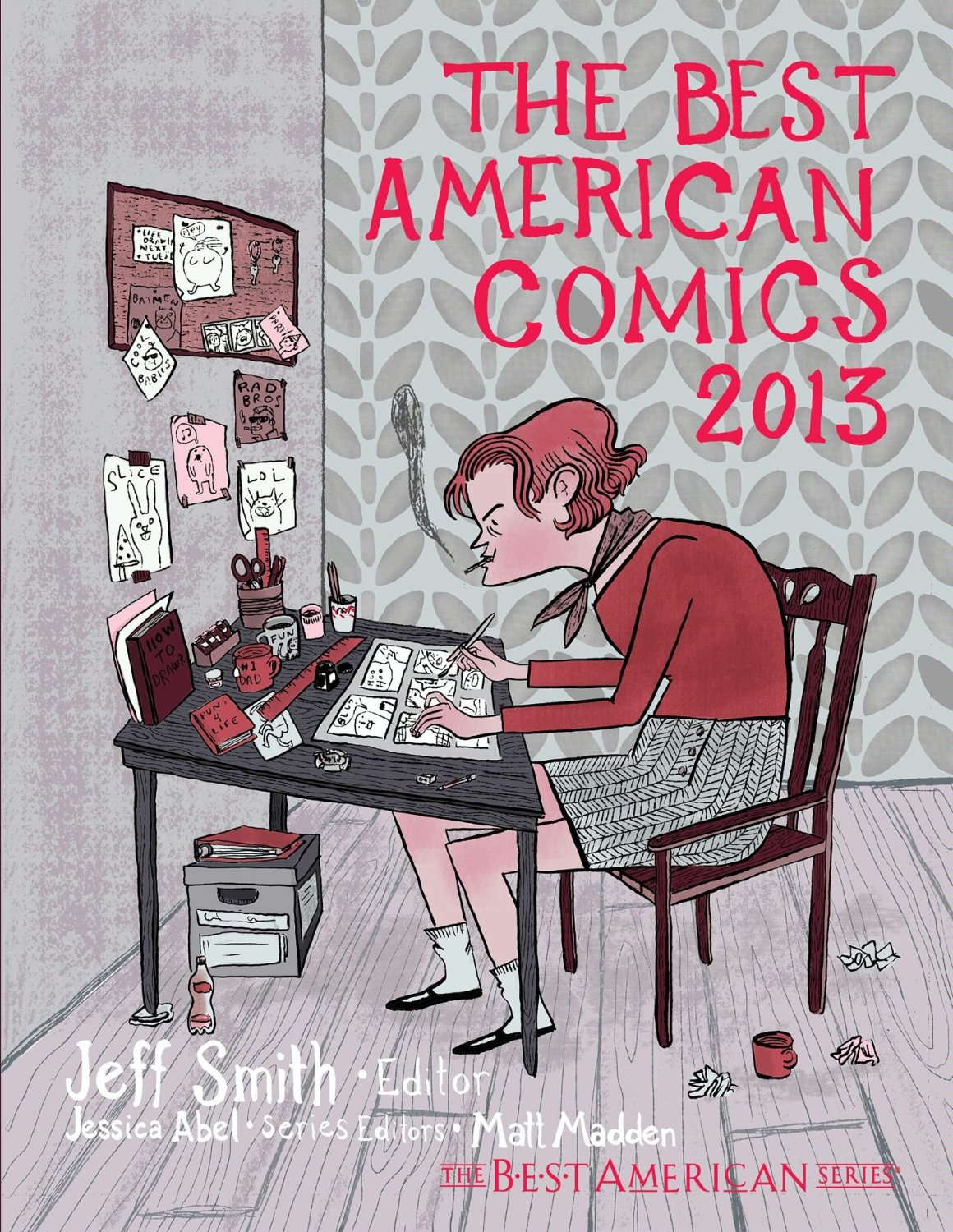
Speaking of comics, one of my favorite new editions is The Best American Comics, featuring fiction and nonfiction art work, from the “funny pages” to graphic novels. There’s now even The Best American Infographics. With an introduction by David Byrne. Go figure.

Review: Backwards

Backwards

By Todd Mitchell

Did you know there is no adjective form of the word “integrity”? Look it up. I was going Backwardsto open this review with a declaration of how integritous we are here at Ensuing Chapters. Or is the word I’m looking for integrian? Integrilicious?

None of the above.

Nevertheless, that’s my silly way to introduce a serious (and seriously good) book with the requisite disclaimer: I have known Todd Mitchell, the author of the young adult novel, Backwards, for about three years, studied under him and served as his teaching assistant in a nonfiction writing class. It’s important to establish this up front, because this will be a glowing review, and I can say with all integrity that the praise is deserved, not spooned out because I know the author.

And with that out of the way, let’s jump to the end. Or rather the beginning. Sort of.

Backwards begins with a teenaged boy, Dan, dead in the bathtub from an apparent suicide. Standing over the scene is our narrator, a Rider (a kind of immaterial wandering soul) who isn’t sure where he is, who he is or how he got there. It doesn’t take him long to realize that he is experiencing time in reverse. We observe Dan’s suicide and his preparations, his daily habits and behaviors, and once we meet pre-dead Dan, it’s easy to diagnose his terminal condition.

I believe the clinical term for it is: He’s an asshole.

But as time bends backward, we pick up more and more fragments of Dan’s life. Yeah, he’s an asshole, but he’s a teenager. Is that so odd? And maybe there’s something dark and vulnerable driving his bad behavior. Indeed there is, but he is also supported with love and encouraging voices, which he silences through self-deliverance.

This is a difficult book to describe, and I’m sure far more difficult to write. Mitchell, however, pulls it off. He taps a mainline to those cringe-worthy cafeteria moments when every little thing was life or death. High school was uncomfortable the first time, and doesn’t seem much better the second time around.

At least not at first.

The narrator, who is living Dan’s life in reverse, provides the wide-angle view that teenagers tend to lack. Actually, it’s a comforting vantage point, and if Dan could’ve seen his life from this perspective, he probably wouldn’t have ended up in the bathtub.

As I’ve often told youth groups as an addictions counselor: Teenagers aren’t stupid. Teenagers just do stupid things. That’s an important distinction, which becomes clear as we watch Dan try to make the right choices, but stumble along in that ham-handed manner that I recognize from my own high school memories. There are missed opportunities, mixed signals, mistaken intentions, the right words left unspoken and the worst ones screamed out loud.

Sound familiar?

That’s the beauty of Backwards. Though the time-manipulated narrative can be disorienting, we are grounded in the familiarity of Dan’s world. Sure, the fashion has changed, but the angst is the same as it always was and will be—and even that elicits a weird nostalgia. Even someone like me, who hated high school and all its cliques, will appreciate its stabilizing force within this chaos.

I also appreciate that the novel isn’t preachy. Of course, the message is clearly against suicide, but Mitchell isn’t talking us off the ledge with niceties. The truth can be vicious, and the author doesn’t recoil from the abyss. Through the character of the Rider, he digs into the horrors of high school and tries to come to terms with the trauma.

Is the Rider successful? The better question is, does it even matter? I’m not well-versed in literary theory, but at its core, Backwards, despite a dash of the spiritual realm, is an existentialist anthem.

Longtime readers know my affinity for existentialist anthems.

My point is that perhaps understanding your awkward years is better than changing them. By revisiting our past, we can be struck by how small everything looks in comparison. If only Dan could’ve seen what the Rider sees.

At least that’s the view from my early 40s. I’m not sure how a young adult would read it, but there’s no doubting the importance of Backwards for its intended audience. But I would argue that Backwards is as much, if not more, of a must-read for adults.

And I’d bet my integritude on that.

Review: Fangasm

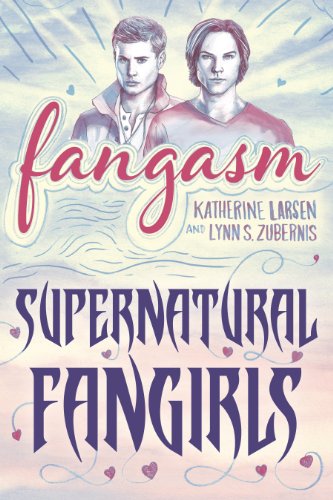
Fangasm: Supernatural Fan Girls

Katherine Larsen and Lynn S. Zubernis 

While I enjoyed Fangasm from page one, I have to admit I was confused at first. What I Fangirlsthought would be an academic account of fan culture, particularly surrounding the TV show Supernatural, turned out to be something altogether different.

Two professors—Katherine Larsen and Lynn S. Zubernis—geek out over the hunky stars of their favorite television show, attending conventions, joining an online community and penning racy fan-fic, all the while discussing the book they were going to write.

Unfortunately, this wasn’t that book.

The original output of their research was the 2012 academic study, Fandom at the Crossroads: Celebration, Shame and Fan/Producer Relationships. Fangasm, on the other hand, is the reporter’s notebook of their exploration.

Once I realized this, I settled in and thoroughly enjoyed the ride. Along the way, the authors feed each other’s “squee”; stalk hunky TV stars; and struggle with strained family relationships, their careers and even their friends. It’s a riotous, road-trip affair, and it’s refreshing to see the lighter side of the uptight academic.

But there’s a serious side to the book as well. In exploring fan-fiction, the duo encounters a diverse body politic. A bulk of the viewer-produced literature is sexual in nature—and due to the make-believe subject matter, and the lack of publisher gatekeeping, fan-fic writers often delve into places even pornographers fear to tread. (Hint: the show’s leading men, though not actually related, play brothers on Supernatural—take that ball and run with it.)

Also on the serious tip are the self-esteem issues that arise. Unfortunately, the shaming of fangirls is not limited to the mainstream community. While the conventions can be a refuge for those who otherwise feel displaced from society, there is an internal enforcement of etiquette that can be just as stratified and exclusionary as the mainstream. It’s a dark and curious sociological paradox.

Ultimately, I would have preferred to geek out with the academic text, but hey, there is no wrong way to get your nerd on. While I don’t approach the level of fanboy status held by Larsen and Zubernis, I know my way around a convention, and I’ve spent thousands of dollars on rare books, albums and KISS memorabilia. I can relate to this duo, and I find it refreshing to learn about a pair of obsessed academics letting their geek flag fly.

Review: Language, Cognition, and Human Nature

Language, Cognition, and Human Nature: Selected Articles

Steven Pinker

I love science and science writing, and when people ask me why, I have a simple answer: Because I really don’t get most of it. I have a scientific curiosity and Pinker2mathematical brain, but if it weren’t for the grading curve, I’d still be taking Freshman biology.

I’ll never fully grasp the writings of Richard Dawkins or Stephen Hawking, but I love reading them. They pique my interest, and I always come away learning something. Maybe it’s my fear of becoming cognitively rigid in middle age, but the prospect of a static or shrinking intellect keeps me up at night. I’m well past the point of exploring texts that merely reinforce my current knowledge base.

Which brings us to Steven Pinker and his new collection of articles, Language, Cognition, and Human Nature: Selected Articles.

While pursuing my master’s degree, I wasn’t feeling challenged in my English coursework, so I signed on for a semester of Philosophy of Language. I loved it, but I can still barely understand half of it. I did learn one thing, though: I kick ass at propositional logic, but predicate logic turns my brain to creamed corn.

So I was excited to read this collection, which Pinker prefaces with a curious introduction concerning general interest science writing. He talks of the popularity of scientists who are able to write for a popular audience (and science writers who can serve as a go-between), but argues that we’re underestimating readers with this approach. Rather than spoon-feeding the masses distilled information, Pinker provides us with the source material: his actual academic articles.

This is not light reading, and be warned it is challenging.

But it is enjoyable and enlightening. If you haven’t tried to wrap your mind around language theory, you need to read this book. Even if you don’t understand half of it, what information you glean will radically affect your relationship with language and the mind.

If nothing else, it’s a head trip—no lab coat required.

Review: Skyway

Bill DeYoung

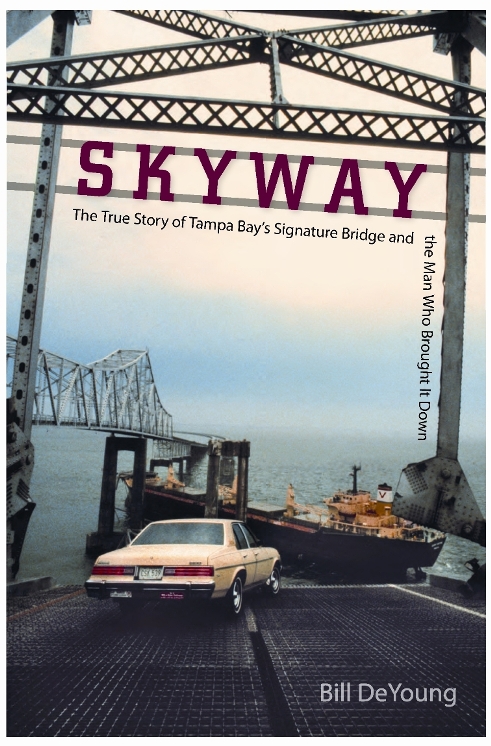
Skyway: The True Story of Tampa Bay’s Signature Bridge and the Man who Brought it Down

It’s hard to elicit raw terror in book form, especially in the opening pages. If the book is Skyway300 pages, you know there is still plenty to come. Real life, however, is a gut-wrencher. For instance, there’s no guarantee I’ll finish writing this review—or that you’ll finish reading it. That’s why well-crafted nonfiction, such as Bill DeYoung’s Skyway, can induce frights greater than most horror novels.

I white-knuckled it through the first two chapters of Skyway, a recounting of the Skyway Bridge disaster of 1980, and was impressed with DeYoung’s narrative talents from stem to stern.

Some background: In 1980 a harbor pilot, John Lerro, was guiding a ship to the Port of Tampa. A freak storm unleashed a nightmare scenario, and without radar or visibility, the ship, the Summit Venture, struck the bridge, collapsing a span of road 150-feet high. Thirty-five vehicle-bound victims, including passengers in a Greyhound bus, plummeted to their death.

It’s a tragedy mostly forgotten outside of Florida, but DeYoung’s brilliant account should change that. With a narrative journalism style, he fleshes out the events of that morning with factual data, news reports and first-hand accounts. We share the helpless terror of the Summit Venture crew as cars plunk into Tampa Bay. We white-knuckle it as a car grinds to a halt inches from the drop. We cheer as motorists band together to halt oncoming traffic and shut down the bridge, saving countless lives.

And then the book really gets good.

DeYoung, a longtime journalist, gives us a longitudinal view of the disaster, from the rise of interstate commerce that necessitated the bridge to the haunted lives of the Skyway survivors decades later. Some of the most interesting bits concern the role the interstate system and mid-20th century financial culture played in building the bridge (and cutting corners from construction to upkeep).

Though it was Lerro who took the blame, it was greed that forced the harbor pilots to take chances in foul weather. Also in play was the exclusionary, good-old-boy culture of the harbor pilots, which deeply scarred Lerro (who was exonerated of any wrong-doing, and in fact was commended for preventing more deaths) following the tragedy.

Skyway put me in mind of Nathaniel Philbrick’s In the Heart of the Sea: The Tragedy of the Whaleship Essex, which is about as high a compliment as you can pay an author of narrative history. Maybe I’ve just got a thing for maritime disasters (I blame Poe and Arthur Gordon Pym for that), but Skyway is a chilling, informative and deeply engrossing narrative.

This is a book worthy of awards and deserving of the bestseller list.

Review: A Brighter Word Than Bright

A Brighter Word Than Bright

by Dan Beachy-Quick

Although A Brighter Word Than Bright is about Romantic poet John Keats, I couldn’t get Keatsmy favorite Oscar Wilde quote out of my head while reading it: “Man is least himself when he talks in his own person. Give him a mask, and he will tell you the truth.”

It’s a cruel irony that nonfiction is thought to be the most accurate medium for Truth—reducing reality to the recitation of facts. If that were so, then the minutes of a company meeting should have more cultural sway than Shakespeare, right? Yet when I was in London, there were scores of young and old gathered at the gates of the Globe Theatre.

I didn’t take a poll, but I’m confident that when people think of London in 1599 (when the original Globe was built), they think of Shakespeare rather than that year’s landmark court ruling, Edward Darcy Esquire v. Thomas Allein of London Haberdasher, which established the foundation for modern antitrust law.

I didn’t see anyone perusing court transcripts outside the Globe.

That’s why Dan Beachy-Quick’s biography of Keats is so refreshing. Rather than retelling his life story or critiquing his work through some previously unexploited element of his personality, Beachy-Quick gives us the biography of the poet’s imagination.

Which, of course, requires a lot of imagination.

No shortage there. Beachy-Quick, author of nearly a dozen collections of poetry, essays and criticism, weaves a fever-dream narrative that treats its subject as more putty than marble, so that Keats, the man, vanishes at times.

Or perhaps Beachy-Quick brings us so close we no longer recognize him.

Either way, A Brighter Word Than Bright engages the reader’s imagination, and the author states from the beginning that:

“I have little interest in offering a portrait of Keats more accurate than those already available… I am more concerned with returning Keats, as best I can manage, back into that half-light that obscures accurate rendering so as to make more brilliant those sudden flashes in his poems and letters that, lightning-like, reveal the storm-tossed grasses in the ceaseless field even as darkness closes the vision again—sudden clarities, and the afterimage that lingers long past the lightning’s strike.”

Our subject is deliberately blurred, grated into the environment with an opacity that is oddly revealing. From an early age, Keats is displaced, yet absorbed by the world. Or perhaps consumed is more like it. Beachy-Quick sketches a grief-burdened man-child weeping beneath a desk for his dead mother. Yet, the boy is not separate from the desk, nor the desk from the room. All is connected in this tragic tableau: “Some music sobs up into song. Some song digs down and confronts what it also must comfort.”

Keats is tormented by his talents, a gift on par with Greek tragedy. Much like Darrin McMahon’s Divine Fury: A History of Genius, Beachy-Quick views genius as something that possesses, rather than something one may possess:

“To listen to genius is to let oneself be guided by that voice in the self that is not the self’s own. It implies an otherness exactly where we expect to find identity; it speaks within us a rumor to us, that we are least ourselves where we are most ourselves.”

This duality zigzags throughout the book, at times we are uncomfortably close and at others removed, disoriented, flipping between past and present tense to remind that art, and the artist’s struggle, belong to all ages. That like Keats’ poems, all is absorbed into a timeless moment—infinity in a single instant and vice versa. (Beachy-Quick cleverly enforces the point with reference to the work of the paradox-obsessed Greek philosopher Zeno.)

As we progress chronologically, Beachy-Quick peppers in some academic critique, for example going through the Odes and incorporating Keats’ letters for context. I was particularly struck by one passage from Keats to his wife, Fanny Brawne:

“I have two luxuries to brood over in my walks, your Loveliness and the hour of my death. O that I could have possession of them both in the same minute. I hate the world; it batters too much the wings of my self-will, and would I could take a sweet poison from your lips to send me out of it.”

Would it be fair to say Keats was the first emo kid?

Actually, that may be as fair as any other portrait. No biography has been able to capture the man in full, which certainly adds to his appeal. Beachy-Quick, with this unconventional and highly original biography, gives us something better than the Truth. He gives us the febrile terror that inhabits the artist’s soul.

Review: The Faceless One

The Faceless One

Mark Onspaugh

The prologue of Mark Onspaugh’s The Faceless One is a primal delight. We begin in Facelessthe forested snow-scape of rural Alaska, 1948, where young Jimmy Kalmaku embarks on a dark journey with his uncle deep into the tundra. Hidden within a remote cave is an evil of which Jimmy has never imagined.

It is also where he learns that he will succeed his uncle as shaman and inherit the task of keeping the Faceless One locked up in that cave.

The uncle says, “Remember our path today… I hope you need never come this way again, but you must remember.”

Clearly, we are not finished with the cave.

And neither is Jimmy.

With this spine-tingling opener, Onspaugh has swirled together the elements of great storytelling: odyssey, myth, duty, loss of innocence. There is a sad inevitability in this scene. Present are the generations of tribesmen, forward and back, guarding this secret place—a never-ending watch against something that exists outside of timespace. Something hallowed. Something in the blood.

Onspaugh has a tender touch that imparts soul into this icy epic which spans generations and locations, jumping ahead to present day when Jimmy, now an elderly man, learns that an archeologist has displaced the mask keeping the Faceless One captive.

With the ancient evil unleashed, Jimmy is called to action. He must remember his uncle’s words… and the way to that dark place.

Releasing this book on Oct. 28 is brilliant marketing—not simply because October is a good time for horror fiction, but because the setting of The Faceless One is a set-piece for a chilly night. What better time than when the veil between the worlds is thinnest to encounter a shapeless evil? To follow its trail from Alaska to New York to Seattle and beyond.

From generation to generation, blood to blood.