Fiction

Review: The Ghost of the Mary Celeste

The Ghost of the Mary Celeste

Valerie Martin’s new novel, The Ghost of the Mary Celeste, is a bit like a star-studded variety show. It’s got a little bit of everything: maritime mystery, historical figures, 06book "The Ghost of the Mary Celeste" by Valerie Martin.supernatural subterfuge and… Sherlock Holmes?

The oddest part about the above description is that this book is more fact than fantasy.

Martin is a prize-winning master of historical fiction (Mary Reilly, Property), and this time around, she takes on the legendary ghost ship Mary Celeste, which was discovered abandoned, though still seaworthy, in 1872, her crew never to be seen again. This true-life mystery caught the attention of Martin, as well as another author (a young Arthur Conan Doyle published a fictionalized account of the ghost ship).

The terror is subtle in this novel. Martin makes use of found documents—journals, diaries, articles—to blend the factual with the fantastic. She meanders through time, takes on the social norms and issues of the day, and makes use of historical record real and imagined. She thrills us, certainly, but unfortunately leaves us with a tangled knot of loose ends.

There is no doubting the quality of the writing. Martin is a master storyteller, and her opening chapter is as harrowing as anything I’ve read this year. She places us in the heart of the Mary Celeste as it sails toward its destiny. Her words, like the storm, encroach, terrorize and ultimately consume, and after finishing the first chapter, I had to set the book aside for a while.

With equal skill, Martin details the lives of those left behind following the tragedy. There is heartbreak, romance and more tragedy on land. Every scene, every line of dialogue, every description is near perfect.

This is, however, a challenging book, not in content but in structure. I’m usually a fan of difficult reads—I take it as a sign of respect when an author, such as Martin, asks more of her readership than passive engagement. The narrative shifts through time, location and point of view. Indeed, there is a clever chronology, as the shipwreck segues to the survivor story segues to Doyle’s voyage segues to spiritualism. However, though they’re all linked by the Mary Celeste, the narratives feel more like vignettes. I found myself invested in each storyline, only to have it pulled out from under me with every new section. Nothing felt complete. As much as the writing drew me in, the shifting narrative pushed me away in equal measure.

This is just one reader’s opinion. Martin’s body of work speaks for itself. She is a gifted writer and storyteller, an astute chronicler of history with a great imagination. To any reader looking for a challenge, I say go for it. Get yourself a copy and enjoy the ride. For me, though, the novel is a bit like the Mary Celeste—seaworthy, but somehow I got lost along the way.

Final Thoughts, 2013

It’s a new year, and as much as we’re looking forward to the 2014 reading list, we have some 2013 shelf clearing left to do. Here is a round-up of books we enjoyed, but were so busy reading we didn’t have time to review.

The Undeserving Poor: America’s Enduring Confrontation with Poverty: Fully Updated and Revised

Michael B. Katz

It’s been a quarter-century since the first edition of this book was published. Some Undeserving Poorthings have changed drastically: The first edition came out at the height of the Reagan-Bush era, whereas the new edition comes on the heels of major Democratic victories in 2012.

But some things haven’t changed: The cultural obsession of equating financial poverty with moral bankruptcy.

Katz does a wonderful job of exploring the evolution of blame-the-poor politics and the invention (and ongoing reinvention) of the underclass. It’s a slippery and interesting social history, and it brings to mind Foucault’s histories of mental illness and prisons.

One of the interesting takeaways for me is the human need to compartmentalize. There is a line drawn between the deserving and the undeserving poor. Women and children tend to occupy the first category, while men almost universally fall into the latter. Politically and culturally speaking, the line drawn between the two groups is solid and severe, with those on one side garnerng support and sympathy and the others disdain and even punishment.

The trouble is that the line, in reality rather than construct, is blurry.

America’s schizophrenic attitude toward poverty shouldn’t be surprising. It’s a country that went from agriculture to industry to technology, where the Roaring ’20s gave way to the Great Depression, which segued into an unprecedented era of prosperity. Where LBJ waged a failed War on Poverty, and his successors waged a failed War on Drugs, which has ultimately amounted to a war on the impoverished.

This is an excellent read for anyone with an interest in economics, politics or social history. It may not resolve any legislative debates, but it will lend the reader more thoughtful consideration of the topic.

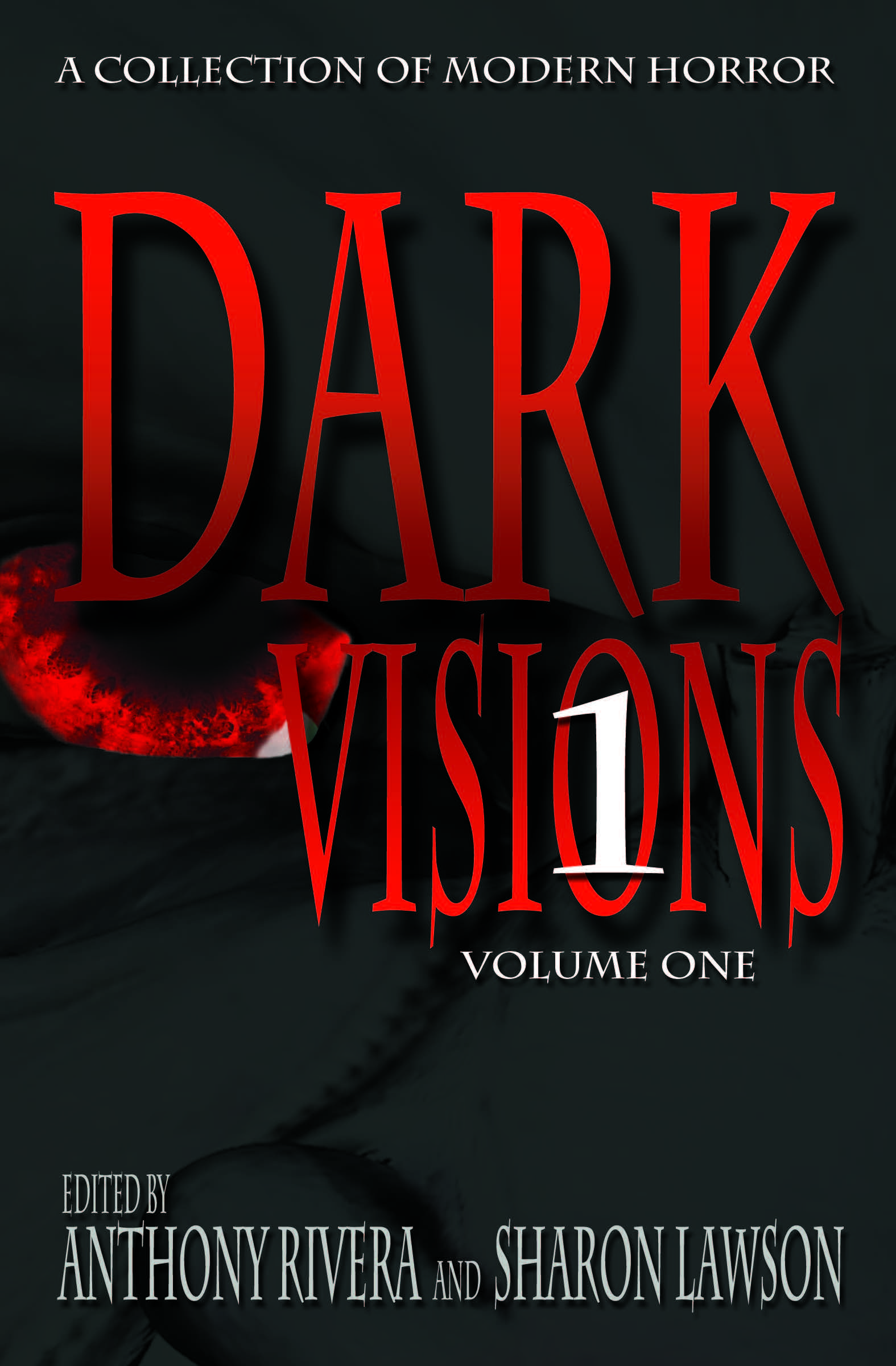
Dark Visions: A Collection of Modern Horror

Edited by Anthony Rivera and Sharon Lawson

I have a longstanding love affair with the small horror press. They’re like neighborhood Dark Visionsbookstores: Some last, the majority fail (ultimately), but most of them are amazing while they last. And like that corner bookstore, they each have their own personality, though ostensibly they are all dealing in similar content.

Enter the first installment of Dark Visions from Grey Matter Press.

They certainly know how to plunge into the darkness: the anthology series begins with an original story from Jonathan Maberry—yes, that Jonathan Maberry. Best of all, his contribution, “Mister Pockets,” takes us back to a place I know and love so well: Pine Deep.

For those unfamiliar, Pine Deep is the small town in rural Pennsylvania that was the setting for Maberry’s first three novels, including Bad Moon Rising, the bad-ass conclusion to the trilogy that any horror fan should begin reading immediately. This is a place that knows how to celebrate Halloween—and there is plenty to be afraid of here. I loved this world that Maberry created, and I was ecstatic to return.

Like all anthologies, there is a little something for everybody, and not every story will be your cup of tea. The important thing is that the quality level is high and consistent throughout, and Dark Visions is certainly a cut above your average anthology.

There is one story in particular that I would like to single out, “The Weight of Paradise” by Jeff Hemenway. This is easily the best new horror story I read this year, and perhaps of even the past few years. It is thoroughly original, dark and morally complicated, the hallmark of great horror fiction. Unless the voting is rigged, this story should win many awards and be anthologized for years to come.

There are plenty of other dark delights as well, and I’m excited for the second installment, scheduled for a summer release.

The Best Specimen of a Tyrant: The Amitious Dr. Abraham von Norstrand and the Wisconsin Insane Hospital

Thomas Doherty

Aside from having similar names, nobody will mistake this Civil War doctor for beloved Best Specimen of a Tyranttelevision dermatologist Martin van Nostrand (though his Seinfeld portrayer, Michael Richards, like the original Dr. von Norstrand, later achieved a certain level of infamy loosely related to the war between the states).

This doctor, deftly brought to life by Thomas Doherty, left behind a trail of failed business and medical practices before his appointment to superintendent of the Wisconsin Insane Hospital. What distinguishes this book from the many institutional narratives (both fictional and real) is that we get a rounded view of hospital administration. Typically, the overseers of institutions are lampooned as either sadistic villains, naïve do-gooders or bungling bureaucrats.

The reality of institutions, and their employees and residents, is much more complicated than that.

For starters, you’re working with a unique population with difficult problems—otherwise your clients wouldn’t have been institutionalized in the first place. Also consider the varying talents between workers, as well as experience, burnout, and the daily stressors of the workplace.

Want to describe a day in the life of a health care worker? Spend an overnight shift in an ER or a detox and write down your observations. Then do that almost every night for five years and go back and review your initial impressions and see how they compare with your current view.

That’s why The Best Specimen of a Tyrant shines. Von Norstrand casts a thorny shadow, and he has the complexity of Greek tragedy. This is a book for anyone with an interest in the checkered and infinitely fascinating history of mental health care.

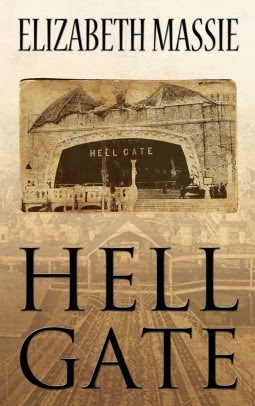
Hell Gate

Elizabeth Massie 

In my MFA program, I was often teased for setting a majority of my stories within an Hell Gate - Elizabeth Massieamusement park or carnival of some kind. What can I say? I’m a fan of works that intersect the routine reality of the everyday with the manufactured reality of the spectacle (see Something Wicked This Way Comes, Rides of the Midway, CivilWarLand in Bad Decline, etc.).

Therefore, Hell Gate combines some of my favorite themes. The story’s centerpiece is the friendship between a psychic and an orphan against the backdrop a series of grisly Coney Island murders. This will appeal to fans of historical thrillers and anyone who’s ever snuck backstage at the circus.

Last-Minute Literature

The tick-tock of the holiday shopping season is winding down (or perhaps gearing up with desperation). If you’re still needing a last-minute book for the literati in your life, these blurbs should help differentiate the Red Ryder BB gun from the lumps of coal.

Diary of Edward the Hamster (1990-1990)

Miriam and Ezra Elia

I didn’t think anyone anthropomorphized animals more than me until I read this diary,Hamster translated from the notes left behind by Edward the Hamster. Much like the Marquis de Sade, who wrote extensively while in prison and only achieved literary fame posthumously, this artifact of Edward’s incarceration is certain to elicit pathos in readers.

It’s clear that Edward has studied the likes of Heidegger and Sartre. His reflections are wrought with defiance, despair and existential angst. He searches for meaning within his cage. There is food, water, a wheel.

“Is there nothing else!” he cries.

Filled with wit and wisdom, this graphic novel is a black comic tribute to a beloved hamster—the most existential beast within the animal kingdom. The drawings are cute, the entries are funny, but sprinkled throughout the book are philosophical nuggets like, “Why write? Life is a cage of empty words,” and “Is this cage of my own making?”

Along the way, we follow Edward through failed escapes, domestic discord and bliss and a final, bloody insurrection. This is a quick and playful read, with clever artwork, and will bring a smile to the philosopher in your life.

The Never List

Koethi Zan

There is a bitter synchronicity to Koethi Zan’s debut novel, The Never List. Concerning the-never-listthe lives of three women held captive in a madman’s basement, The Never List hit shelves 10 days before Ariel Castro pled guilty to holding three women hostage in his Cleveland basement.

I’m reminded of the Alice Cooper tale of his first trip to England. According to legend, a woman died during the flight, and it fueled his notoriety when he emerged on UK soil trailing a cadaver. Serendipity may not be the polite word, but by dictionary definition…

So, I read this book in July and loved it. The writing is solid and the narrative compelling, and I intended to review it at that time. Unfortunately, it got lost in the barrage of new releases.

There is a news hook, though, as the book is being adapted for television, and will be written by transgressive author A.M. Homes, which should make for wonderfully disturbing television.

The First Thanksgiving

Nathaniel Philbrick

This short work, a reworking of a chapter from Philbrick’s Mayflower: A Story of ThanksgivingCourage, Community, and War, is a great introduction to anyone interested in historical nonfiction who may be daunted by Philbrick’s longer works. There aren’t enough superlatives for Philbrick’s writing, and this appetizer will make any reader want to read the Mayflower, or any of his works, in full.

It’s the history of a holiday that we still celebrate, yet holds little connection to its origin. Here, we get the story we never learned in elementary school—such as the high mortality rates of the Pilgrims. Thanksgiving is now a spectacle of consumption and consumerism. Yet of the roughly 150 passengers and crew aboard the Mayflower, only half survived that first winter. Suffice to say, reading about the hardships of the settlers at the time of the first Thanksgiving will shame anyone who dares complain about Black Friday checkout lines.

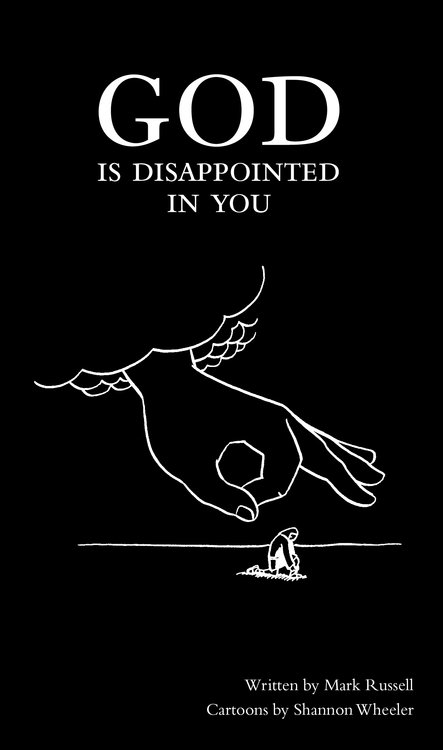
God is Disappointed in You

By Mark Russell and Shannon Wheeler

Some jokes never get old, as evidenced in this irreverent abridging of The Bible. The god_is_disappointed_in_you_cover_lghumor is sharp, varying from silly to satirical, and the illustrations add to the humor. While it is funny, there is also an earnestness within the narrative, as Russell attempts to condense the entire text to its core concepts.

Ambitious idea, and one not to be taken too seriously, but I dispute the author’s claims of accuracy. For example, which version of The Bible? If biblical scholars have been unable to agree on the official canon, I won’t expect it to be decoded in a humor book.

But taken for what it is, God is Disappointed in You is good, clean fun, filled with soul-lightening humor. If the publisher is smart, they’re already compiling a 365-frame calendar version to market over the holidays.

If so, sign me up.

Doomed

Chuck Palahniuk

Chuck, we love you. Please remember that. Lullaby is one of the most amazing booksdoomed-us_0 I’ve ever read, and I even found a way to work it into my master’s thesis. Choke is cutting social satire of the first order, Fight Club one of the greatest films ever made. Survivor is brilliant in plot, character and execution, and don’t get me started on the thrill-ride that is Haunted.

But I do have a few pet peeves that pop up in Doomed, the sequel to Damned.

First, I don’t have much patience for fiction written in the voice of a child. No matter the skill of the writer, an adult giving voice to a child always comes across as inauthentic and, in the worst cases, foolish. Also, exactly what are we to learn from a child narrator? It certainly won’t shock or disturb any hardened reader of horror or transgressive fiction.

Second, humor in horror is an iffy proposition. When it works, it’s organic, or the comedy is more disturbing than the tragedy (for example, many of the stories in Haunted). Better incidental humor than intentional. Doomed reads more like a Christopher Moore novel (albeit an extremely dark and cynical one).

I’m a fan of Moore’s, but his brand of humor is expected. When I read Palahniuk, I look forward to that nausea that lingers and ultimately consumes me, which I’ve found absent in Doomed.

Review: Best American

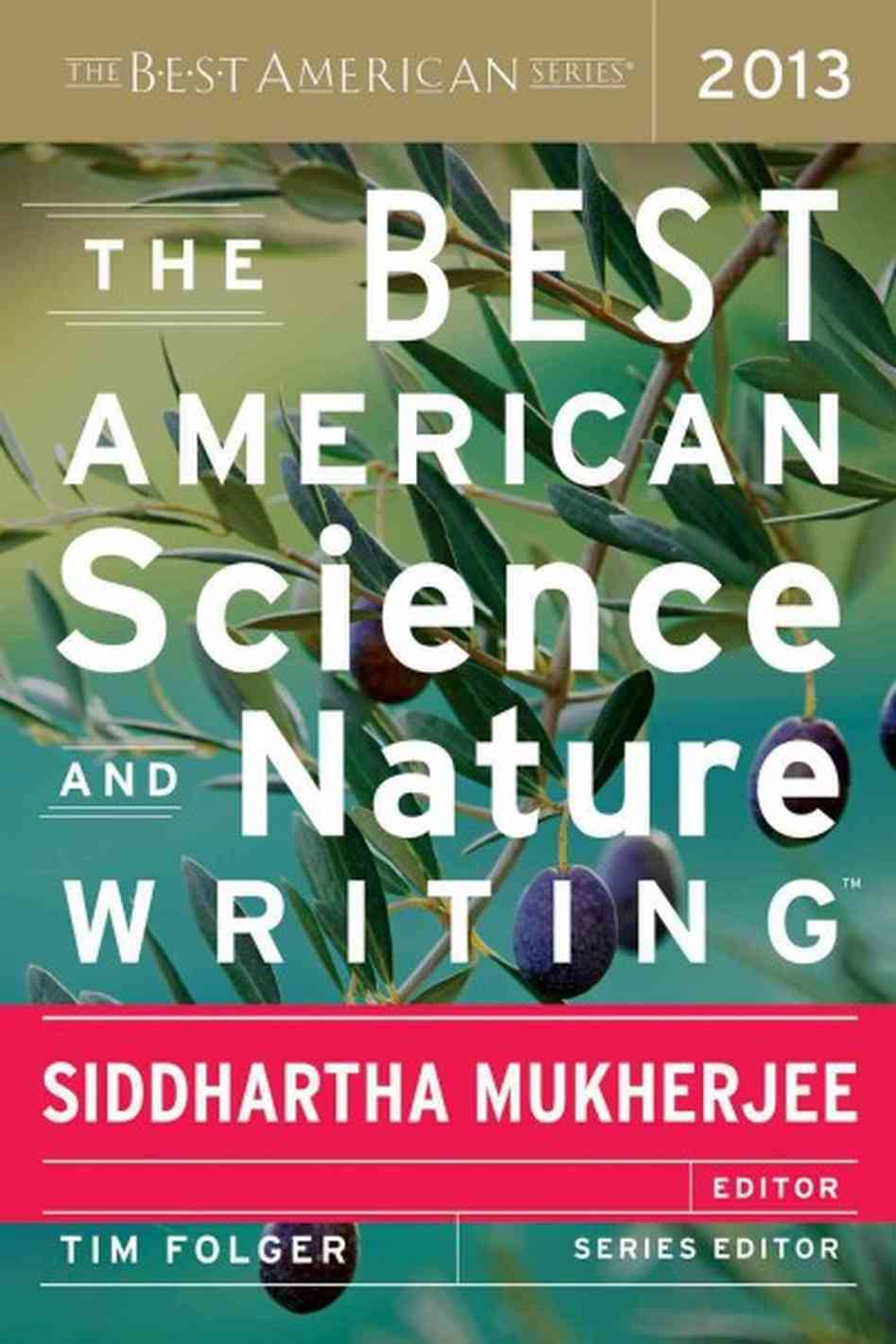
The Best American series has designed such a unique identity that I can recognize a volume through the thickest wrapping paper. The symmetry of the books is soothing, Best American Science 2013and they look dynamite aligned on the shelves. A friend recently stared in awe of their arrangement on my bookcase (thanks OCD).

But it’s the content that really makes Best American stand out.

My three favorite editions are the science, essay and mystery writing editions, with lots of love for the sports, short stories and nonrequired reading, but that’s part of what makes the series so successful: everybody has a favorite, but is usually willing to take a gander at the others.

So when I see a Best American beneath the tree, I’m not worried about which one it is. I know I’ll enjoy it no matter what.

Here is a sampling of what you’ll find in this year’s editions:

For me, the 2013 headliner is The Best American Science and Nature Writing, edited by Siddhartha Mukherjee (The Emperor of All Maladies). Standouts include Kevin Dutton’s “What Psychopaths Teach Us About How to Succeed,” adapted Best American Essays 2013from his book, The Wisdom of Psychopaths, as well as Oliver Sacks’ “Altered States,” and Gareth Cook’s “Autism Inc.”

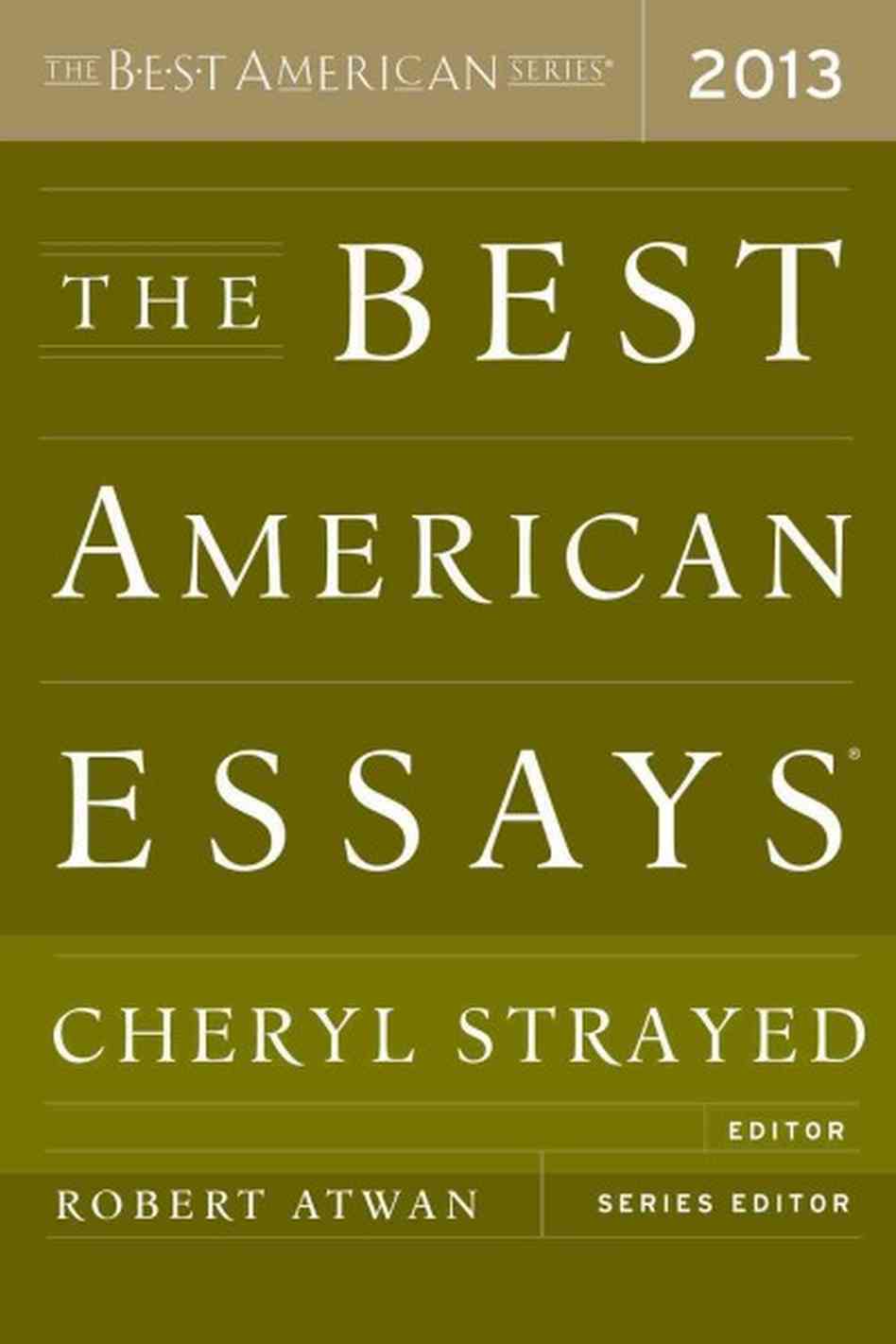
The Best American Sports Writing is edited by J.R. Moehringer, whose magazine feature, “Resurrecting the Champ,” inspired a wonderful fictionalization on the big screen. Must-reads include Rick Reilly’s “Special Team,” Paul Solotaroff’s “The NFL’s Secret Drug Problem,” and Erik Malinowski’s “The Making of ‘Homer at the Bat,’ the Episode that Conquered Prime Time 20 Years Ago Tonight.” For top-shelf nonfiction, look no further than The Best American Essays, featuring Zadie Smith, Michelle Mirsky and Alice Munro.

Joyce Carol Oates, Michael Connolly and Hannah Tinti headline The Best American Mystery Stories, while Junot Diaz, George Saunders and Steven Millhauser take the spotlight in The Best American Short Stories. Elizabeth Gilbert guest edits The Best American Travel Writing.

Once again, The Best American Nonrequired Reading slays us with its Best American Comics 2013combination of literati and irreverence. Case in point: there are pieces by Walter Mosley, Sherman Alexie and Kurt Vonnegut, while the “best of” categories include “Best American Poem About a Particle Accelerator,” “Best American Apocryphal Discussion Between Our Nation’s Founding Fathers” and “Best American Comic That Ends in Arson.”

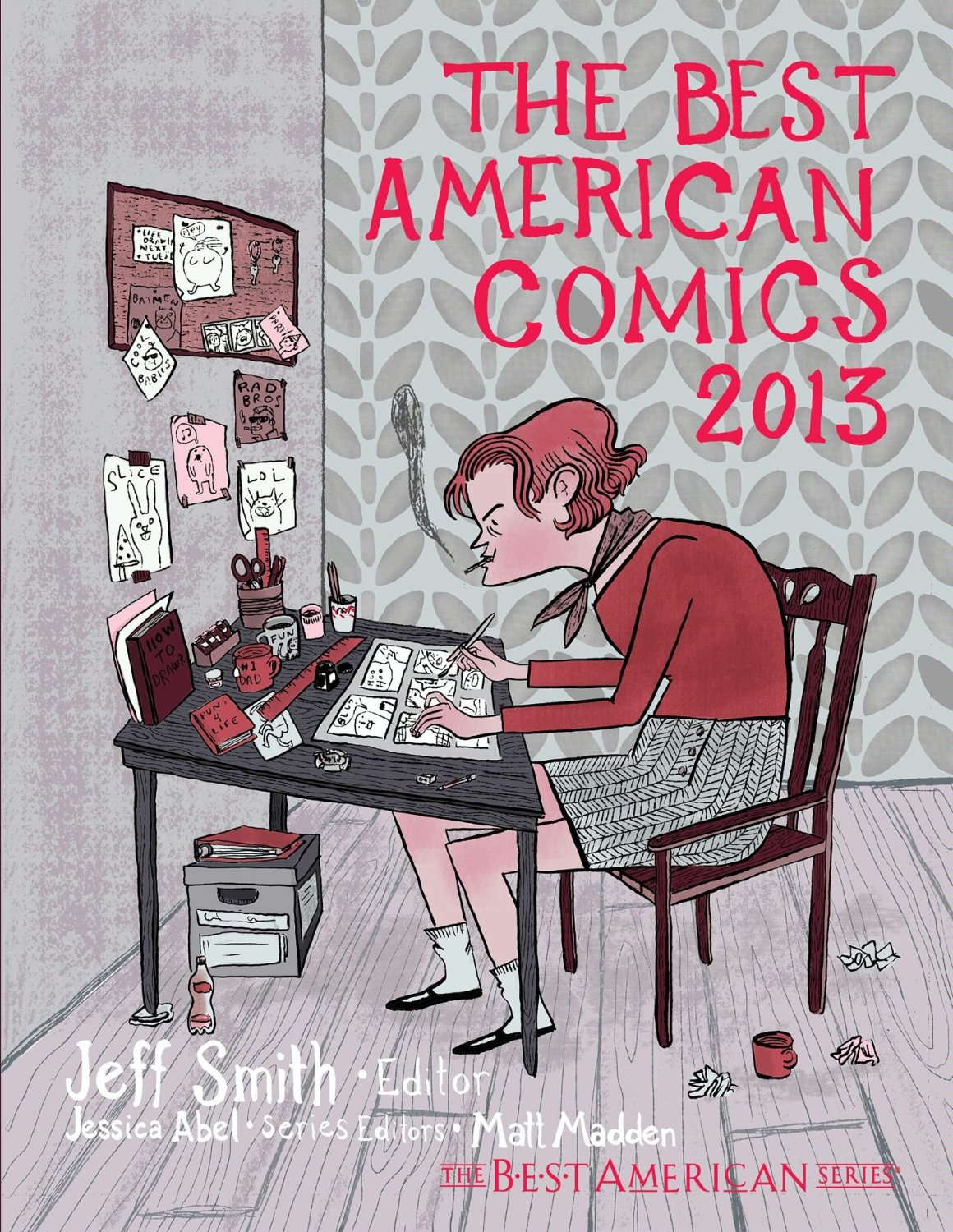
Speaking of comics, one of my favorite new editions is The Best American Comics, featuring fiction and nonfiction art work, from the “funny pages” to graphic novels. There’s now even The Best American Infographics. With an introduction by David Byrne. Go figure.

Review: Backwards

Backwards

By Todd Mitchell

Did you know there is no adjective form of the word “integrity”? Look it up. I was going Backwardsto open this review with a declaration of how integritous we are here at Ensuing Chapters. Or is the word I’m looking for integrian? Integrilicious?

None of the above.

Nevertheless, that’s my silly way to introduce a serious (and seriously good) book with the requisite disclaimer: I have known Todd Mitchell, the author of the young adult novel, Backwards, for about three years, studied under him and served as his teaching assistant in a nonfiction writing class. It’s important to establish this up front, because this will be a glowing review, and I can say with all integrity that the praise is deserved, not spooned out because I know the author.

And with that out of the way, let’s jump to the end. Or rather the beginning. Sort of.

Backwards begins with a teenaged boy, Dan, dead in the bathtub from an apparent suicide. Standing over the scene is our narrator, a Rider (a kind of immaterial wandering soul) who isn’t sure where he is, who he is or how he got there. It doesn’t take him long to realize that he is experiencing time in reverse. We observe Dan’s suicide and his preparations, his daily habits and behaviors, and once we meet pre-dead Dan, it’s easy to diagnose his terminal condition.

I believe the clinical term for it is: He’s an asshole.

But as time bends backward, we pick up more and more fragments of Dan’s life. Yeah, he’s an asshole, but he’s a teenager. Is that so odd? And maybe there’s something dark and vulnerable driving his bad behavior. Indeed there is, but he is also supported with love and encouraging voices, which he silences through self-deliverance.

This is a difficult book to describe, and I’m sure far more difficult to write. Mitchell, however, pulls it off. He taps a mainline to those cringe-worthy cafeteria moments when every little thing was life or death. High school was uncomfortable the first time, and doesn’t seem much better the second time around.

At least not at first.

The narrator, who is living Dan’s life in reverse, provides the wide-angle view that teenagers tend to lack. Actually, it’s a comforting vantage point, and if Dan could’ve seen his life from this perspective, he probably wouldn’t have ended up in the bathtub.

As I’ve often told youth groups as an addictions counselor: Teenagers aren’t stupid. Teenagers just do stupid things. That’s an important distinction, which becomes clear as we watch Dan try to make the right choices, but stumble along in that ham-handed manner that I recognize from my own high school memories. There are missed opportunities, mixed signals, mistaken intentions, the right words left unspoken and the worst ones screamed out loud.

Sound familiar?

That’s the beauty of Backwards. Though the time-manipulated narrative can be disorienting, we are grounded in the familiarity of Dan’s world. Sure, the fashion has changed, but the angst is the same as it always was and will be—and even that elicits a weird nostalgia. Even someone like me, who hated high school and all its cliques, will appreciate its stabilizing force within this chaos.

I also appreciate that the novel isn’t preachy. Of course, the message is clearly against suicide, but Mitchell isn’t talking us off the ledge with niceties. The truth can be vicious, and the author doesn’t recoil from the abyss. Through the character of the Rider, he digs into the horrors of high school and tries to come to terms with the trauma.

Is the Rider successful? The better question is, does it even matter? I’m not well-versed in literary theory, but at its core, Backwards, despite a dash of the spiritual realm, is an existentialist anthem.

Longtime readers know my affinity for existentialist anthems.

My point is that perhaps understanding your awkward years is better than changing them. By revisiting our past, we can be struck by how small everything looks in comparison. If only Dan could’ve seen what the Rider sees.

At least that’s the view from my early 40s. I’m not sure how a young adult would read it, but there’s no doubting the importance of Backwards for its intended audience. But I would argue that Backwards is as much, if not more, of a must-read for adults.

And I’d bet my integritude on that.

Review: The Faceless One

The Faceless One

Mark Onspaugh

The prologue of Mark Onspaugh’s The Faceless One is a primal delight. We begin in Facelessthe forested snow-scape of rural Alaska, 1948, where young Jimmy Kalmaku embarks on a dark journey with his uncle deep into the tundra. Hidden within a remote cave is an evil of which Jimmy has never imagined.

It is also where he learns that he will succeed his uncle as shaman and inherit the task of keeping the Faceless One locked up in that cave.

The uncle says, “Remember our path today… I hope you need never come this way again, but you must remember.”

Clearly, we are not finished with the cave.

And neither is Jimmy.

With this spine-tingling opener, Onspaugh has swirled together the elements of great storytelling: odyssey, myth, duty, loss of innocence. There is a sad inevitability in this scene. Present are the generations of tribesmen, forward and back, guarding this secret place—a never-ending watch against something that exists outside of timespace. Something hallowed. Something in the blood.

Onspaugh has a tender touch that imparts soul into this icy epic which spans generations and locations, jumping ahead to present day when Jimmy, now an elderly man, learns that an archeologist has displaced the mask keeping the Faceless One captive.

With the ancient evil unleashed, Jimmy is called to action. He must remember his uncle’s words… and the way to that dark place.

Releasing this book on Oct. 28 is brilliant marketing—not simply because October is a good time for horror fiction, but because the setting of The Faceless One is a set-piece for a chilly night. What better time than when the veil between the worlds is thinnest to encounter a shapeless evil? To follow its trail from Alaska to New York to Seattle and beyond.

From generation to generation, blood to blood.

Shine On

When civilization was rebuilding following an interking-007national plague, the epicenter of humanity was Chautauqua Auditorium in Boulder, Colo. At least that’s how it happened in Stephen King‘s The Stand, an epic tale of apocalypse, atonement and the will to persevere.

So it was fitting that, in the aftermath of the floods that devastated Colorado’s Front Range, particularly Boulder, a crowd of more than 1,200 gathered in Chautauqua on Sept. 26.

But this time it wasn’t to hear from Stu Redman or Mother Abigail. It was to hear from the man himself.

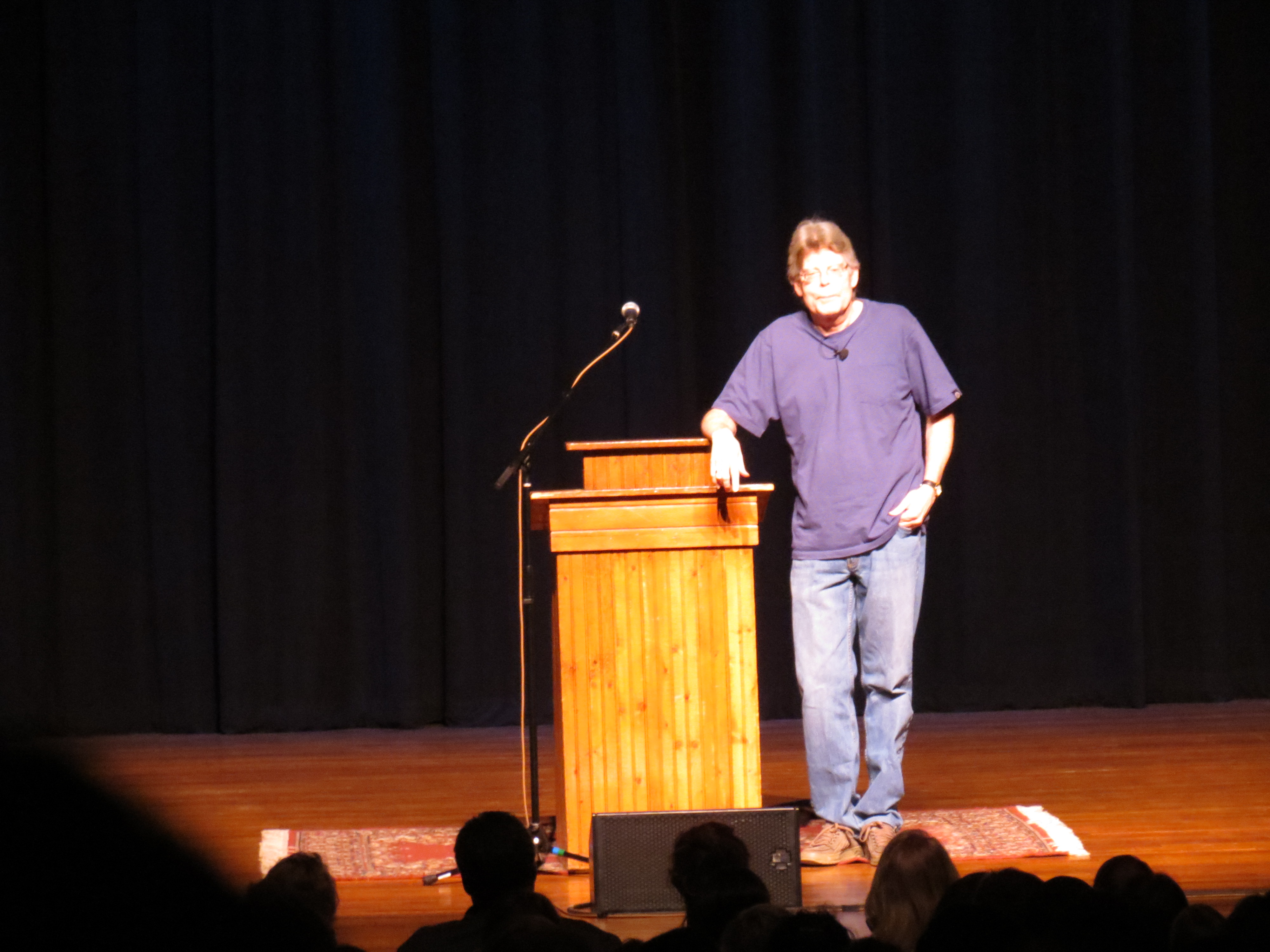
“This is where the first Boulder Free Zone meeting was held, right here in this auditorium,” King said early in his talk before a sell-out crowd.

King, his wife Tabitha and two of their children briefly lived in the city in the mid-’70s, following the publication of King’s second book, ‘Salem’s Lot. He authored two of his most famous novels in the shadow of the Flatirons, The Stand and The Shining.

So it’s only fitting that he returned to Boulder to celebrate the release of Doctor Sleep, the long-awaited sequel to The Shining.

“I wanted to see if my old King Soopers was still there,” King joked, referring to the grocery store in his former South Boulder neighborhood.

It’s still there, as is the Stanley Hotel an hour up the road in Estes Park.

First published in 1977, The Shining was King’s first hardback bestseller. And while most folks are familiar with the Stanley Kubrick interpretation, the film featured a few exterior shots of Boulder and nothing of the Stanley Hotel on which it was based. (The Stanley is now home to ghost tours, Halloween galas and the Stanley Film Festival—and I highly recommend the pilgrimage.)

King recalled fondly his mountain writing studio and the inspiration he felt there.

“It was the greatest writing time of my life,” he said, though he doesn’t recall the specifics of creating the actual books. “I only remember that I was happy. I was engaged. I think most imaginative writing is like that.”

King’s innate talent and creativity was likely aided by a progressive, anything-goes attitude of a college town in the foothills undergoing the growth spurt that transformed it into one of the country’s top-rated cities—an epicenter of technology, education and craft-brewed beer.

“I stopped to pick up a hitchhiker one day, on Broadway, and I got rear-ended,” King said of one of his more interesting Boulder memories. “The hitchhiker ran off, and I got cited.”

A second vehicular mishap provided the inspiration for another King classic. His car broke down in Boulder Canyon, and he was walking into town for assistance. While crossing a bridge, he noticed the clack of his cowboy boots on the wooden planks. He wondered: What might be underneath this bridge listening to his footfalls?

Perhaps a clown—and thus the seed of Pennywise, the supernatural killer in It, was planted.

But the book he was really here to talk about was Doctor Sleep, which hit shelves on Sept. 25.

“People kept asking me whatever happened to Danny Torrence,” he said. “I decided, finally, that I would try to write a sequel.”

He was fascinated, he said, with the cyclical nature of family dysfunction, how children of abusive or alcoholic parents tend to repeat that behavior as adults. So it’s fitting that Danny’s adult life is, well, complicated.

Now in his 40s, Danny is a hospice worker in New Hampshire, where, along with the help of an intuitive cat, he helps suffering patients come to rest. But though the novel begins in New England, it inevitably takes to the road.

And that road could only lead to one place.

“Eventually, he has to go back to Colorado and to Boulder,” King said.

He read excerpts from Danny’s return to the city, which involved a particularly nasty hangover and an over-the-top gross-out gag that will have his most hardened readers choking up.

It is a sequel decades in the making, and a return to one of King’s greatest triumphs. This is a treat for long-time fans, and new ones. During the Q&A, a question came from a fan who started reading King in their youth, and now their kids are reading the books.

“I think it’s nice when people pass the book down from generation to generation,” King said.

But his literary legacy includes more than his books and films. It also includes his offspring. His youngest son, Owen, is the author of Double Feature, and his oldest son is best-selling author Joe Hill. Joe and his dad have collaborated on two novellas and often share ideas when writing their books. For example, they were simultaneously working on Doctor Sleep and Hill’s NOS4A2, and each included a scene in which their characters cross paths.

“In a strange way, it’s almost like writing with another part of myself,” King said of his collaborations with Joe.

Doctor Sleep will certainly bolster the already absurdly rich King oeuvre. It will take readers back to some cherished places, both physical and psychic: Boulder, the Overlook Hotel and one of the finest and most terrifying works of psychological horror ever penned.

And together, we will once again croak our favorite and most-haunted mirrored phrase: RedRum.

Summer Horror Roundup

Though the days still blister, at night there is a welcome chill and the softest whiff of decay. It’s a beautiful smell, and within a few weeks we’ll hit full-on autumn. Though we’re excited about the fall, we’d be remiss if we didn’t discuss some of the summertime horror we’ve enjoyed throughout the year.

The Hole

William Meikle

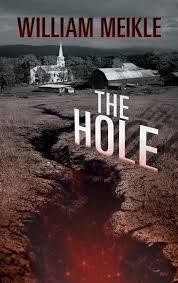
Now this is a book I can relate to: hard drinking, manual labor, mines, sinkholes, battles with subterranean evil.The Hole

Ah, to be 23 again.

From the start, this fast-paced small-town horror shudders with ominosity. (Is ominosity a word? If not, it should be.) Intense headaches and nosebleeds afflict the townsfolk, and then the earth comes out from under their feet.

Literally.

A giant sinkhole opens in a back yard (leading to a hilarious septic tank scene) and begins swallowing up the countryside like the San Andreas Fault. At first, the backwoods residents fear a natural disaster.

But then they notice the creatures rising up from the hole.

And so the horror begins…

Enjoy this quick-hit tale of small-town suspicion, working-class gumption and a long-buried secret that won’t stay dead.

Doors

Daniel Brako

Being a dorky loner, I spent most of my summers watching late-night reruns of The Twilight Zone. That certainly figured intoDoors my attraction to Doors, which concerns a psychologist working with a patient who sees doors everywhere he looks. Then, the doctor begins to see them too.
I’ve always loved the idea of another world overlapping with our own, only visible if we squint in just the right light. It has the appeal of a conspiracy theory. It’s the world, just slightly askew. All around us, invisible, with dire consequences. A world within a world. (Don’t get me started on quark theory.)

Having worked in mental health, I’ve conversed with many schizophrenics, delirious alcoholics and addicts in the throes of a psychotic break. Their storytelling has the effect of quicksand—you don’t realize how engrossed you are in their story until you’re up to your neck. They give you a plausible setting and people, then a string of plausible events occur, followed by a string of less-plausible events, then even less and less plausible, and then suddenly, boom, the narrator reveals that the gunshot was stopped by the metal plate inside his head and the rebounding bullet struck the shooter instead.

It’s a dissociative feeling. Everything seemed so normal, so sane, twisting only in slight degrees before you realize it’s all a delusion. Or is only some of it? That’s what makes it so creepy.

It’s our world, slightly askew.

That’s what I was hoping for in Doors, and it begins promising enough. The manic patient begins his tale, and I got that tingle of dissociation. Unfortunately, it doesn’t last. The psychologist, David Druas, buys into the narrative too quickly. I wanted more push-back from David, mainly to prolong that quicksand effect, but also for verisimilitude: No legitimate psychologist would be convinced so quickly.

At this point I realized that the novel rushed through this part to get to the pulse-pounding events that follow. That’s unfortunate. I was hoping for more of a psychological head-trip.

Meeting the book on its own terms, this is a well-conceived novel with thrilling and engaging sequences. And I can certainly except the supernatural in horror fiction. But I wish the story hewed closer to plausibility so I could longer relish that feeling of slowly being drawn in to a nightmare.

The Last Whisper in the Dark

Tom Piccirilli

Yes, we have reviewed this book already, but it’s worth repeating. This is a tremendous book by a gifted author. Put this on yourWhisper “must-read” list.
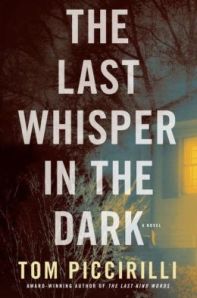
And for anyone who missed the earlier review, here you are:

There are not enough superlatives when discussing Tom Piccirilli. The man is a brilliant and diverse writer: He’s won awards for his horror, fantasy, thrillers and even poetry—bagging the prestigious Bram Stoker award on four occasions.

Previous novels, such as Shards, A Choir of Ill Children and November Mourns, have shocked and terrified, but with his new release, The Last Whisper in the Dark, Piccirilli takes us to a far more tender place.

A tender place, it turns out, just as disarming as his nightmares.

I’ll sum it up this way: I was shedding tears by page three. I think the only other book that has ever had me crying this early in the narrative is Dave Eggers’ A Heartbreaking Work of Staggering Genius.

Piccirilli has a knack for character development and storytelling, and The Last Whisper in the Dark, a sequel to 2012’s The Last Kind Words, may be his deepest work yet.

Concerning Terrier (Terry) Rand, a young thief from a family of small-time criminals, Piccirilli has given us a protagonist as sympathetic as he is fearless. On the surface, the story is about the disappearance of Terry’s friend Chub and the ensuing search that drives him head on into gangsters, killers and a femme fatale.

But on a deeper level, this is a tale of honor and family and the clumsy way we go about expressing our feelings to the ones we love. The Rands are a proud and tragic clan, with dementia and criminality in their blood—as well as an outlaw tendency that keeps them on the fringes of society.

But their strongest trait is honor. Terry is loyal to an estranged friend who stole the only woman he ever loved. He quietly looks out for his sister, even as she rebels against him and helps desecrate their dead brother’s grave. He remains devoted to a family that can occasionally be distant and dysfunctional, but always has each other’s backs.

You can mess with Terry, but you’d best not fuck with his family.

You’ll fall in love with Terry by the end of the first chapter, and you’ll be cheering him on the rest of the novel. And when it’s done, you’ll applaud Piccirilli for this tender bit of noir literature.

Piccirilli is an established icon within the horror realm, but he has yet to crack through to the mainstream, which is unfortunate. This is a writer worthy of notice, and hopefully this book is the one that reaps him the exposure and attention he deserves.

M.K. Wren, A Gift Upon the Shore

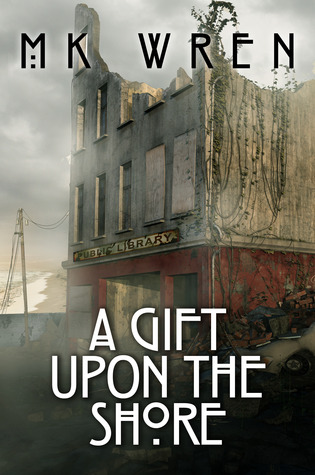
It’s interesting reading M.K. Wren’s classic novel nearly a quarter century since its release in 1990. For one thing, a nuclearGift apocalypse sounds downright quaint and makes me eerily nostalgic for my childhood fears of nuclear annihilation.

Aside from that, A Gift Upon the Shore is timeless—and even prescient. Following a wave of destruction, two women begin building a library in coastal Oregon, dedicated to preserving the great works of literature, history, and, by extension, civilization. Unfortunately, their only neighbors are a group of fundamentalist survivors who promote the destruction of all books other than the Bible.

In 2013, libraries and bookstores are struggling, Texas school boards are editing history and I downloaded the novel, in a matter of seconds, from a Web site onto my e-reader (unthinkable in 1990).

OK, Wren isn’t exactly Nostradamus. Folks were probably declaring the death of books within hours of Guttenberg’s invention, and fundamentalists have far less sway than they did during the Satanic Panic of the 1980s. Even Salman Rushdie has been able to come out of hiding.

But like Wren’s protagonists, digital publishing has guaranteed that our literary history will live on, from the freedom of publishing in the medium to noble endeavors like Project Guttenberg.

A Gift Upon the Shore remains a wondrously beautiful novel, whatever the era, and one worthy of a revisit or a first look.

Review: The Last Whisper in the Dark

There are not enough superlatives when discussing Tom Piccirilli. The man is a brilliantWhisper and diverse writer: He’s won awards for his horror, fantasy, thrillers and even poetry—bagging the prestigious Bram Stoker award on four occasions.

Previous novels, such as Shards, A Choir of Ill Children and November Mourns, have shocked and terrified, but with his new release, The Last Whisper in the Dark, Piccirilli takes us to a far more tender place.

A tender place, it turns out, just as disarming as his nightmares.

I’ll sum it up this way: I was shedding tears by page three. I think the only other book that has ever had me crying this early in the narrative is Dave Eggers’ A Heartbreaking Work of Staggering Genius.

Piccirilli has a knack for character development and storytelling, and The Last Whisper in the Dark, a sequel to 2012’s The Last Kind Words, may be his deepest work yet.

Concerning Terrier (Terry) Rand, a young thief from a family of small-time criminals, Piccirilli has given us a protagonist as sympathetic as he is fearless. On the surface, the story is about the disappearance of Terry’s friend Chub and the ensuing search that drives him head on into gangsters, killers and a femme fatale.

But on a deeper level, this is a tale of honor and family and the clumsy way we go about expressing our feelings to the ones we love. The Rands are a proud and tragic clan, with dementia and criminality in their blood—as well as an outlaw tendency that keeps them on the fringes of society.

But their strongest trait is honor. Terry is loyal to an estranged friend who stole the only woman he ever loved. He quietly looks out for his sister, even as she rebels against him and helps desecrate their dead brother’s grave. He remains devoted to a family that can occasionally be distant and dysfunctional, but always has each other’s backs.

You can mess with Terry, but you’d best not fuck with his family.

You’ll fall in love with Terry by the end of the first chapter, and you’ll be cheering him on the rest of the novel. And when it’s done, you’ll applaud Piccirilli for this tender bit of noir literature.

Piccirilli is an established icon within the horror realm, but he has yet to crack through to the mainstream, which is unfortunate. This is a writer worthy of notice, and hopefully this book is the one that reaps him the exposure and attention he deserves.