book reviews

Review: Abominable Science

If you were like me growing up, you had a stack of Weekly Reader books about the spooky and the supernatural at your bedside. These were the source of maAbominable_Science_cover-576px-300x450ny restless nights for me, in particular books on Bigfoot and the Loch Ness Monster. My friend Todd still speaks with reverence about the Bigfoot episode of In Search Of… with Leonard Nimoy.

We are the ideal audience for Abominable Science, co-authored by a scientist and a writer who was obsessed with the mythology of cryptids (a fancy term for a creature of legend whose existence has not been documented).

The nuts and bolts of the book are simple, yet genius. The authors examine the cases of legendary cryptids (Bigfoot, Nessy, the Yeti) and consider the scientific evidence, essentially disproving, or at least discrediting, their existence.

The first part of this equation is great fun. The second part is like when the mean kids first tell you there is no Santa Claus.

In other words, buzz kill.

The authors devote too much space to debunking the “evidence” of cryptids. Look, we know they’re not real. What makes these creatures so interesting is not whether or not they exist, but rather in the mysteries and folklore that surround them. If Bigfoot did exist, he would no longer be a mystery. He’d be a zoo exhibit. While it is important to show where the science doesn’t add up, the debunking feels a bit like a deposition at times, which isn’t nearly as much fun. (Just ask Paula Deen.)

The other issue I have with Abominable Science is redundancy. The book is divided into sections addressing each of the cryptids individually. Unfortunately, the commonalities between the cases make parts of the narrative redundant.

The result is diminishing returns.

The Bigfoot section is riveting. The Loch Ness section is interesting and very well written, but replace an American forest with a Scottish lake and you’ve got more or less the same storyline. By the third section, we know what to expect: unreliable eyewitness accounts, grainy photographs, unidentified footprints, overactive imaginations and outright deceptions, etc.

So, the book might have been arranged so that it addressed the similarities between the legends at once rather than divided by cryptid.

I also wish the authors had a bit more fun with it. The narrative is playful at times, but the hyperactive debunking misses the point that these legends are, more than anything, fun. Look, we know professional wrestling isn’t true competition along the lines of football or baseball, but its appeal lies not in its verisimilitude, but rather in the storytelling, the characters and the spectacle itself.

Otherwise, wouldn’t WWE have implemented instant replay a long time ago? (Even Bud Selig would have the sense to review and overturn illegal tags and errant three counts.) They would also probably do something about those metal folding chairs that always seem to find their way into the ring.

But perhaps I doth protest too much. At its heart, Abominable Science is not intended to be a buzz kill. It is an enjoyable read that will have you laughing out loud at times—and you might even learn a little science along the way.

So, if you’re the type that can’t pass up a Bigfoot or ghost hunting special on cable television, you will love this book. And though it will confirm that the cryptids in question don’t exist, it won’t stop us from tuning in. If anything, it reinforces the universality of creature mythology and our attraction to fantasy and mystery. (Earlier this year, Syfy debuted its new show, Joe Rogan Questions Everything, with a
full hour devoted to hunting Bigfoot.)

We will always be obsessed with the unknown. We will be happily drawn into those blurry shadows of the natural world. I’m happy to report that we will always remain… In search of…

Review: The Last Whisper in the Dark

There are not enough superlatives when discussing Tom Piccirilli. The man is a brilliantWhisper and diverse writer: He’s won awards for his horror, fantasy, thrillers and even poetry—bagging the prestigious Bram Stoker award on four occasions.

Previous novels, such as Shards, A Choir of Ill Children and November Mourns, have shocked and terrified, but with his new release, The Last Whisper in the Dark, Piccirilli takes us to a far more tender place.

A tender place, it turns out, just as disarming as his nightmares.

I’ll sum it up this way: I was shedding tears by page three. I think the only other book that has ever had me crying this early in the narrative is Dave Eggers’ A Heartbreaking Work of Staggering Genius.

Piccirilli has a knack for character development and storytelling, and The Last Whisper in the Dark, a sequel to 2012’s The Last Kind Words, may be his deepest work yet.

Concerning Terrier (Terry) Rand, a young thief from a family of small-time criminals, Piccirilli has given us a protagonist as sympathetic as he is fearless. On the surface, the story is about the disappearance of Terry’s friend Chub and the ensuing search that drives him head on into gangsters, killers and a femme fatale.

But on a deeper level, this is a tale of honor and family and the clumsy way we go about expressing our feelings to the ones we love. The Rands are a proud and tragic clan, with dementia and criminality in their blood—as well as an outlaw tendency that keeps them on the fringes of society.

But their strongest trait is honor. Terry is loyal to an estranged friend who stole the only woman he ever loved. He quietly looks out for his sister, even as she rebels against him and helps desecrate their dead brother’s grave. He remains devoted to a family that can occasionally be distant and dysfunctional, but always has each other’s backs.

You can mess with Terry, but you’d best not fuck with his family.

You’ll fall in love with Terry by the end of the first chapter, and you’ll be cheering him on the rest of the novel. And when it’s done, you’ll applaud Piccirilli for this tender bit of noir literature.

Piccirilli is an established icon within the horror realm, but he has yet to crack through to the mainstream, which is unfortunate. This is a writer worthy of notice, and hopefully this book is the one that reaps him the exposure and attention he deserves.

Review, On Dissent: Its Meaning in America

On DissentNot many books from Cambridge University Press make it to the summer reading list, but On Dissent: Its Meaning in America is one of the better ways to revolt against the light-hearted beach-readers out there. Hell, it’s patriotic. America was born in dissent, and we celebrate it still. With fireworks—even illegal ones (though from now on I argue that M-80s are not outlaws, but rather the tools of dissent).

But why is dissent so much of our DNA? What does it even mean to dissent? These were the questions nagging at Ronald K.L. Collins and David M. Skover, two esteemed political scholars who were surprised to find that there was no true analysis of the concept of dissent.

That’s what they set out to create with this short, thought-provoking work.

For the most part, Collins and Skover accomplish their goal. The tone is philosophical in nature, and the authors begin by attempting to define dissent and identify its practitioners. Sure, anyone can point to the examples of Thoreau, King and Paine, but the authors take on trickier issues, such as how clear the line is (or isn’t) between civil disobedience and criminality. What role does violence play in dissent, or does an action cease to be dissent once it becomes violent?

Collins and Skover do a great job, and scholarly service, by identifying the fundamental traits of dissent, such as its being goal-oriented and indicative of a power dynamic. They buttress their definition by exploring hypotheticals and philosophical dilemmas (is a hired protester a dissenter?), and they do it all with an accessible writing style that will appeal to non-academic readers who might not otherwise seek out this book.

Of course, it’s not perfect, and the biggest issue I have is with the authors’ overreliance on expert commentary, such as that of Howard Zinn and Ralph Nader. The quotations are often redundant and unnecessary. The collective intellect of Collins and Skover is authoritative enough, and I recommend skimming through the offset commentary.

But there’s nothing else I would skim over in this book—particularly the epilogue. Here, the authors move away from definitions and thought experiments and present their own take on dissent—that contrary to rebellion, dissent is a vital and cohesive component of a democracy:

“Consent and dissent are two sides of the same coin. Without dissent, consent is meaningless; without consent, dissent loses much of its animating purpose” (152).

On Dissent is a quick and wonderful read. It will get you thinking. It will get you talking. It will remind you that though we may disagree, the freedom to disagree and express opposing viewpoints is what makes us strong.

Stephen King, Joyland

JoylandJoyland by Stephen King

My rating: 3 of 5 stars

The first three-fourths of
Joyland
are amazing, some of King’s best recent work. The ending, however, is a bit too easy and familiar. King’s previous offering through Hard Case Crime, The Colorado Kid, subverted convention and was far more challenging to the reader.

Infused with heart and the nostalgic thrills of boardwalk carnivals, Joyland is worth the ticket price. The novel begins as a rail-rattling thrill ride, but, in the end, eases too gently into the station.

View all my reviews

The Perils of Memoir: Author vs. Event, or a review of Hope After Faith

Writing a memoir or personal essay is the literary equivalent of a high-wire act. It’s a thing of awe and wonder when it works, but the possibility of disaster is great. The margin of error is razor thin due to the “so what?” litmus test. All nonfiction needs to address this question, but it becomes far more stringent with memoir, which is the book version of going on a first date and talking only about yourself.

As much as I want to love Hope After Faith (as a fan of atheism, philosophy and memoir), it ultimately fails to meet the “so what?” criteria. This is not the fault of content, but rather infrastructure.

The structure of a memoir varies depending if the reader interest is on the writer or the event. One dives into Tina Fey’s Bossypants to learn more about the person. One picks up David Carr’s The Night of the Gun because they’re intrigued by the titular event, through which the reader will acquire interest in the writer.

Unfortunately, Hope After Faith begins with a chronological account of Jerry DeWitt’s life. Nothing personal, but since I don’t know the author, I’m not yet interested in his life story. The narrative would benefit from a stated thesis or present commentary rather than launching straight into DeWitt’s life story.

I’ve heard DeWitt is a great speaker, and I imagine he’d be a fascinating interview, but this is clearly a case where the prospective reader is drawn to the event more than the author. We hope to find the author interesting as well, of course, but the reason we crack the spine in the first place is to hear about his conversion.

That said, while this memoir didn’t work for me, I can see it being of interest and even value to others. Just know that the emphasis is more on the faith, not as much on the after.

Saki and Edward Gorey: The Unrest-Cure and Other Stories

In a wet-dream coupling worthy of GothicMatch.com, New York Review Books Classics has reissued a collection of Saki short stories illustrated by Edward Gorey.gorey

This twisted ballet of Edwardian sensibilities is darkly hilarious, and Gorey breathes new life into Saki’s drawing-room nightmares. Saki’s black humor shines in the dark delicacies “Sredni Vashtar,” “The Stampeding of Lady Bastable,” and “The Open Window.”

Like Saki, Gorey had a love of macabre humor, particularly set in the dramatic Victorian and Edwardian periods. His drawings incarnate the grim, merciless caricature of the English elite.

My favorite is the story “Tobermory,” which concerns the titular cat who discomfits house-party guests when he acquires the ability to speak. Gorey, a devout cat lover, must have enjoyed drawing this twisted tale. As a cat lover myself, I think Saki captured the spirit of how a cat would talk, if he could. He tells the ugly truth about the superficiality of the aristocrats, and he has little use for small talk: “It was obvious that boring questions lay outside his scheme of life.”

This makes him a threat to the partiers because he is the only one willing to scratch (if you’ll pardon the pun) beneath the surface and capable of exposing their dirty laundry and has no vested interest in status to keep him quiet.

So, of course, they set out to kill him.

When Mr. Appin, who taught Tobermory to speak, protests, the others suggest he experiment with less-independent animals “who are under proper control.”

The rich, absurdly disastrous ending both lampoons the artifice of the elite and the dangers one faces when speaking truth to power.

June Recommendations

In another day we’ll be heading off to London, and around this time Transgress will publish its annual summer book preview/review. In the coming days, we’ll be dishing out smaller portions of the issue, beginning with today’s blurbs about some books you may have missed this past month.

Joyland, Stephen King

I plan on devouring this little beauty on the first leg of the transatlantic flight. As joylandyou know, we at Ensuing Chapters and Transgress Magazine are all about funhouses and noir. So, a Stephen King paperback original about a funhouse for the imprint Hard Case Crime?

Bring it.

King’s previous offering through Hard Case was The Colorado Kid, a wonderfully creepy tale about an unsolved murder in a small Maine town. Some of you may also know it as the SyFy program, Haven.

I’ve got my ticket, and I’m already chilled thinking of the horrors that await in Joyland.

Creation: How Science is Reinventing Life Itself, Adam Rutherford

I recommend Adam Rutherford’s Creation for any fan of science writingcreation. However, my endorsement comes with a disclaimer: The electronic review copy I downloaded was corrupted and difficult to navigate. The result is that I didn’t read this book front to back, as I normally do. However, I was able to access about half of it, and what I read I thoroughly enjoyed.

Of particular interest to Transgress readers are the graphic details of surface cuts when explaining how the skin recovers from a wound. The squeamish reader might want to tag this book as horror for this reason alone.

Though I doubt there are any squeamish readers this blog.

Stylistically, Creation blends wit and storytelling with fair doses of hard science. Fans of Sam Kean, Mary Roach and Malcolm Gladwell will find much to love in its pages.

The Ocean at the End of the Lane, Neil Gaiman

Not since Joseph Campbell has an author had both a profound understanding oceanof mythology and the ability to present it to a general audience with such passion. I see Gaiman and Campbell as two sides of an intergenerational coin: the academic who deconstructs myths and the author who creates them.

His new novel, his first for adults since 2005’s Anansi Boys, concerns a young boy returning home–and reconsidering odd events from summers past.


The Hole, William Meikle

And what summer would be complete without a subterranean adventure? This twisted treat comes from one of my favorite publishers, DarkFuse, and concerns a chasm (literally, not figuratively) snaking through a rural town. What comes next promises to be delightfully morbid. I’ve got this on my to-read list and can’t wait to descend into its depths. A review will come later this summer.

Come back tomorrow for a review of The Unrest-Cure and Other Stories by Saki, illustrated by Edward Gorey.

Garry Wills: Why Priests?

Why Priests?, the latest book from author and historian GarWhy Priestsry Wills, is one slippery fish. The provocative title suggests a foundation-shaking argument, but the book is as much biblical history as contemporary critique. At first glance, the title may sound anti-Catholic, but Wills is a Catholic, and even dedicates the book to a priest.

And his argument has nothing to do with church scandals, church politics or past or current leadership.

So slippery is this book that is has two different titles, appearing in most places as Why Priests?: A Failed Tradition and in others as Why Priests?: The Real Meaning of the Eucharist.

I refer to it by the former, as that seems to be most prevalent, but I believe the latter provides a better description of the book. “A Failed Tradition” suggests an accusation or a polemic, but Wills answers the question, “Why priests?” not with slings and arrows, but with scripture and scholarship. It reads more like a history of the priesthood.

And what a curious history indeed. Wills sifts through a Gibraltar-esque mountain of biblical research, interpretation and second and tertiary sources. He explores the familiar (the AAA trinity of theologians: Augustine, Anselm and Aquinas) and the lesser known (Melchizedek). Most of his time is devoted not to priests directly, but to the Eucharist and the New Testament’s Letter to Hebrews.

Overall, this is a fascinating, well-written and -researched book, and I enjoyed the biblical scholarship and moments of philosophy. However, I’m not buying it as an argument against the priesthood. Only in his opening and conclusion does Wills concentrate his energies directly on the issue of priests. The rest is a somewhat tangential flow of information.

I recognize what Wills is doing: He’s searching every back alley and byway for any topic related to the priesthood. But it’s easy for the reader to lose the thread. The subject matter was interesting enough to keep me reading, but at the end of every chapter, I wasn’t quite connecting the material with the thesis.

In the chapter, “A New High Priest,” Wills turns from historian to philosopher, and this is when the book is most compelling. First, he examines the ritual of sacrifice and the logical pitfalls one stumbles upon when making parallels with crucifixion in Letter to Hebrews:

If what Jesus is doing is making out a bequest, the receivers of the bequest are not the receivers of the sacrifice—which is offered to the Father, who can get no benefits from the bequest [147].

Most interesting is the chapter titled, “Who Killed Jesus?” Again, scripture and theology are bound in logical paradoxes. Even Anselm, father of the ontological argument, struggles with the order of the Trinity (a biblical family tree with seemingly circular paternity). Is the Father the prime mover? The Trinity?

Perhaps my favorite paradox is the Eucharist. If the body and blood of Christ is truly present in the bread and wine (transubstantiation), what happens when it comes out the other end? Is Jesus still present post-processing? Apparently, this was, historically, an important topic of theology, and the answer, as you might expect, is a little odd.

In the closing section, Wills lays out his final argument: “If Peter and Paul had no need of priests to love and serve God, neither do we” [256].

I believe this is his elevator pitch. He’s not arguing against Catholicism, he’s not even calling for (nor expecting) the abolishment of the priesthood. He’s simply making a case that, spiritually, priests aren’t a necessary conduit to God.

For that, Wills makes a strong and compelling case.

A Playground for Insomniacs

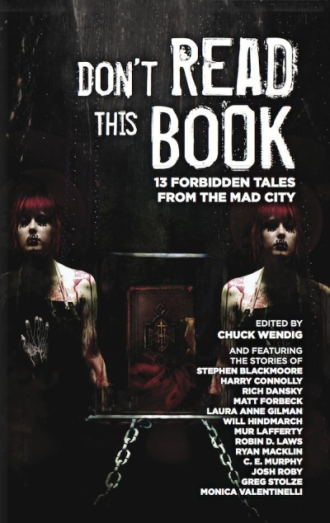
For some, sleep is a peaceful proposition. For others, like me, lights out has always been more of a punishment. The latter is the intended audience of Evil Hat Productions’DRTB Don’t Read This Book, a collection of 13 waking nightmares for the hard of sleeping.

These stories are set in the world of the Don’t Rest Your Head RPG, which I haven’t played, but seems perfectly designed for someone like me. My loose understanding of the game, based on reading this book (despite the admonition of its title) and researching a little about the RPG, is that it takes place in a dystopian dreamland (Mad City) populated with clockwork cops, shadow stalkers and any other gritty creature your mind can conjure up. You are among the Awake—insomniacs who have stayed up far too long and find themselves within the freak show of Mad City.

The Awake are in quite the pickle. Fall asleep and you die. But stay awake for too long and you’ll go mad and permanently inhabit the nightmare.

This is genius. Having been lifelong frenemies with the Sandman, I recognize this world, and it is more terrifying than most fictional places. Probably because I know what it feels like to go to work on your fourth day awake. I know the psychedelic side effects of clocking out from your graveyard shift and then clocking in at your day job a few minutes later. Things move in ways they shouldn’t, you lag a few seconds behind in every conversation and, worst of all, a mechanical noise fills your ears—not a buzz or a ring, but a machine-like pulsing that clouds thought and creates the sensation that someone is constantly following you.

Hallucinate from staying awake? Been there. That’s why the nightmares within Don’t Read This Book, edited by Chuck Wendig, are familiar territory for me.

And thoroughly enjoyable.

Standouts include Stephen Blackmore’s “Don’t Lose Your Patients,” Mur Lafferty’s “Don’t Bleach Your Memories” and Harry Connolly’s “Don’t Chew Your Food,” but this is a solid anthology front to back.

Gamers, steampunks, urban fantasists and horror fiends will find something to love in here. But those who may enjoy it most are us insomniacs.

Those of us who know that the torture of falling to sleep is worse than any nightmare that may be lurking on the other side.

Hilary Davidson: Evil in All Its Disguises

If I were writing a one-word review of Hilary Davidson’s Evil in All Its Disguises, released March 5, that word would be: incongruous. And it would be a massive compliment.Evil Cover

In this subtle crime novel, the third in the Lily Moore series, Davidson drops us in an Escher-like room of distorted realities. Everything looks normal, just slightly askew, and it’s these atmospheric incongruities that make Evil such an enjoyable read.

For series initiates, such as myself, Lily Moore is a travel writer with a checkered past: a mentally unstable family history; a deceased, junkie sister; a quasi-gangster business tycoon ex who will do anything to get her back. This is the baggage she takes with her to Acapulco to review the once-glamorous Hotel Cerón.

It’s nothing unusual: just another press junket with a circle of travel writers, and a PR flak, she’s known for years. Yet, when she arrives at the hotel, Moore is surprised to find it in disrepair, and disturbed to learn that one of her closest friends on the trip, Skye, is in over her head on an investigative piece. During their brief and baffling conversation, Skye expresses concern for her safety, and then steps away to take a call.

And so the unraveling begins. Skye doesn’t return from that phone call, and nobody at the isolated resort seems concerned. Through her exploration, Lily learns that the hotel is a recent acquisition by her ex’s company, manned by his henchman, Gavin, and before long she realizes she’s been lured to the Hotel Cerón under false and deadly pretenses.

There is a breathless quality to the prose that I enjoyed. The action is tightly contained (the plot unfolds in around 48 hours), and, from one chapter to the next, I couldn’t put it down. Aside from a superfluity of internal dialogue and redundant flashbacks, the writing is well-paced and tightly organized, and Davidson manages to give us a tour of the resort, including the unfinished bungalows, the empty wings and even the rotting interior, without feeling like a travelogue—probably due to her actual background as a travel writer. (To my fellow gluten-intolerants I recommend her Gluten-Free Guidebook blog.)

But as with a travel review, the pros must be weighed against the cons. Evil suffers from an overload of plot twists. The phrase “trust no one” certainly applies. This isn’t all bad, as the finer twists reveal character complexity (and that delicious incongruity). But as the plot turns pile up, they begin to lose credibility.

Evil diverges from the transgressive and brutal horror literature usually reviewed in this space. There’s a cozy quality to the story that is actually kind of refreshing. The book kept me up at night not because it was disturbing, but because it was engaging.

I predict big things for this book, and I’m sure it will earn a deserved place on the best-seller list.