Authors

Review: The Humor Code

The Humor Genome Project

A journalist and a scientist walk into a bar… travel the world, return to the lab and come out with what is likely the best book you’ll read all year

by Vince Darcangelo


In my graduate form and technique class, our instructor, Steven Schwartz, devoted a three-hour class period to humor. I was shocked to learn that there was a dearth of The Humor Codecomic literature to study.

Why had so few serious writers ventured down that rabbit hole?

“Comedy is not kind,” Schwartz explained to us. “There is blood in comedy, which is why most people shy away from being comic writers.”

Joel Warner and Peter McGraw would agree.

“We’re here to explore the dark side of humor, how comedy can divide and degrade,” they write in their new book, The Humor Code: A Global Search for What Makes Things Funny.

“Here,” in this case, is Denmark, but also Japan, Palestine, Peru and beyond. For more than two years, this odd couple of comedy—Warner a journalist (Westword, Wired, Slate) and McGraw a humor researcher/marketing instructor (at the University of Colorado at Boulder)—traveled the world to learn what incites nasal milk projectiles in other cultures.

Specifically, the intrepid twosome tested whether McGraw’s Benign-Violation Theory (BVT) of humor applied to an international audience.

The theory itself is quite intuitive and elegant in its simplicity: Humor arises from the violation of a norm (be it political, social, personal), but in a way that is recognized as harmless or good-natured (“jk”) by all involved.

The prime illustration is tickling. Taken outside of its traditional context, tickling is a clear violation of personal space, yet it sometimes elicits laughter.

More importantly for the BVT, sometimes it does not.

If a stranger on the bus jabs his fingers in your armpits and begins to wiggle them, the appropriate response is a slap or the tossing of a hot beverage in his face. This is a close encounter of the non-benign kind.

Now, pause for a moment and try to tickle yourself. Go ahead, no judgment. Couldn’t do it, could you? Your fingers go through the motions, but it’s just not the same. That’s because though your intention was benign, it was not a violation of personal space.

Therefore, not funny.

But let your personal tickle monster have at the back of your ear lobes, and you just might cry with laughter. It’s a violation of personal space, but by someone on the guest list—ostensibly with good intentions.

*

So that’s the theory of BVT, how about the application?

For that, Warner and McGraw visit a humor science library in Japan; deliver clown therapy to a Peruvian barrio alongside Patch Adams; interview notorious Danish cartoonists; participate in laughter yoga (yes, that’s a thing); attend comedy festivals; and McGraw even gives stand-up comedy a try in Denver’s toughest room.

That’s a lot to fit into a single book, but you’ll want to read every word. The Humor Code is an engaging blend of science writing, travel writing and narrative nonfiction. This is one of the best books you will read this year, and it is deserving of major awards.

*

Here I’ll pause for a short disclaimer. Let it be noted that Joel Warner is a friend of mine. I have cat-sat for him on occasion, not to mention the numerous times we’ve helped each other stumble home from the Boulder bars at 2 a.m.

For three years, Warner and I were co-workers at an alternative newsweekly in Colorado, and on a daily basis I was witness to his talent, integrity and work ethic. From our earliest days in the newsroom, the editorial team knew he would be writing best-selling books someday.

That day is today.

*

If I had to make comparisons, I would liken The Humor Code to Sam Kean’s The Disappearing Spoon and Eric Weiner’s The Geography of Bliss. Like those two books, the reader comes away knowing more about the topic, and about the world at large, than they would’ve thought when they first cracked the spine—and in a way that makes you laugh as much as you learn.

Mixing the experimental with the anecdotal, here are a few of their discoveries:

  • “Japan is a high-context society. The country is so homogenous, so unified in its history and culture, that most zingers don’t need set-ups at all.” (“The United States, on the other hand, is as low context as you can get.”)
  • “…A sense of humor is seen as a sign of intelligence, social desirability and overall genetic fitness. In other words, good jokes are a guy’s version of colorful peacock plumes…”
  • “We found humor designed to ease people’s pain, a laughter shared by Palestinian street kids and Israeli Holocaust survivors alike.”

The latter observation is the exclamation point to a friendly interaction between a Palestinian shopkeeper and an Israeli policeman. It was a beautiful moment that even had this cynical bastard singing “We Are the World.”

*

But there’s more to humor (and The Humor Code) than just the har-hars and the touchy-feelies. Alongside the camaraderie is the reality of political and cultural blowback. For the tender moments observed in Palestine, there is the reminder that the sketch comedy television show was shut down when it became too controversial. We learn that real life goes on for Patch Adams after his Hollywood ending. There is personal tragedy and, lest we forget, reminders of the embassies and churches that were set on fire, the people who were murdered and those who remain captives in their own homes for fear of their lives because of a newspaper comic.

Yes, because of a newspaper comic.

In a commentary that would do Professor Schwartz proud, Warner and McGraw write:

“We laugh loudest at the most arousing humor attempts, the stuff that’s laced with a bit of danger. So in order to come up with the best comedy, we have to skirt ever closer to the realm of tragedy, hurt and pain. For some people, the result will hit that perfect, hilarious sweet spot. For others, it goes over the line.”

Warner and McGraw aren’t afraid to get their hands dirty, whether they’re mining gallows humor in war zones, dissecting the world’s funniest joke or bombing onstage before a crowd of angry drunks, these guys bravely submerse themselves in the blood sport that is comedy.

They write: “It’s almost as if making people laugh during dark and troubling times is so vital, so crucial, that it outweighs common sense, and maybe even self-preservation.”

Their observations are sharp, insightful and they’re not afraid to explore the breadth of emotions comedy elicits. They’re even bold enough to be funny on five continents.

Their conclusions? Well, you’ll have to read the book for those, but of course, as with all great literature, you’ll soon learn that the joy is in pursuing the question, not necessarily finding a definitive answer.

The journey might take you to some dark places, so be sure to pack a clown nose with your Band-Aids.

And may all your violations be benign.

Review: Kinder Than Solitude

Kinder Than Solitude

Yiyun Li

This is a book that will break your heart. From the uncomfortable opening scene at the Li_Kinder-Than-Solitudecrematorium, across continents and decades, this is a longitudinal gut-punch of a novel dealing with loss, guilt, terror and fragility.

The person being burned to ashes in the beginning is Shaoai, a childhood friend of the three main characters who was poisoned (perhaps deliberately, perhaps not) in her youth. She has finally passed after two decades in a coma, and her death brings together our lead trio—Moran, Ruyu and Boyang.

From here, the journey turns inward.

Li pens exquisite prose, with beautifully crafted sentences as philosophical as they are proficient. If I have one critique it is that the language, however beautiful, can sometimes stand in the way of the storytelling. Li is able to meditate on moments, which can subsume the reader into the novel, but at times can also push them out.

This is literary mystery, so of course there’s more to it than solving the crime. This is as much about Shaoai’s poisoner as Sherman Alexie’s Indian Killer is about catching a serial killer. What matters isn’t revealing what happened, but exploring the intersection of the lives touched by Shaoai’s coma and death—inhabiting the grief and guilt harbored by the three survivors.

We all have childhood regrets, and we’ve all known someone who never made it to adulthood (though not necessarily linked the way they are here). There are things we would like to change. There are times we wonder why we’re still here and someone else isn’t.

How do we go on with this knowledge? Li doesn’t necessarily answer that question, but she gives us a disarming portrait of three childhood friends coming to terms with a past they can’t quite shake and a mystery that will both intertwine them and isolate them forever.

Review: Playing at the World

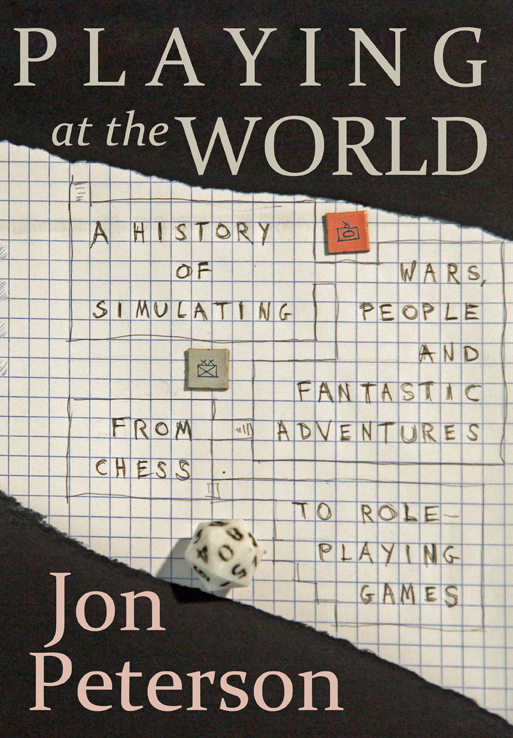
Playing at the World

Jon Peterson

Remember the first time you crawled a dungeon, slayed the dragon and stuffed as playing_worldmuch treasure as you could into your “bag of holding”? Felt good, right? But the true prize wasn’t the booty. Sure, I enjoyed counting the gold and platinum coins, drooling over the prospects of upgraded armor, a magic-enhanced broad sword and whatever mischief I could scare up with a few copper pieces at the local tavern.

But what intrigued me most were the tattered spell scrolls, mysterious tomes and the secrets of the ancients.

It shouldn’t be much of a surprise. A rabid imagination is the primary tool that all fans of role-playing games bring to the table, and a trove of yellowed parchment and faded maps makes us froth at the mouth. Just how powerful is that fireball incantation? What wisdom could be discovered in that old paladin’s codex?

That’s what it feels like digging into Jon Peterson’s Playing at the World: A History of Simulating Wars, People and Fantastic Adventures, from Chess to Role-Playing Games. For any experienced gamer, this is a hoard worthy of any dungeon campaign.

It’s no longer groundbreaking to think of gaming as a topic for academic or cultural studies, but while many books have been written about gaming and gamers, they tend to be focused on a particular aspect of the genre, rather than presenting a comprehensive history. Peterson spent more than five years of archival research and writing creating Playing at the World, the definitive history of gaming and, by far, the most ambitious.

Though originally published in 2012, Peterson’s book has been reissued in honor of D&D’s 40th birthday. Four decades can offer a lot of history, but Peterson goes even further, tracing its lineage back to chess and existing war games.

By Peterson’s own admission, this book isn’t necessarily intended for a mainstream audience. It is a dense, detailed work of history and, if I dare say, sociology. It belongs on the book shelf (or e-reader) of any serious gamer, and though it may not be a front-to-back page-turner, it is an important resource for anyone who geeks out on geeking out.

The book’s most important contribution, though, has yet to be realized. In the decades to come, as gaming and gaming studies grow even bigger, Playing at the World will serve as both source material and historical lockbox upon which the future of gaming is framed and its past is preserved.

Review: The Winter People

The Winter People

Jennifer McMahon

What is it about New England that inspires isolated, small-town horror tales in which the Winter Peopleblood runs as cold as the weather? I’m not sure what it is exactly, but having spent many a wintry a night in Maine, I am familiar with that feeling.

And I can’t get enough of it.

Jennifer McMahon captures that frostbite feeling perfectly in The Winter People, a heartbreaker of haunted legends and legacies, curses and karma, and, more than anything, unendurable loss.

The Winter People has a dual narrative—a modern-day mystery in which a teenager, Ruthie, is forced to take charge of her little sis when their mother goes missing. While searching for her mother, she stumbles upon the diary of Sara Harrison Shea, who lived in the house in 1908.

The diary does not have a happy ending. Both Sara and her daughter died in 1908, but the journal entries suggest that death is not exactly the end of the story.

The Winter People is well-written and bursting with heart. There are mysteries at every turn, and reminders that grief can be deadly. Or worse. In one of the book’s most haunting devices, Ruthie discovers that her mother has nailed shut her closet from the outside. For what purpose? Let your imagination go wild with that one.

The soul of the book, though, is the “sleepers.” Ruthie learns of a spell that will raise the dead for seven days’ duration, after which they are gone forever. It’s a universal temptation. Wouldn’t it be great to say a proper goodbye to a loved one who died suddenly? To hold a lover’s hand just a little longer? To actually say the things we think to say only after it’s too late?

Or would it be a daily torment, watching the minutes and hours crumble to dust?

But there is always a price. Like a modern retelling of “The Monkey’s Paw,” there are consequences for disrupting the dead, and The Winter People reminds that despair can drive even the most sensible among us to dangerous depths.

That’s what makes this novel so endearing. And so heartbreaking.

Review: The Ghost of the Mary Celeste

The Ghost of the Mary Celeste

Valerie Martin’s new novel, The Ghost of the Mary Celeste, is a bit like a star-studded variety show. It’s got a little bit of everything: maritime mystery, historical figures, 06book "The Ghost of the Mary Celeste" by Valerie Martin.supernatural subterfuge and… Sherlock Holmes?

The oddest part about the above description is that this book is more fact than fantasy.

Martin is a prize-winning master of historical fiction (Mary Reilly, Property), and this time around, she takes on the legendary ghost ship Mary Celeste, which was discovered abandoned, though still seaworthy, in 1872, her crew never to be seen again. This true-life mystery caught the attention of Martin, as well as another author (a young Arthur Conan Doyle published a fictionalized account of the ghost ship).

The terror is subtle in this novel. Martin makes use of found documents—journals, diaries, articles—to blend the factual with the fantastic. She meanders through time, takes on the social norms and issues of the day, and makes use of historical record real and imagined. She thrills us, certainly, but unfortunately leaves us with a tangled knot of loose ends.

There is no doubting the quality of the writing. Martin is a master storyteller, and her opening chapter is as harrowing as anything I’ve read this year. She places us in the heart of the Mary Celeste as it sails toward its destiny. Her words, like the storm, encroach, terrorize and ultimately consume, and after finishing the first chapter, I had to set the book aside for a while.

With equal skill, Martin details the lives of those left behind following the tragedy. There is heartbreak, romance and more tragedy on land. Every scene, every line of dialogue, every description is near perfect.

This is, however, a challenging book, not in content but in structure. I’m usually a fan of difficult reads—I take it as a sign of respect when an author, such as Martin, asks more of her readership than passive engagement. The narrative shifts through time, location and point of view. Indeed, there is a clever chronology, as the shipwreck segues to the survivor story segues to Doyle’s voyage segues to spiritualism. However, though they’re all linked by the Mary Celeste, the narratives feel more like vignettes. I found myself invested in each storyline, only to have it pulled out from under me with every new section. Nothing felt complete. As much as the writing drew me in, the shifting narrative pushed me away in equal measure.

This is just one reader’s opinion. Martin’s body of work speaks for itself. She is a gifted writer and storyteller, an astute chronicler of history with a great imagination. To any reader looking for a challenge, I say go for it. Get yourself a copy and enjoy the ride. For me, though, the novel is a bit like the Mary Celeste—seaworthy, but somehow I got lost along the way.

Review: About Three Bricks Shy of a Load

About Three Bricks Shy of a Load

Roy Blount Jr.

Many have described football as an encapsulation of America itself (see Sal OPEN ROAD INTEGRATED MEDIA BOOK COVERPaolantonio’s How Football Explains America), and I’m inclined to agree. Of course there’s a time lag, since Europeans arrived on this continent four centuries before the birth of American football.

For historical synchronicity, let’s say the 19th-century invention of the sport parallels the arrival at Plymouth Rock; the 1920 formation of the National Football League (then known as the American Professional Football Association) was the Continental Congress; and the years leading up to and including the early Super Bowls was the Wild West. Since then, football has enjoyed the popularity and profit of post-WWII America.

The bridge between the NFL’s lawless pre-history and current glory days is the 1970s, when the organized mayhem of the sport electrified color televisions across the nation. It was the decade dominated by the Pittsburgh Steelers.

In 1973, author Roy Blount Jr., whom many will know as a regular panelist on National Public Radio’s Wait Wait… Don’t Tell Me!, spent the season with the Steelers at a crucial moment—months after the Immaculate Reception and a year before their first Super Bowl victory.

The result was the gonzo-style About Three Bricks Shy of a Load, which has been re-released in honor of the book’s fortieth anniversary.

I have a personal interest in this book: I was born in western Pennsylvania in 1972, and you bet your ass I bleed black and gold. Possessing that strain of superstition unique to sports, I don’t think it’s a coincidence that the Steelers won a grand total of 0 postseason games prior to my birth and since then have been the winningest team in football.

As a youth, I idolized the ’70s Steelers, but didn’t yet have the sophistication (or skepticism) to consider the lives of the men behind the facemasks. It was with great interest, then, that I read About Three Bricks Shy of a Load to learn more about the incubation of a dynasty. What sets this apart from similar books (such as Their Life’s Work and Steel Dynasty) is that it captures the highs and lows of the 1973 season without the sentimentality of age or the foreknowledge of future championships.

However, this isn’t a yearbook. This is an in-the-trenches account of the players and personalities that epitomized professional football of that era—a time before the NFL became PG rated. Blount’s embedded reporting is remarkable, from the openness of alcohol, drugs and sex to the lingering racial and culture divides of the 1960s. I’ve learned more about the team I idolized in this one book than I did growing up an hour from Three Rivers Stadium.

However, this is still a book of general interest. Although its emphasis is on one team, it is a pivotal bit of prehistory to the NFL’s dominance. A raw, unfiltered look at a free-wheeling sports league before it became a tight-lipped, humorless corporation.

Of course, there are shadows that loom over this narrative. Just as nobody in 1973 could have foreseen the success of the Steelers and the NFL, also unknown was the physical toll of steroids and repeated blows to the head. The significance of this book will likely increase with age, especially as the NFL finds itself at a crossroads—its popularity has never been greater, but lawsuits, science and dropping youth enrollment portent a shaky future.

History is always a work in progress, and the definitive narrative of the NFL has yet to be written. But when it is, About Three Bricks Shy of a Load will be a document of a special time in a special place, the story of a team on the cusp of greatness falling just shy of its goal.

Review: Buddhist Biology

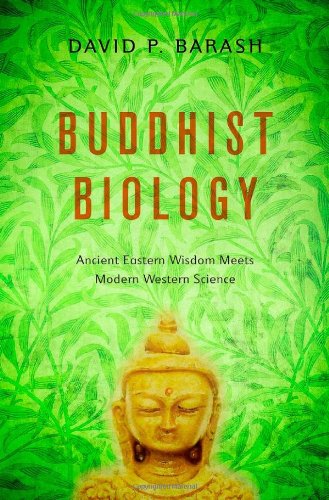
Buddhist Biology

David P. Barash

Forgive me a nostalgia trip to 1994, when alt-jazz rockers Soul Coughing released their Buddhist Biologydebut album Ruby Vroom. The lead track was “Is Chicago, Is Not Chicago,” a hypnotic, oddly existential number allegedly inspired by a bad acid trip in which singer Mike Doughty must distinguish between himself and his surroundings.

It made for a great song, but any biologist will tell you it doesn’t hold up to modern science. Or, for that matter, not-so-modern philosophy.

But Doughty was working toward something significant in that trippy little tune: Where does the “I” end and the “everything else” begin?

It may very well be at the intersection of science and spirituality, according to scientist and self-described Buddhist atheist David P. Barash, author of the brilliant Buddhist Biology.

He admits at the beginning that his goal is an ambitious one: to locate common ground where science and spirituality may coexist. Whereas the Abrahamic religions have long been at odds with science, he argues that Buddhist thought is compatible with high school textbooks.

“Why? Because among the key aspects of Buddhism, we find insistence that knowledge must be gained through personal experience rather than reliance on the authority of sacred texts or the teachings of avowed masters, because its orientation is empirical rather than theoretical, and because it rejects any conception of absolutes.” (18)

That is to say, it allows for the scientific method.

Barash eloquently connects the principles of anatman (not-self), anitya (impermanence) and pratityasamputpada (interdependence) to current biological knowledge. Science has shattered the duality of the actor and the environment, and in doing so has validated thousands of years of Buddhist philosophy.

I am particularly interested in anitya, which leads us into discussions regarding the illusion of time and motion. In considering life as a sequence of moments, Barash distinguishes between the experiencing self and the remembering self (which is similar to Sartre’s Pre-Reflective Cogito, but don’t get me started on my boy Jean-Paul).

The main idea is that each moment is unique and temporary. Nothing lasts, except for in memory, through which we develop a narrative and impose continuity.

Now, I’ll leave the scientific explanations to Barash, as I’m not very qualified to give a proper breakdown, and only slightly more so to discuss eastern philosophy. What I am qualified to provide, though , is a recommendation of Buddhist Biology. Barash takes difficult concepts and presents them in a thoroughly readable and enjoyable narrative. You’ll learn new things, brush up on your philosophy and find it difficult to close this book.

You’ll come away with the realization that there is no distinction between Chicago and Not Chicago, Is and Is Not. There is only this moment.

Or more simply put, There Is.

Review: Backwards

Backwards

By Todd Mitchell

Did you know there is no adjective form of the word “integrity”? Look it up. I was going Backwardsto open this review with a declaration of how integritous we are here at Ensuing Chapters. Or is the word I’m looking for integrian? Integrilicious?

None of the above.

Nevertheless, that’s my silly way to introduce a serious (and seriously good) book with the requisite disclaimer: I have known Todd Mitchell, the author of the young adult novel, Backwards, for about three years, studied under him and served as his teaching assistant in a nonfiction writing class. It’s important to establish this up front, because this will be a glowing review, and I can say with all integrity that the praise is deserved, not spooned out because I know the author.

And with that out of the way, let’s jump to the end. Or rather the beginning. Sort of.

Backwards begins with a teenaged boy, Dan, dead in the bathtub from an apparent suicide. Standing over the scene is our narrator, a Rider (a kind of immaterial wandering soul) who isn’t sure where he is, who he is or how he got there. It doesn’t take him long to realize that he is experiencing time in reverse. We observe Dan’s suicide and his preparations, his daily habits and behaviors, and once we meet pre-dead Dan, it’s easy to diagnose his terminal condition.

I believe the clinical term for it is: He’s an asshole.

But as time bends backward, we pick up more and more fragments of Dan’s life. Yeah, he’s an asshole, but he’s a teenager. Is that so odd? And maybe there’s something dark and vulnerable driving his bad behavior. Indeed there is, but he is also supported with love and encouraging voices, which he silences through self-deliverance.

This is a difficult book to describe, and I’m sure far more difficult to write. Mitchell, however, pulls it off. He taps a mainline to those cringe-worthy cafeteria moments when every little thing was life or death. High school was uncomfortable the first time, and doesn’t seem much better the second time around.

At least not at first.

The narrator, who is living Dan’s life in reverse, provides the wide-angle view that teenagers tend to lack. Actually, it’s a comforting vantage point, and if Dan could’ve seen his life from this perspective, he probably wouldn’t have ended up in the bathtub.

As I’ve often told youth groups as an addictions counselor: Teenagers aren’t stupid. Teenagers just do stupid things. That’s an important distinction, which becomes clear as we watch Dan try to make the right choices, but stumble along in that ham-handed manner that I recognize from my own high school memories. There are missed opportunities, mixed signals, mistaken intentions, the right words left unspoken and the worst ones screamed out loud.

Sound familiar?

That’s the beauty of Backwards. Though the time-manipulated narrative can be disorienting, we are grounded in the familiarity of Dan’s world. Sure, the fashion has changed, but the angst is the same as it always was and will be—and even that elicits a weird nostalgia. Even someone like me, who hated high school and all its cliques, will appreciate its stabilizing force within this chaos.

I also appreciate that the novel isn’t preachy. Of course, the message is clearly against suicide, but Mitchell isn’t talking us off the ledge with niceties. The truth can be vicious, and the author doesn’t recoil from the abyss. Through the character of the Rider, he digs into the horrors of high school and tries to come to terms with the trauma.

Is the Rider successful? The better question is, does it even matter? I’m not well-versed in literary theory, but at its core, Backwards, despite a dash of the spiritual realm, is an existentialist anthem.

Longtime readers know my affinity for existentialist anthems.

My point is that perhaps understanding your awkward years is better than changing them. By revisiting our past, we can be struck by how small everything looks in comparison. If only Dan could’ve seen what the Rider sees.

At least that’s the view from my early 40s. I’m not sure how a young adult would read it, but there’s no doubting the importance of Backwards for its intended audience. But I would argue that Backwards is as much, if not more, of a must-read for adults.

And I’d bet my integritude on that.

Review: Skyway

Bill DeYoung

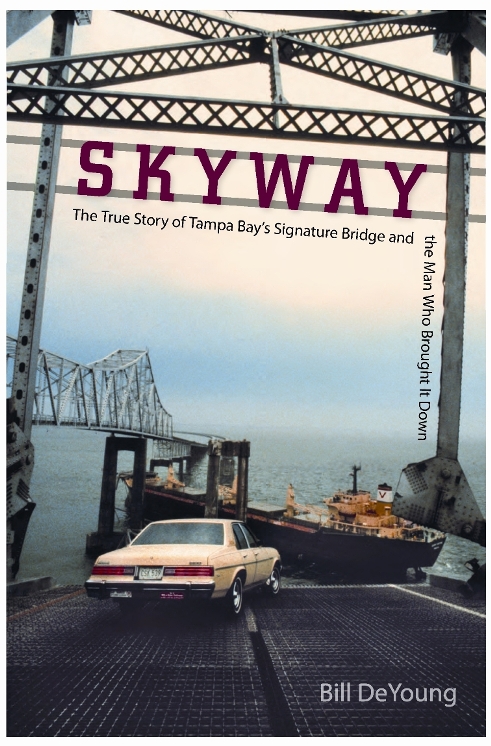
Skyway: The True Story of Tampa Bay’s Signature Bridge and the Man who Brought it Down

It’s hard to elicit raw terror in book form, especially in the opening pages. If the book is Skyway300 pages, you know there is still plenty to come. Real life, however, is a gut-wrencher. For instance, there’s no guarantee I’ll finish writing this review—or that you’ll finish reading it. That’s why well-crafted nonfiction, such as Bill DeYoung’s Skyway, can induce frights greater than most horror novels.

I white-knuckled it through the first two chapters of Skyway, a recounting of the Skyway Bridge disaster of 1980, and was impressed with DeYoung’s narrative talents from stem to stern.

Some background: In 1980 a harbor pilot, John Lerro, was guiding a ship to the Port of Tampa. A freak storm unleashed a nightmare scenario, and without radar or visibility, the ship, the Summit Venture, struck the bridge, collapsing a span of road 150-feet high. Thirty-five vehicle-bound victims, including passengers in a Greyhound bus, plummeted to their death.

It’s a tragedy mostly forgotten outside of Florida, but DeYoung’s brilliant account should change that. With a narrative journalism style, he fleshes out the events of that morning with factual data, news reports and first-hand accounts. We share the helpless terror of the Summit Venture crew as cars plunk into Tampa Bay. We white-knuckle it as a car grinds to a halt inches from the drop. We cheer as motorists band together to halt oncoming traffic and shut down the bridge, saving countless lives.

And then the book really gets good.

DeYoung, a longtime journalist, gives us a longitudinal view of the disaster, from the rise of interstate commerce that necessitated the bridge to the haunted lives of the Skyway survivors decades later. Some of the most interesting bits concern the role the interstate system and mid-20th century financial culture played in building the bridge (and cutting corners from construction to upkeep).

Though it was Lerro who took the blame, it was greed that forced the harbor pilots to take chances in foul weather. Also in play was the exclusionary, good-old-boy culture of the harbor pilots, which deeply scarred Lerro (who was exonerated of any wrong-doing, and in fact was commended for preventing more deaths) following the tragedy.

Skyway put me in mind of Nathaniel Philbrick’s In the Heart of the Sea: The Tragedy of the Whaleship Essex, which is about as high a compliment as you can pay an author of narrative history. Maybe I’ve just got a thing for maritime disasters (I blame Poe and Arthur Gordon Pym for that), but Skyway is a chilling, informative and deeply engrossing narrative.

This is a book worthy of awards and deserving of the bestseller list.

Review: A Brighter Word Than Bright

A Brighter Word Than Bright

by Dan Beachy-Quick

Although A Brighter Word Than Bright is about Romantic poet John Keats, I couldn’t get Keatsmy favorite Oscar Wilde quote out of my head while reading it: “Man is least himself when he talks in his own person. Give him a mask, and he will tell you the truth.”

It’s a cruel irony that nonfiction is thought to be the most accurate medium for Truth—reducing reality to the recitation of facts. If that were so, then the minutes of a company meeting should have more cultural sway than Shakespeare, right? Yet when I was in London, there were scores of young and old gathered at the gates of the Globe Theatre.

I didn’t take a poll, but I’m confident that when people think of London in 1599 (when the original Globe was built), they think of Shakespeare rather than that year’s landmark court ruling, Edward Darcy Esquire v. Thomas Allein of London Haberdasher, which established the foundation for modern antitrust law.

I didn’t see anyone perusing court transcripts outside the Globe.

That’s why Dan Beachy-Quick’s biography of Keats is so refreshing. Rather than retelling his life story or critiquing his work through some previously unexploited element of his personality, Beachy-Quick gives us the biography of the poet’s imagination.

Which, of course, requires a lot of imagination.

No shortage there. Beachy-Quick, author of nearly a dozen collections of poetry, essays and criticism, weaves a fever-dream narrative that treats its subject as more putty than marble, so that Keats, the man, vanishes at times.

Or perhaps Beachy-Quick brings us so close we no longer recognize him.

Either way, A Brighter Word Than Bright engages the reader’s imagination, and the author states from the beginning that:

“I have little interest in offering a portrait of Keats more accurate than those already available… I am more concerned with returning Keats, as best I can manage, back into that half-light that obscures accurate rendering so as to make more brilliant those sudden flashes in his poems and letters that, lightning-like, reveal the storm-tossed grasses in the ceaseless field even as darkness closes the vision again—sudden clarities, and the afterimage that lingers long past the lightning’s strike.”

Our subject is deliberately blurred, grated into the environment with an opacity that is oddly revealing. From an early age, Keats is displaced, yet absorbed by the world. Or perhaps consumed is more like it. Beachy-Quick sketches a grief-burdened man-child weeping beneath a desk for his dead mother. Yet, the boy is not separate from the desk, nor the desk from the room. All is connected in this tragic tableau: “Some music sobs up into song. Some song digs down and confronts what it also must comfort.”

Keats is tormented by his talents, a gift on par with Greek tragedy. Much like Darrin McMahon’s Divine Fury: A History of Genius, Beachy-Quick views genius as something that possesses, rather than something one may possess:

“To listen to genius is to let oneself be guided by that voice in the self that is not the self’s own. It implies an otherness exactly where we expect to find identity; it speaks within us a rumor to us, that we are least ourselves where we are most ourselves.”

This duality zigzags throughout the book, at times we are uncomfortably close and at others removed, disoriented, flipping between past and present tense to remind that art, and the artist’s struggle, belong to all ages. That like Keats’ poems, all is absorbed into a timeless moment—infinity in a single instant and vice versa. (Beachy-Quick cleverly enforces the point with reference to the work of the paradox-obsessed Greek philosopher Zeno.)

As we progress chronologically, Beachy-Quick peppers in some academic critique, for example going through the Odes and incorporating Keats’ letters for context. I was particularly struck by one passage from Keats to his wife, Fanny Brawne:

“I have two luxuries to brood over in my walks, your Loveliness and the hour of my death. O that I could have possession of them both in the same minute. I hate the world; it batters too much the wings of my self-will, and would I could take a sweet poison from your lips to send me out of it.”

Would it be fair to say Keats was the first emo kid?

Actually, that may be as fair as any other portrait. No biography has been able to capture the man in full, which certainly adds to his appeal. Beachy-Quick, with this unconventional and highly original biography, gives us something better than the Truth. He gives us the febrile terror that inhabits the artist’s soul.