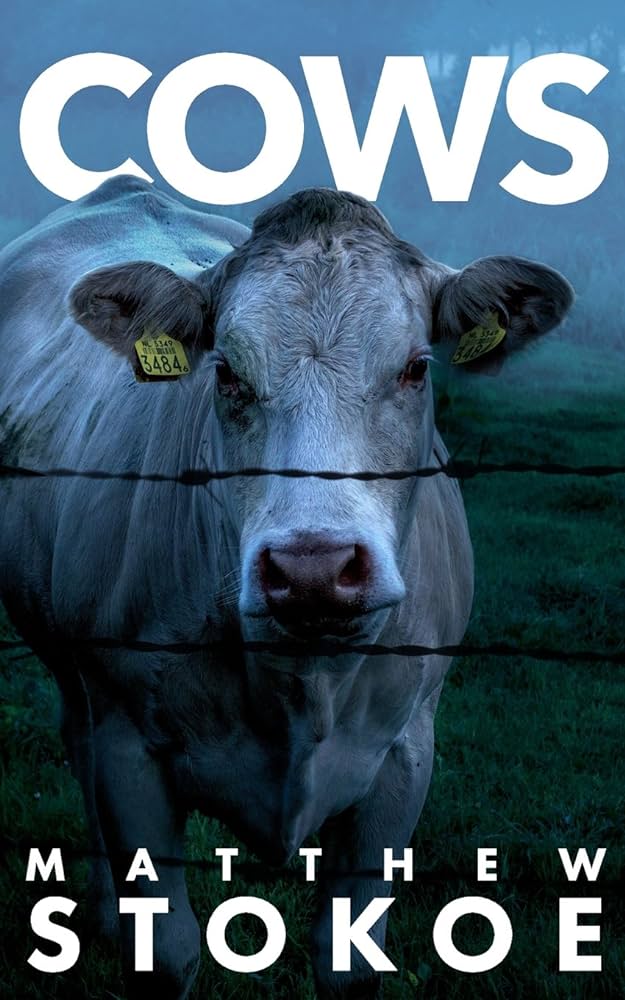
Cows is the rare book that can be filed under both extreme horror and literary fiction. It earns its notoriety for its unflinching descriptions of despair, abuse, bestiality and coprophagia, but what elevates it above the edgelording of most extreme horror is Matthew Stokoe’s beautiful, evocative and squirm-inducing prose.
“Riding the backs of his corpuscles, leaping onto them from his stomach wall and through the thick gray coils of his intestines, not giving a shit what his heart wanted, the hard black grit of Mama’s catabolized meals jammed itself into his flesh and fat and gristle.”
Friends, that’s page one.
The story follows Steven, a young man whose life is like something out of a Quay Brothers film. There’s no origin story. He just exists in a dreary and oppressive Skinner box with his abusive, corpulent mother on the outskirts of an unnamed city.
When we meet Steven, he is starting a new job at the meat processing plant. He spends his day shoving chunks of butchered bovids into a grinder. At home, his mother feeds him rancid food to keep him weak and belittled.
Thanks to television, however, he strives to one day be normal and happy — just like a perfect sitcom family. He wants to share that life with Lucy, his upstairs neighbor.
When his foreman, Cripps, promises to turn Steven into an alpha male, he follows his lead, believing it will win him the happiness he seeks. So, along with a freakshow of co-workers, he commits rites of passage that will send even the strongest gag reflex into hyperdrive.
At first, it appears to work. Steven begins a paraphilic relationship with Lucy and stands up to his mother. He even assumes the duties of preparing his mother’s meals (read the book to get the irony of that last statement).
But that changes after Steven has a dialogue with one of the cows.
*Record scratch*
No, I didn’t say he has a monologue (or even a moo-ologue). He has a conversation with a cow that has escaped the slaughterhouse and tells Steven that he’s headed down a bad path. The cow also asks for his help in getting revenge on Cripps.
OK, that’s a lot, and I’ve barely scratched the surface. It’s not an easy book to discuss because, well, it’s strange and it inspires strong and varied feelings. It amuses as much as it disturbs and is at times deeply existential (wonderfully so) and at others surreal (mixed bag).
It felt a lot like reading The 120 Days of Sodom. At first it’s horrifying and difficult to read. Then it becomes comical and over-the-top. By the end, you’re reckoning with the novel’s philosophical intentions — not in spite of, but because of that journey.
Without a doubt, the most compelling relationship in the book is between the complementary spirits of Steven and Lucy. Steven attributes his unhappiness to what he lacks. He believes it exists out there, same as it’s portrayed on TV. If he could just get past the obstacles in his way he could be happy.
Lucy, on the other hand, chalks up her unhappiness to something sick within her. She is on an endless quest to find and destroy the poison she believes lives inside her body. She dissects animals, looking for this diseased part of the anatomy. She urges Steven to examine the cow innards on her behalf. She has an endoscopy hose that she uses to map her discontent.
The result is an endless cycle of drudgery, abuse and disappointment. The only moments of joy Steven experiences is when he’s having sex with Lucy, having sex with his side piece (ahem… a cow) or torturing and killing his various enemies. Those are the moments when he feels vital, alive, powerful.
But it turns out the talking cows were right. The path he’s on will not lead him to happiness. Ironically, Cripps is also right, when he tells Steven, “Don’t be frightened by the sickness. It lessens each time until it ceases to be felt.”
It reminded me (too much) of when I worked in an animal shelter years ago. For the mental health of the staff, we were only required to perform euthanasias one day a month — and those were some of the worst days of my life.
After the first time, I spent twenty minutes dry-heaving in a bathroom stall and sobbing like a child. The next time, I needed some alone time, but didn’t feel as sick, and I felt less so with each procedure. The last time, my eyes watered, but no tears fell. The sickness was gone.
In Cows, that’s a feature, not a bug. If you eat enough shit, you get used to the taste (literally, in the case of this book). Likewise, if exposed to enough killing, abuse and exploitation, you become desensitized to that as well.
But as Steven learns, that is a very different feeling than happiness.

 Ensuing Chapters